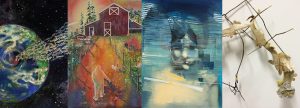
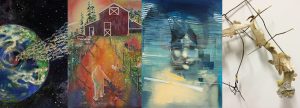
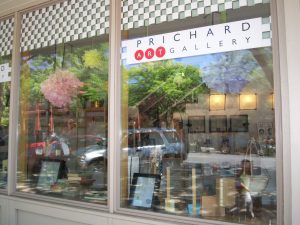
Poet Georgia Tiffany and the multitalented Ryan Lawconceived an unusual brain child in Endangered, a collaborative project of visual arts and poems by 30 participants. The poets and artists, all of whom live and work on the Palouse of eastern Washington and north-central Idaho, were asked to freely interpret the concept of being “endangered.” An exhibit of the resulting works opens on May 21st, 2015, at the Prichard Art Gallery under the auspices of the University of Idaho College of Art & Architecture. A reading and reception are scheduled for the 21st from 5 to 7 p.m. with music provided by John Paul Shields. The exhibit will remain open through June 6th.
Downtown Moscow, Idaho
~ ~ ~ ~
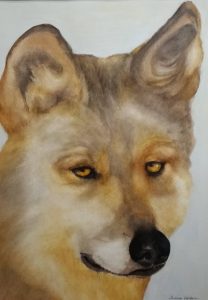
Poets and visual artists worked in pairs on Endangered, drawing inspiration from one another. Anesa Miller was assigned to work with the painting “Mexican Gray Wolf” by Jeanne Wallace. Anesa says, “It’s a remarkable portrait, just as one would see a commemorative likeness of a human face. I began to hear poetic rhythms the moment I saw this painting.” See this pairing of poem and artwork below.
~ ~ ~ ~
Listen to the poem Homo Sapiens Under Siege
by Anesa Miller (1 minute 16 seconds)
The wolf is at the door.
Keep your weapons near.
They’ll overrun
the land we love.
Our children shake with fear.
“Mexican Gray Wolf” by Jeanne Wallace
The wolf lurks just outside—!
They range around the yard.
We’ll know no peace
until they cease.
Be always on your guard.
Let’s take them from above,
from the safety of a plane!
We’ll lay them low
in fields of snow,
their fight and speed in vain.
Because—
They hound the innocents,
rapacious woodland gang.
The doe knows dread
till her throat runs red.
None can outpace the fang.
The wolf is on the prowl.
They howl beneath the moon.
They rip the sky
with yip and cry.
They’ll feast upon us soon!
Their hunger never ends.
They bound behind the sleigh.
Toss the baby overboard—!
to keep blood lust at bay.
~ ~ ~ ~
Click here for directions to the Prichard Art Gallery in Moscow, Idaho. Visit Endangered between the evening of May 21st, 2015, and June 6. Click here for hours.
The topic of child welfare looms large in my novel Our Orbit. It tells the story of an Appalachian girl who crosses the tracks to become foster daughter to an educated family. Love and conflict ensue as all the burning social issues of our time raise their sometimes ugly heads. In gratitude to those who helped me learn about the many demands and great rewards of foster care, I am sharing information on this topic throughout the month of May 2015, National Foster Care Month.
~ ~ ~ ~
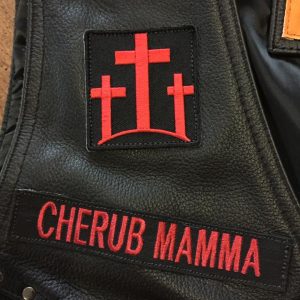
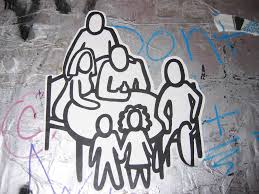
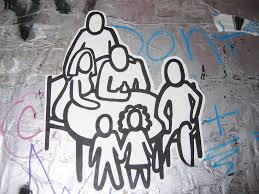
“Cherub Mama” is a blogger and a work-at-home mom of bio and foster children. When I went browsing her blog to look for information on family reunification, I stumbled on this brief post. It is practical, to-the-point, and yet I found her words deeply moving. So much is said between the lines. Foster children’s visits to non-custodial parents can be fraught with emotion, but this blogger explains their fundamental purpose.
my thoughts on visits
The goal of foster care is (almost) always reunification. Even if the State determines that the biological parent(s) is not safe, a family member is always preferred over non-relative adoption. The goal is to keep families together.
Most of the time that is a very good goal!!!
Please don’t go in to foster care if you’re not willing to support reunification. Because this stuff is hard. Super hard. Crazy hard. But it’s necessary.
Here are my thoughts on visits. A metaphor if you will. And I don’t take credit for this idea, but for the life of me I have no idea where I heard it first.
Visits are the equivalent of ripping a band-aid off a wound so you can keep it raw.
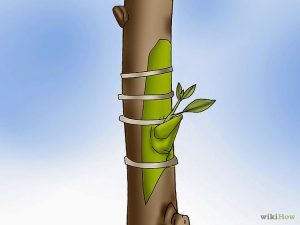
Imagine if you will…their family tree. Each member is a branch. When the children were removed from Wendy (Bio Mom), their branches were cut off their tree. They were separated from what kept them alive. My family welcomed them into our home. They’re Red Delicious. We’re Granny Smith. But we’re all apple trees and my tree can keep their branches alive.
However, the goal is for their branches to get grafted back on to THEIR tree. They aren’t supposed to attach to our tree forever. So we have to keep the wounds raw. We don’t want the kids’ branches to dry off and die. They do have to attach to us. But they can’t attach permanently. We have to continually keep the end of their branch wet and raw so they can attach back to their Red Delicious tree (or at least to a tree in their orchard) when it’s safe.
Every visit keeps that wound open and raw so the ultimate goal of reunification can take place.
These cherubs came to my home a month ago. We’ve had one month for them to get used to our orchard. We’ve nourished their branches and given them all they need to be strong, healthy and to grow.
Today we get to rip that grafting tape off and send them back to their original tree for a visit.
The topic of child welfare looms large in my novel Our Orbit. It tells the story of an Appalachian girl who crosses the tracks to become foster daughter to an educated family. Love and conflict ensue as all the burning social issues of our time raise their sometimes ugly heads. In gratitude to those who helped me learn about the many demands and great rewards of foster care, I am sharing information on this topic throughout the month of May 2015, National Foster Care Month.
Wanted: Special families for special kids—take the challenge through foster care.
The ad caught your eye. You have been thinking about doing foster care for a long time. You think you want to commit yourself and your family to fostering a child. But how do you involve your kids in the decision making and prepare them for the addition of a foster youth? Whether your kids live at home with you, or are out on their own, listen to their thoughts and ideas about fostering.
Talk about Foster Care
Depending upon the age and maturity of your children, the first step to making a decision about family foster care is to have a discussion with your kids. Kids may have many questions about the youth that are in foster care.
Eventually, your family will want to discuss what ages, gender, and types of kids fit best for your family. Have a family meeting and talk about the special needs of kids in foster care. What abilities and skills do family members have to help meet these needs? Consider discussing the following topics:
Purpose of foster care. Foster care provides kids the care they need (such as getting medical treatment, counseling, living in a safe home, exposing kids to healthy family life, supporting kids to attend school) for positive changes to happen for the child and their family. Kids in foster care can often be reunited with their family or sometimes adopted.
Types of kids in foster care. Kids come from many different circumstances. Sometimes they have experienced abuse, neglect, truancy from school, special medical and emotional needs, or may have behavior issues. Sometimes kids in foster care have no serious problems.
Situations. Many times, parents of kids in foster care are unable to take care of their children due to their own problems (drugs, alcohol, mental illness, incarceration, limited understanding or interest in being a parent, deceased parents or no family).
Behavior problems. Like all of us, some kids have no issues while some may be aggressive, quiet, hyperactive, withdrawn, immature, or fearful. They may act out sexually, hoard food, have sleeping problems or have drug and alcohol abuse issues.
Moscow, Idaho, has a population of approximately 25,000. The town is said to be named after the home city of a Russian immigrant who established a trading post in the area in the 1860s.
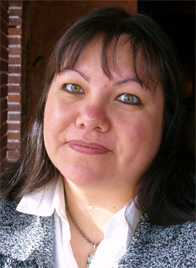
Tiffany joins me today for a chat about her new appointment— AM: Congratulations! April 2015 marked the beginning of your 3-year term as poet laureate of Moscow, Idaho. I have to admit, I was surprised when I heard about this—not that you would be appointed, but that Moscow even has a poet laureate! Is it common for a small city like Moscow to offer such a position?
Tiffany Midge (TM): I can’t say for certain, but I do know of a couple of other small-town poets laureate, and I know of several current and former state poets laureate.
AM: How long has Moscow has followed this practice?
TM: This is the first time! The arts council only recently created the post, and it was advertised for people to apply. I’ve always held that I aspired to be Poet Laureate but would settle for Poet-Want-Fries-With-That. And, of course, I often joke about holding the Distinguished Writer in Residence at Moscow/Pullman Highway’s Jack–n-the Box. But this is for realz. I’ve come up in the world!
AM: What are some of your responsibilities as poet laureate?
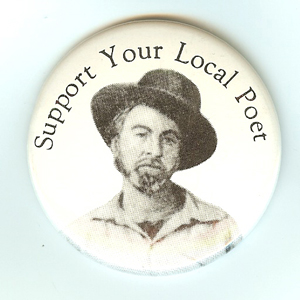
TM: (Refers to a printout.) Okay, my mandate is “to raise the visibility of poetry and other literary arts within the community through outreach, education, and other programs.” Part of what that means is, I’ll be offering at least one public poetry workshop per year; I’ll be writing and sharing at least three poems per year that “speak in some way to the distinctive character” of Moscow; and I’ll give two or more local readings at “civic functions” like the Art Walk.
AM: Sounds like a busy agenda but pretty good fun.
TM: That’s what I said!
AM: I want my readers to know that you’re an enrolled member of the Standing Rock Sioux Reservation and you’ve always taken a big interest in Native American authors and artists, among other contemporary work. Is Moscow a positive locale for such artists to present and share their creativity?
TM: There have always been events here on the Palouse that celebrate indigenous culture.
“The Palouse” refers to a geographical region characterized by a unique geological history. It spans much of southeastern Washington state and north/central Idaho. The name is derived from the French for “grass” in probable combination with the name of the Palus or Palusha tribe.
TM: One of the more exciting and interesting events took place in 2011, when UI’s English Department and other community folks organized Hoopaloosa.
“The name, HooPalousa, is a play on words, Hoops and Palouse, basketball and the region where the university is located and appropriate for a game of hoops with writers known for playing with words.” Hoopaloosa has been described as “a fun [basketball] game between the Moscow SuperSonnets, representing the University of Idaho, and a team from the Spokane area called the Spokane Dirty Realists.” The purpose was to raise money towards funding an annual Graduate Writing Fellowship for a Native American student/writer. The game was organized by novelist and memoirist Kim Barnes of the University of Idaho creative writing faculty. Star attraction of the game was National Book Award winner Sherman Alexie who came to Moscow from Seattle to play on the Spokane team.
TM: Also, last spring Natalie Diaz—a sensationally talented poet—was invited and came here to give a reading. And last fall our local bookstore, BookPeople of Moscow, hosted a launch reading of Yellow Medicine Review—an Indigenous literary magazine that I guest-edited and which featured several local writers.
AM: How about your own work as a writer? What have been doing lately, and will it tie in with your new public role?
TM: I’m looking forward to my collection of poetry The Woman Who Married a Bear coming out next year—March/April, 2016, from the University of New Mexico Press.
TM: That’s right. But more recently I have been writing prose—a couple of novels and some essays. I expect my poetry will tie in with the laureate post, the three or more poems per year that I’ll present at public events. I’m looking forward to a couple of events coming up this spring: The first is the Endangered Project, which is a collaboration between visual artists and poets to be presented in May.
The Endangered Project is an undertaking of visual arts and poetry organized by local artists in the Moscow area. The theme of “endangerment” was interpreted freely by each participant. Works will premier at a public opening and reading to be held in downtown Moscow at the Prichard Art Gallery on Thursday, May 21, 2015. The exhibit will run through June 6.
TM: Then in June, is the launch of another project that’s new to Moscow: poetry bus broadsides. Several broadside posters are being created by the very well-known Broadsided Press.Elizabeth Bradfield is producing mine: it’s a sonnet about Spring Valley Reservoir [just south of Moscow] and the bird life one encounters there. The artwork is by Ryan Law. There will be a launch event on June 12 at 4PM at the transit station where the broadsides are to be hung (or they might be on the inside of buses, that’s still unclear). This will be part of the Moscow Art Walk.
“’Smaller communities can give the art a more intimate feel because you’ll often know the artists or author of the work you see on the side of the bus,’ says Elizabeth Bradfield, founder and editor-in-chief of Broadsided Press. Bradfield is excited to have the partnership with Moscow, because it blends the local and national side of art”. — The Daily Evergreen,Washington State University’s student newspaper, 4/22/15
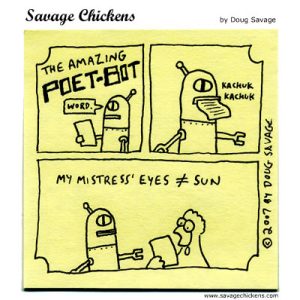
With thanks to www.savagechickens.com!
AM: I have to confess, you are such a great humorist, that when I first saw your post on Facebook where you mentioned becoming Poet Laureate of Moscow, I thought it might actually be a parody or joke of some kind. Don’t get me wrong: I love Moscow, and I’m thrilled that we now have you to be our special poet. It’s just that I tend to think of public poets as establishment figures—reading on solemn occasions with no hint of comic relief. Can you set me straight on this?
TM: One of the characters in my novel said, “humor is a veil for fury.” I’m still sorting out exactly what that means. In response to your idea that public poets are “establishment figures—reading on solemn occasions without any irony,” I find that in and of itself very funny: as if life should be a humorless occasion!
I was always that kid who was stifling my giggles in church. I once published a humorous essay about attending my mother’s funeral. Irreverence. Sad clowns. There is so much atrocity and brutality in the world, I can’t help but want to pursue the flip side to that, especially in my writing, if for no other reason than to maintain my sanity.
So often we hear that people don’t like poetry. That poetry doesn’t make sense. I once had a high school student say that poetry was pretentious. I think that using humor in poetry helps to debunk those kinds of notions. Humor potentially takes out the “Ivory Tower” mystique and makes poetry relatable to everyday life, because it can and does bear witness to our everyday activities. It heightens and enlarges them, endowing them with purpose and meaning. Humor invariably disarms us, catches us off guard, and brings the pleasure of connection.
AM: There are, no doubt, many details of a public poet’s role that I don’t even know to ask you about. What would you want people to understand about this role?
TM: A poet whose name I can’t remember said something to the effect that poetry should be a dance around the fire. And in many other countries the role of a poet is very highly regarded. Poetry is consciousness-raising. It incites, it reckons, it entertains, it educates. It’s reportage. It acts as a thousand and one things, but it remains marginalized within our broader mainstream culture. Yet, we use language constantly! We are speaking in pure poetry every moment and aren’t even aware of it! Our most mundane activities are relayed to the people around us, and there are so many gems to be mined in those exchanges.
AM: Tiffany Midge, congratulations for serving as our first poet laureate of Moscow, Idaho. Thank you, and thanks, too, for speaking with us today.
“We like to think of our awards program as the ‘Sundance’ of the book publishing world,” says Catherine Goulet, Chair of the 2014 Next Generation Indie Book Awards program.
Anesa Miller is seeking participants for a “launch team” to help publicize Our Orbit’s re-release from Booktrope Publishing in summer 2015 — Clickherefor details on this opportunity!
In an article at CNN.com titled “If it’s cool, creative, and different, it’s indie,” journalist Catherine Andrews wrote: “The term ‘indie’ traditionally refers to independent art — music, film, literature or anything that fits under the broad banner of culture — created outside of the mainstream and without corporate financing.”
Independent book publishing companies are independent of the major conglomerates that dominate the book publishing industry. The indies include small presses, larger independent publishers, university presses, e-book publishers, and self-published authors.
According to Goulet, “Like other independent artists, many indie book publishers face challenges that the industry giants don’t experience. They typically have to work a lot harder to get their best books into retail stores and ultimately into the hands of readers.”
“Authors and publishers in the Next Generation Indie Book Awards are serious about their books,” adds Goulet. “They aim to stand out from the crowd of millions of books in print.”

 However, the goal is for their branches to get grafted back on to THEIR tree. They aren’t supposed to attach to our tree forever. So we have to keep the wounds raw. We don’t want the kids’ branches to dry off and die. They do have to attach to us. But they can’t attach permanently. We have to continually keep the end of their branch wet and raw so they can attach back to their Red Delicious tree (or at least to a tree in their orchard) when it’s safe.
 Tiffany joins me today for a chat about her new appointment—
 AM: What are some of your responsibilities as poet laureate?