by anesamiller_wuhi6k | Jul 27, 2015 | Blog, Writing & Publishing
Many thanks to Dawn Brazil, an author and all-round great person, who not only provided the inspiration for this post but also shared it first on her blog, Dawn Brazil’s Brilliant Babbles about Books —

When I first visited Dawn’s website several weeks ago, I was impressed with her use of music: music video clips, playlists, and more. It made me realize what a special source of inspiration music offers for all the arts and for life, overall. We can turn to it any time to refresh our mood or energize our creativity. Songs that we love and melodies we remember from long ago yield rich imagery for many writers.
I took a look back at my novel, Our Orbit, and noticed that music plays an important part in the story.
The first instance comes in the opening scene. It’s just a small point, but I think it helps to reveal the main character. Miriam Winslow is a girl of nine, the youngest child of a close-knit working-class family. Before the plot takes off with Miriam’s forced removal from her home and placement in foster care, I wanted to give a glimpse of how her intimate family members knew her. Rather than spend a lot of space of this, I tried to choose a telling detail. Miriam’s feeling for music helped me out—
(As Miriam’s mother, Emaline, drives through a snowstorm to pick up an older daughter, they bypass the turn for their home at Friendly Village Mobile Home Park.)
Emaline suppressed a sigh. Instead of slowing for the turn, she tapped the horn and called out, “Hold the fort, Friendly!”
“Friendly, holding steady—” sang little Miriam from the back seat, quick to answer the cue in this family routine of forgotten origin, homage to the home where Emaline arrived as a bride half her life ago.
In this short passage, my aim was to show that Miriam is a happy child who enjoys melody and is not shy about sharing her voice. She expresses loyalty to her family by singing a “ditty” they invented for fun before she was born. As the story goes on, readers will learn that Miriam’s older brothers and sister have largely given up such family rituals as they began to deal with mainstream culture at school and among their peers. Miriam is the one who keeps family traditions alive, and she will bring them to her new foster family.
As a motif in our writing, music can play a wonderful role in revealing cultural differences between groups of people. Our Orbit explores these differences on a small, local scale: Miriam’s birth family and her foster family have a great deal in common, and yet they belong to separate groups with limited contact. Both families have lived in the same Ohio county for generations. They are of the same race and similar heritage from northern Europe. And both families are Protestant Christians of weekly church-going habits. Even so, the barriers between them are economic class and educational background.

When Miriam first attends church with her foster family, she is awed by the large building, bright chandeliers, and long hallways for Sunday school classes and meeting rooms. People are more dressed up than she is accustomed to, and all their clothes are new and brightly colored. But it is Miriam’s reaction to the music at this big, new church that makes clear to readers: She grew up on the other side of the tracks.
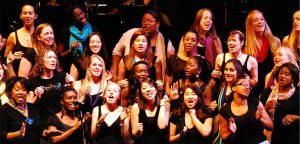
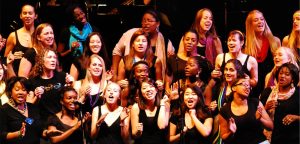
While Miriam ran up the church steps…she heard a choir strike up a song inside. Sounded like a hundred people! Across the bright lobby…you could see the flash of white-and-gold robes as the singers stepped left, right, back, front, clapping their hands on each move. A rock band with guitars and drums was playing along. Tambourines rattled…
This must be the hugest church in town, Miriam thought, All we have back at Holy Redeemer is one little piano. And even with every person singing, there were only a few dozen voices…
Miriam’s home church was a small, “backwoods” congregation without paid professionals to direct a choir or play instruments. Although she soon comes to appreciate the music at her foster family’s prosperous church, her first impression is mixed. Based on her experience, the “loud, peppy music” seems more like a performance than a call to worship. More like a “dance party” than an occasion to repent one’s sins.
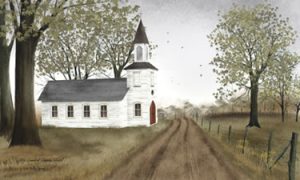
 (When Miriam’s foster father, Rick, takes her back to visit her home church, Holy Redeemer Tabernacle, we see the tradition through his eyes.)
[It was] a tiny white-washed church on Key Ridge, south of town… The piano’s tinny chords rang out… There was no choir director and no hymnals, but harmony swelled from two to four parts. The voices were strong for such an elderly crowd—
To Canaan’s land I’m on my way,
Where the soul of man never dies,
And my darkest nights will turn to day,
Where the soul of man never dies…
People embraced. Some laughed, others wiped away tears…
Here is a list of a few songs that played in my head as I worked on Our Orbit. I’ve hunted up those I could find on YouTube to give an impression of how they sound. Some of the hymns are quoted in the book (as in the scene above), while others served more to set a mood for my writing.
“The Soul of Man Never Dies” performed by Tony Rice and Ricky Skaggs. From the DVD “Legends of Flatpicking Guitar.”
“There is a Balm in Gilead” performed by Mahalia Jackson.
“The Stable Song” performed by Gregory Alan Isakov.
And to close on a happy note, here is “Dreams” performed by the Cranberries. This is the favorite song of Miriam’s teenage sister Rachelle. It becomes embarrassing to Rachelle when her friends make fun of the band because they are Irish and “talk funny.” So we see that Rachelle’s musical taste is a bit more open-minded than some of the people around her!
~ ~ ~ ~

Visit Dawn Brazil at her blog, Brilliant Babbles About Books.
Connect with Dawn on Facebook, on Twitter, on Goodreads, Pinterest, and on Amazon.
~ ~ ~ ~
Thank you for visiting my blog today! Please check out the rest of the website and let me know if you like what you see, or if you have suggestions. You can reach me by leaving a comment in the box below or by clicking the Contact link at upper right (or just click here). Consider subscribing to my blog or newsletter. And stop by again soon!
by anesamiller_wuhi6k | Jul 23, 2015 | Blog, Series: Drawer no more!, Writing & Publishing
This post by friend and author Anne Leigh Parrish first appeared on Women Writers, Women’s Books on December 15, 2014. Thanks for sharing, Anne!
 As the fiction editor for Eclectica Magazine, it’s been both a privilege and pleasure to read story submissions. Finding the handful of pieces that take my breath away is what it’s all about. The good ones shine through, those that are brilliant positively sparkle.
That said, it’s too bad that so many stories that come my way miss the mark. These are usually decently written, no obvious grammatical errors, no huge prose clunkers. What they fail to do is hold my interest and make me care about the outcome. I see the same mistakes over and over. I thought I’d make a list of these, as a sort of guide to aspiring authors.
~ Not telling a story.
So many writers don’t seem to know what a story is, and isn’t. A story is not a nice description of how things are. It’s not a sensibility, or a mood. While those elements surely contribute to a story, a story itself is a narrative where there must be a change in the reader’s understanding of the events, or in the protagonist’s understanding. You leave a story seeing something you didn’t see at the outset, something that makes sense of what’s come before.
~ Trying to tell too many stories at once. In a short story, you need to figure out what the core is – the central theme, event, action, upheaval etc. All other story lines wrap around that central core, supporting it, or opposing it as a way to further illustrate what you’re driving at. Keep it simple. Don’t have too many characters, or an overly complicated plot. As you write, it’s very tempting to bring in an element that seems really interesting or colorful, but unless it fits with the whole, leave it out.
~ Characters with no inner life. A lot of stories that come through my queue feature people I couldn’t care less about, because I don’t know what makes them tick. I see what they do and where they live. I hear their conversations. But what do they feel? What do they care about? What are they most afraid of losing, or willing to fight for? If I don’t know what a character has at stake, I stop reading. So, make me care. Show me your character in a moment of crisis. She doesn’t have to act bravely or wisely, but in a way I recognize as a fellow human being.
~ Dialog that’s stiff or unnatural. Think about how people really talk to each other. They often don’t use complete sentences. Sometimes they swear. Are they cynical, sarcastic? Are they barely holding themselves together under an emotional strain? Make note of funny, strange, or colorful things you overhear people say, and find a way to work them into your fictional exchanges. One of my stories has my protagonist overhearing two strangers talking, and one says, “She’s as crazy as a box of hair.”
~ Bad pacing. Nothing kills a story faster for me than bad pacing. I give any piece about five pages, and if the action hasn’t gotten off the ground, I bail out. Equally bad is pacing that races along, skimming crucial scenes. Figure out what’s most important in your story, and spend enough time on it, but don’t drag it out. You have to keep moving.
~ Keeping the reader at arm’s length. Beginning writers tend to over-explain, as if they’re afraid that their readers won’t “get it.” Readers are asked to trust authors and suspend their disbelief; and writers must trust readers to be smart enough to fill in a few gaps for themselves. If you think you have to spell everything out, you may be assuming that your reader is pretty dumb. You need to show, not tell. Draw the reader in; let her experience what’s going on right up front, not from some cozy seat up in the balcony.
~ An ending that’s too neat. When I come to the end of a story, I like something left to my imagination. Maybe the protagonist will get the boy back, after all. Maybe she’ll get to a point where she can really move on with her life. Maybe she’ll meet someone even better. I want to decide for myself what happens. At this point, the author no longer gets to call the shots. It’s okay to leave some ambiguity and room for interpretation. You don’t need to tie everything up and have your characters live happily ever after, and in fact, it’s a lot better if you don’t.
I close with what someone once told me about the goal of fiction: “To lift us off from reality, and startle us into recognition.” Avoid mistakes, write the story only you can write, and do it brilliantly!
~ ~ ~ ~
 Anne Leigh Parrish’s debut novel, What Is Found, What Is Lost, came out in October 2014 from She Writes Press. Her second story collection, Our Love Could Light The World (She Writes Press, 2013) was a finalist in both the International Book Awards and the Best Book Awards. Her first collection, All The Roads That Lead From Home (Press 53, 2011) won a silver medal in the 2012 Independent Publisher Book Awards. She is the fiction editor for the online literary magazine, Eclectica. She lives in Seattle.
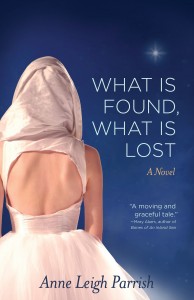
Check out Anne’s debut novel What Is Found, What Is Lost.
Visit Anne’s blog and connect with her on Facebook.
Follow Anne on Twitter.
On Goodreads.
And on Pinterest.
~ ~ ~ ~
Many thanks for visiting my blog today! Please browse the website and let me know if you like what you see, or if you have suggestions. You can reach me by leaving a comment in the box below or by clicking the Contact link at upper right (or just click here). Consider subscribing to my blog or newsletter. And stop by again soon!
by anesamiller_wuhi6k | Jul 20, 2015 | Blog, Series: Drawer no more!, Writing & Publishing

Wild dreams….
A long-awaited milestone, such as the publication of a novel, brings both joy and reflection. Mine, Our Orbit, was published last month by Booktrope of Seattle after years of work and (often frustrated) hope. Questions come to mind, some my own and others posed by friends or fellow writers: What do we accomplish by writing books in the digital age? Why crank out hundreds of pages in the days of 140-character tweets? And is the “game worth the candle” in terms of rewards, whether tangible or otherwise—to borrow a phrase from an era when reading had less competition as a form of entertainment and enlightenment?
My favorite uncle, a student of art history in his youth, always affirmed the adage that, “Truth is beauty and beauty, truth.” With a smirk, he would add, “That’s all you need to know!” My truth in writing a novel of social conflict set in the notorious swing state of Ohio involves such controversial matters as abortion and prejudice based on class, race, and sexual orientation. The effort to treat these issues with a fictional type of truth earns me no love from certain quarters, including a few branches of my own family.
Was it worth it? Does publishing a book justify losing friends and alienating people? I don’t expect fame or life-altering royalty checks. So the question leads me to ponder the notion of a “writing career.” Actually, that’s been on my mind for 50 years as the highest achievement I could possibly attain! Social media reveals that this goal is shared by tens of thousands of people in the English-speaking world. But I’m not sure how most would define the term “career.”

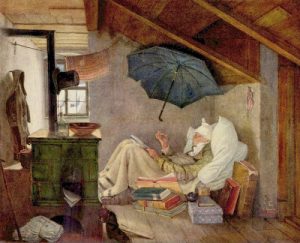
“The Poor Poet” by Carl Spitzweg
One obvious question is whether a career must produce monetary income. Things we do, no matter how we love them, tend to be called a “hobby” if they fail to bring in at least as much money as required for ongoing practice. No doubt hobbies get an unfairly negative rap. Still, the word has a connotation of triviality or light amusement. Distraction for dilettantes: knitting today, decoupage tomorrow.
 This is nothing like the attitude of most writers toward their craft. The inner voice that guides the pen (or fingers on keyboard) is an intimate part of our selfhood. Writing expresses a quality of the author’s mind that seems to embody a higher personality. Even a soul. Until we frame experience in words, we hardly know what happened or what to think. At the same time, writing is a way of reaching out to people we could never meet in our physical lives, a point of contact with humanity. Or at least a hope for contact if we succeed in finding readers.
Eventually, we couldn’t switch to another “career,” or even another “creative outlet,” if we wanted to. As writers are known to declare in moments of despond, “I’m entirely unfit to do anything else!” (Although some have done quite well, after all. Bless their hearts.)

From The TELEGRAPH, Watercolor believed to portray the Brontë sisters
Throughout history, writers have failed to earn enough money to shake a quill at. Yet many of these wound up contributing to the canon of world literature and belatedly entered the hearts of more readers than they dreamed of finding while they wrote and struggled. Among the members of this special club are Thoreau, Dickinson, Poe, Kafka, at least two of the Brontës, and John Kennedy Toole (the posthumous Pulitzer Prizewinner for A Confederacy of Dunces).
And it should never be forgotten that others have paid the ultimate price for stubbornly practicing their craft under totalitarian regimes. Not merely denied a living wage, these writers were hounded and killed for the truth of their words: Osip Mandelstam, Nikolai Gumilyov, and Víctor Jara. Still more were marginalized and persecuted: Anna Akhmatova, Theodor Kramer, Boris Pasternak, Alexander Solzhenitsyn.

Solzhenitsyn: Gulag mug shot
The PEN International Writers in Prison Committee reminds us that persecution continues around the world today. American writers may have little more to fear than being ignored and unsupported, but we share the dedication to a practice that often resembles a calling more than a career. We feel an inner drive to seek perfect self-expression despite the lack of material reward. Or reward of any kind: Praise, recognition, a place in society, even self-respect. When our work is such a profound reflection of our minds, affirmation is a persistent craving, but all may be withheld by the cruel muse. Not to mention a society with “other priorities.”
But writers persevere.
Having known a good number of aspiring authors, I feel qualified to insist that few are hoping for lifetime poverty followed by posthumous fame. In fact, few appear to give any thought to what might become the “great works” of the future. Most would like to realize a small profit on book sales, or at minimum, break close to even on their investment in materials and services such as editing, proofing, and design. Our wildest dreams may involve the sale of film rights, which might at least begin to pay down an English major’s student loans. Only those who mimic the style or genre of popular authors like Stephen King or Danielle Steel seriously imagine that their work will bring riches or renown.
Samuel Johnson would say that the world has grown crowded with blockheads. (He of the famous quote, “No man but a blockhead ever wrote except for money.”) True, Mr. Johnson lived in an illiterate age, when the slightest skill with letters carried a premium. It’s far easier today to go broke amid a crowd of scriveners than it was in the 18th century. Nonetheless, this deters few from trying to distinguish themselves. Ourselves. So again, I ponder, why do we do it? How do we go on?
It’s hard to turn away from a true calling. What’s often termed “the writing life,” in which daily practice takes precedence, requires an almost spiritual discipline. When it may take years to “finish” a book and longer to perfect it, deferred gratification is the order of the day. But for a writer striving to publish, it’s even more essential to “sit with” your ego, in the Buddhist sense: to tolerate its flights of arrogance without succumbing to them. To use that energy while resisting its delusions of grandeur.
Why do we do it? How do we go on?
You must believe in your skills enough to keep applying words to page, but not so much as to allow specific hopes—This agent will take me! That magazine will feature me!—to outgrow the proverbial, tiny mustard seed. Disappointment is always around the corner…though fresh efforts are available as well.
 And so, many of us content ourselves with a monkish satisfaction and careful management of our own expectations. A life of self-denial? To keep faith with one’s artistry, always striving in uncertainty to bring forth greater truth, is a type of loyalty to one’s humanity. To all of humanity.
Then comes the occasional word of thanks from a reader: your story touched a chord, raised a memory, sparked new ideas! Or a reviewer demonstrates a deep engagement with the work—”Yes! That’s what I was trying to say all along.” For a moment, drudgery vanishes, and the calling becomes a blessing we cannot fail to answer. The effort was worth every word: all the words on the page and the thousands more crossed out like submerged stones that let you walk on water.
~ ~ ~ ~
Many thanks to Anne Leigh Parrish for hosting this original post on her blog on 6/30/15. Anne is the author of the acclaimed novel What Is Found, What Is Lost. Visit Anne today!
Connect with Anne on Facebook.
Follow Anne on Twitter.
On Goodreads.
And on Pinterest.
~ ~ ~ ~
And thanks for visiting my blog today! Please browse the website and let me know if you like what you see, or if you have suggestions. You can reach me by leaving a comment in the box below or by clicking the Contact link at upper right (or just click here). Consider subscribing to my blog or newsletter. And stop by again soon!
by anesamiller_wuhi6k | Jun 22, 2015 | Blog, Series: Drawer no more!
The following does not fit with any topics I usually discuss here, except maybe “writing in general”: As a writer, it’s my duty to use words to make sense of the senseless. So for my peace of mind and for anyone else who happens by—
 Please don’t misread: I am NOT saying that one crime is worse than another. Families shot at a block party, women shot in a gym, and, certainly, children shot while they attend school—all are heinous and heartbreaking crimes. But honesty compels me to admit that, regarding some of them, I’ve learned to take refuge in comforting excuses. Only a sicko would fire upon children! Only fanatics would shoot a doctor at prayer, or dozens of teens at summer camp, or peaceful citizens at a Unitarian Church.
Something is blatantly wrong with those people. Their attitudes are certifiably outside the norm of human behavior. Psychological science might even develop a test to find and treat this illness…
These comforting excuses allow me to distance myself from such crimes. To shield myself from the pain forced upon victims’ families and witnesses. Yes, bona fide mental illness is often involved. Still, the idea of illness as a cause for crime becomes a refuge, even a delusion, that grants me a false sense of personal safety.
Avoid crazy people, and all will be fine. Sickos aren’t that hard to spot. They can be locked away.
Those comforts fail me when I hear about the attack at the Mother Emanuel Church in Charleston, South Carolina. It is tempting to call the blatant racism behind this crime “sick.” It might bring some comfort to deem the killer another lunatic, outside the norms of society.
But by all accounts, Dylann Roof made rational choices, acted methodically, considered NOT going through with his plan…and yet elected to kill. He embraced the beliefs of many older (supposedly wiser) people across the nation who’ve shown fear and disgust with the first non-white President of these United States. Never mind that this President was elected twice by large majorities of fellow citizens. Dylann Roof chose hate, and it led him to take the lives of people who, he admitted, had been kind to him.
I find no refuge from this.
True, Roof appears to be a fanatic, not unlike the murderer of Dr. George Tiller in a church in my hometown of Wichita, Kansas, back in 2009. Apparently, Roof convinced himself that black people are “taking over” America. That is strong evidence of delusional thinking, in light of recently publicized police killings of black persons, often unarmed. Not to mention disproportionate incarceration. So indeed, Roof may be mentally unstable.
But for a young person to choose such a warped view of the world, and such a pointed, intentional way to act out his hatred on innocent people…
This one breaks my heart even worse than the others.
 The only possible comfort at this moment comes with the news that services went forward at Mother Emanuel yesterday. That thousands turned out on Sunday to march across the Ravenel Bridge, to show support for the victims and families. That survivors have declared, “Hate will not win,” amid their choice of forgiveness. These responses bring a glimmer of hope that outrage at this crime may strengthen the quest to overcome the gaping wounds of racism and gun violence in America.
Hope—your name is one with these good Christians who lost their lives: Tywanza Sanders, Ethel Lance, Cynthia Hurd, Rev. Sharonda Singleton, Myra Thompson, Susie Jackson, Rev. DePayne Middleton-Doctor, Rev. Clementa Pinckney and Rev. Daniel L. Simmons Sr.
Broken or not, my heart goes out to their friends and families.
by anesamiller_wuhi6k | Mar 31, 2015 | Blog
 Published author and intrepid romantic Jacquée T. shares the following entry from the section of her multifaceted website titled “Love for Words.” First posted here a few weeks ago, this discussion of the term “reverie” spoke to me with a lovely eloquence!
Writers know that every word in a book or poem, however brief or obscure, carries its own special weight and character. What could be more important to any type of creative artist than a “fantastical vision,” be it ever so “impractical”?
As Jacquée T. elucidates—
A reverie is a deep absorption in one’s notions.
A person in a reverie is indulging in positive thoughts, perhaps to the point of elation.
♥ Sign on for my excellent GIVEAWAY throughout April 2015: WIN $50 in books from Powell’s Independent Bookstore! Click for details! ♥
Definitions via RANDOM HOUSE KERNERMAN Webster’s College Dictionary online:
1. a state of meditation or fanciful musing.
2. a daydream.
3. a fantastic, visionary, or impractical idea.
One might bask in reverie privately, while it diverts them from surroundings. Or they might feel so overwhelmed by their reverie, they yen to shout it from the rooftops.
Either way, outsiders, should they gaze at that person’s reverie, might admire the inspiration, or consider it mere madness.
“Reverie” derives from Old French reverie, meaning “revelry, raving, delirium.”
Usage examples:
a) After Jenny accepted his invitation to dinner, George basked in reverie to plan an unforgettable date.
b) Sarah took a two-week cruise for her vacation. The evening before the luxury liner returned to port, she reclined on deck and took reverie over her diverse and magical experiences.
c) Andrew Snodd requested VIP passes to the Horse Riders Club annual Rein Ball, based on the fact that his belated grandfather was once the Club treasurer. Committee members considering Mr. Snodd’s request dismissed it as a reverie.
Famous inspiration: Paul Anka’s classic song “You Are My Destiny” begins with lyrics—
“You are my destiny
You share my reverie…”
When have you felt lost in REVERIE?

___________
Connect with Jacquée T. on Twitter via @JacqueeT


 (When Miriam’s foster father, Rick, takes her back to visit her home church, Holy Redeemer Tabernacle, we see the tradition through his eyes.)




 This is nothing like the attitude of most writers toward their craft. The inner voice that guides the pen (or fingers on keyboard) is an intimate part of our selfhood. Writing expresses a quality of the author’s mind that seems to embody a higher personality. Even a soul. Until we frame experience in words, we hardly know what happened or what to think. At the same time, writing is a way of reaching out to people we could never meet in our physical lives, a point of contact with humanity. Or at least a hope for contact if we succeed in finding readers.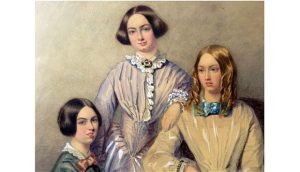




 The only possible comfort at this moment comes with the news that services went forward at Mother Emanuel yesterday. That thousands turned out on Sunday to march across the Ravenel Bridge, to show support for the victims and families. That survivors have declared, “Hate will not win,” amid their choice of forgiveness. These responses bring a glimmer of hope that outrage at this crime may strengthen the quest to overcome the gaping wounds of racism and gun violence in America.
 Published author and intrepid romantic Jacquée T. shares the following entry from the section of her multifaceted website titled