by anesamiller_wuhi6k | Aug 3, 2015 | Blog, Writing & Publishing

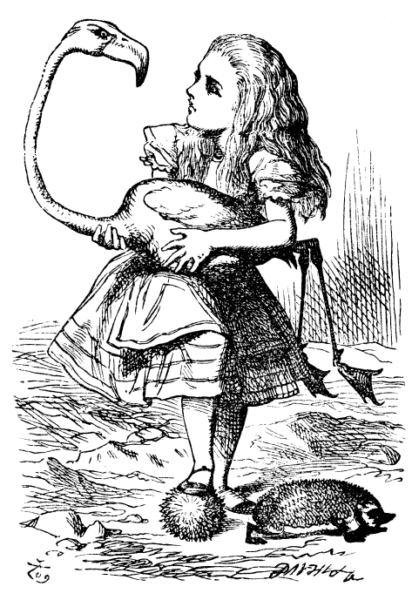
Illustration from AAIW by John Tenniel
I’m grateful to friend and author Marnie Cate for inspiring this post and hosting it on her lovely website a few weeks ago. When I first visited Marnie’s site, I noticed that her work concerns magic and the paranormal. I had to admit off the bat that, by contrast, I am primarily drawn to realism. However, I do NOT claim to have any better grasp of “reality” than writers of other genres. To me, realism in fiction basically means that, “Things may get weird, but no supernatural forces will be blamed.”
I’m not sure when the realist bug bit me so hard. Earlier in life, my favorite books were The Chronicles of Narnia, The Fellowship of the Ring, and Alice in Wonderland. A long detour through Russian literature may have done it (which is why I call myself a “recovering academic”). The 19th-century Russian novels of Tolstoy, Turgenev, and Dostoevsky are often classed as a “golden age of realism.”
Nonetheless, I love flashbacks, dream sequences, and the mysteries of nature—these can all be excellent elements in fiction, in my opinion. In fact, there is one key element in my new novel, Our Orbit, that doesn’t fit the realist mold.
One of the main characters in my novel is a young girl named Miriam, who has the misfortune of witnessing her father’s arrest by a SWAT team. Terrified, she hides under her parents’ bed, expecting US Marshals to come for her next. Of course, she does not understand that they will take her not to jail but to a foster home. Nonetheless, while she trembles in hiding, something strange takes place —
…the light switch clicked by the door of Daddy’s bedroom. Miriam tried to sink into the floor. Light reached for her under the edge of the sheet. …she saw dark boots in the doorway.
“Hey,” said the man’s voice. “You playing hide-and-seek in here? You can come out now, okay?”
He sounded young. Not so mean as the others. Miriam snuffled, wiped her face on her sleeve. She knew it would tell him she was under the bed.
His knees crackled when he bent down. “Come on,” he said, almost beside her now. “Don’t be so scared. We’re not here to hurt you.”
The miracle wasn’t that his voice sounded kind. The miracle was that his voice called up another, a voice Miriam had been the last person on earth to hear. Her daddy had said many times, “Miriam was with her when she died.” And Isaac said, “You know, Miriam, you were the last person to talk to Momma alive.” So now she heard her mother again, almost like the breath of someone sleeping beside you in a warm bed on a winter night—
Now is a time to be very brave. This man is not going to harm a child, I promise you that much. And no more bad things will happen tonight. You will go to a good and safe place.
Things may get weird, but no supernatural forces will be blamed…
Throughout the conflicts that develop in the story, Miriam continues to hear the voice of her deceased mother. I think it becomes clear that this is a source of comfort and guidance for her, almost as if her mother were still there. When my beta readers considered these episodes, a few said that I should explicitly clarify whether Miriam’s own psychology was causing this voice, or if it was intended to be a paranormal phenomenon.

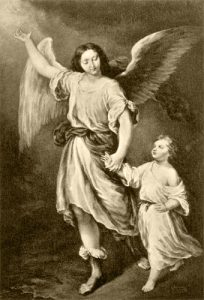
Guardian angel….
Like most writers, I think, I was reluctant to ‘cut and dry’ the mystery. The question of whether the spirit of Miriam’s mother literally speaks to her in times of trouble remains open. In my opinion, the story lends itself a bit more to one interpretation than the other, but I hope readers will find the meaning that speaks to them.
~ ~ ~ ~

Visit author Marnie Cate and connect with her on Facebook, on Twitter, and Goodreads. Find her book, Remember, Protectors of the Elemental Magic on Amazon.
~ ~ ~ ~
Thank you for visiting my blog today! Please check out the rest of the website and let me know if you like what you see, or if you have suggestions. You can reach me by leaving a comment in the box below or by clicking the Contact link at upper right (or just click here). Consider subscribing to my blog or newsletter. And stop by again soon!
by anesamiller_wuhi6k | Jul 27, 2015 | Blog, Writing & Publishing
Many thanks to Dawn Brazil, an author and all-round great person, who not only provided the inspiration for this post but also shared it first on her blog, Dawn Brazil’s Brilliant Babbles about Books —

When I first visited Dawn’s website several weeks ago, I was impressed with her use of music: music video clips, playlists, and more. It made me realize what a special source of inspiration music offers for all the arts and for life, overall. We can turn to it any time to refresh our mood or energize our creativity. Songs that we love and melodies we remember from long ago yield rich imagery for many writers.
I took a look back at my novel, Our Orbit, and noticed that music plays an important part in the story.
The first instance comes in the opening scene. It’s just a small point, but I think it helps to reveal the main character. Miriam Winslow is a girl of nine, the youngest child of a close-knit working-class family. Before the plot takes off with Miriam’s forced removal from her home and placement in foster care, I wanted to give a glimpse of how her intimate family members knew her. Rather than spend a lot of space of this, I tried to choose a telling detail. Miriam’s feeling for music helped me out—
(As Miriam’s mother, Emaline, drives through a snowstorm to pick up an older daughter, they bypass the turn for their home at Friendly Village Mobile Home Park.)
Emaline suppressed a sigh. Instead of slowing for the turn, she tapped the horn and called out, “Hold the fort, Friendly!”
“Friendly, holding steady—” sang little Miriam from the back seat, quick to answer the cue in this family routine of forgotten origin, homage to the home where Emaline arrived as a bride half her life ago.
In this short passage, my aim was to show that Miriam is a happy child who enjoys melody and is not shy about sharing her voice. She expresses loyalty to her family by singing a “ditty” they invented for fun before she was born. As the story goes on, readers will learn that Miriam’s older brothers and sister have largely given up such family rituals as they began to deal with mainstream culture at school and among their peers. Miriam is the one who keeps family traditions alive, and she will bring them to her new foster family.
As a motif in our writing, music can play a wonderful role in revealing cultural differences between groups of people. Our Orbit explores these differences on a small, local scale: Miriam’s birth family and her foster family have a great deal in common, and yet they belong to separate groups with limited contact. Both families have lived in the same Ohio county for generations. They are of the same race and similar heritage from northern Europe. And both families are Protestant Christians of weekly church-going habits. Even so, the barriers between them are economic class and educational background.

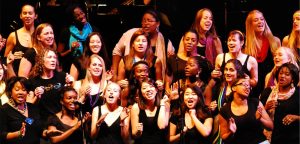
When Miriam first attends church with her foster family, she is awed by the large building, bright chandeliers, and long hallways for Sunday school classes and meeting rooms. People are more dressed up than she is accustomed to, and all their clothes are new and brightly colored. But it is Miriam’s reaction to the music at this big, new church that makes clear to readers: She grew up on the other side of the tracks.
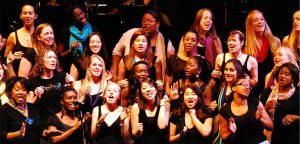
While Miriam ran up the church steps…she heard a choir strike up a song inside. Sounded like a hundred people! Across the bright lobby…you could see the flash of white-and-gold robes as the singers stepped left, right, back, front, clapping their hands on each move. A rock band with guitars and drums was playing along. Tambourines rattled…
This must be the hugest church in town, Miriam thought, All we have back at Holy Redeemer is one little piano. And even with every person singing, there were only a few dozen voices…
Miriam’s home church was a small, “backwoods” congregation without paid professionals to direct a choir or play instruments. Although she soon comes to appreciate the music at her foster family’s prosperous church, her first impression is mixed. Based on her experience, the “loud, peppy music” seems more like a performance than a call to worship. More like a “dance party” than an occasion to repent one’s sins.
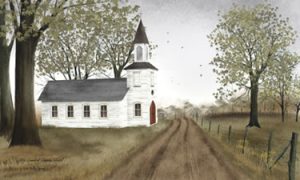
 (When Miriam’s foster father, Rick, takes her back to visit her home church, Holy Redeemer Tabernacle, we see the tradition through his eyes.)
[It was] a tiny white-washed church on Key Ridge, south of town… The piano’s tinny chords rang out… There was no choir director and no hymnals, but harmony swelled from two to four parts. The voices were strong for such an elderly crowd—
To Canaan’s land I’m on my way,
Where the soul of man never dies,
And my darkest nights will turn to day,
Where the soul of man never dies…
People embraced. Some laughed, others wiped away tears…
Here is a list of a few songs that played in my head as I worked on Our Orbit. I’ve hunted up those I could find on YouTube to give an impression of how they sound. Some of the hymns are quoted in the book (as in the scene above), while others served more to set a mood for my writing.
“The Soul of Man Never Dies” performed by Tony Rice and Ricky Skaggs. From the DVD “Legends of Flatpicking Guitar.”
“There is a Balm in Gilead” performed by Mahalia Jackson.
“The Stable Song” performed by Gregory Alan Isakov.
And to close on a happy note, here is “Dreams” performed by the Cranberries. This is the favorite song of Miriam’s teenage sister Rachelle. It becomes embarrassing to Rachelle when her friends make fun of the band because they are Irish and “talk funny.” So we see that Rachelle’s musical taste is a bit more open-minded than some of the people around her!
~ ~ ~ ~

Visit Dawn Brazil at her blog, Brilliant Babbles About Books.
Connect with Dawn on Facebook, on Twitter, on Goodreads, Pinterest, and on Amazon.
~ ~ ~ ~
Thank you for visiting my blog today! Please check out the rest of the website and let me know if you like what you see, or if you have suggestions. You can reach me by leaving a comment in the box below or by clicking the Contact link at upper right (or just click here). Consider subscribing to my blog or newsletter. And stop by again soon!
by anesamiller_wuhi6k | Jul 14, 2015 | Blog, Foster Care, National Foster Care Month
Perspective makes all the difference when parenting a traumatized child. It can transform moments of irritation into life-affirming opportunities.

“Watchful” is exploring the power of expressing of his opinions and emotions. Pretty much that boils down to him saying no a lot and complaining. The rationale, objective part of my brain knows this is a great milestone, since he feels comfortable enough to share his negative emotions. Previously, such behavior would have earned him a beating by his bio parents. It’s wonderful that he’s trying to figure out if it’s true that some parents won’t hit him when he misbehaves.
But then there’s the practical side when I’m trying to get him out the door to camp and he’s refusing to put on his shoes. The county driver is staring at me and pointing at his watch. Teenaged “Silent One” is fuming that he’s being made late for his running team’s practice. “Sassy” is “being helpful” by scolding Watchful, which makes him double down on stubbornly not putting on his shoes. Watchful’s sister Joyful decides to get in on the action and suddenly claims that she doesn’t understand what you mean by “put on your shoes.” Meanwhile, the dog is barking and desperately trying to nip at the county driver.
“Just one moment, please,” I say to the driver, who’s face clearly conveys his thoughts of what a crazy household.
Deep breath #1. Deep breath #2.
“Sassy, can you please be in charge of the dog and take her into the other room, please?” I say. Nagging sister and annoying dog successfully dealt with.
“Watchful and Joyful, you have to the count of three to put on your shoes,” I say. Joyful begins putting on her shoes. Second sister moving in right direction.
“What are you going to do? You can’t make me,” responds Watchful, testing me on whether I will hit him to get him to comply.
“Put your shoes on by the count of three or I will put them on for you,” I come back. “We need to be respectful of Silent One’s need to be on time for practice.”
Silent One’s pissy stance relaxes as he hears me acknowledge his desire to get to practice.
Watchful begins to put on his shoes…in slow motion.
Deep breath #3.
“Put your shoes on regular speed,” I say sternly, but calmly.
Watchful puts on his shoes and then wanders off away from the door.
“It’s time to leave for camp, Watchful. Get in the car. Regular speed,” I direct.
Watchful gets in the car.
Kinda looks like just an annoying parent moment. And at a certain level, it is a bit annoying. But honestly, I’m secretly happy inside.
Because he has given me the perfect opportunity to prove what kind of person I am. I’ve just shown him that I am not a parent who will smack him when he misbehaves. I’m also not the parent who will let him get away with not following the rules. I’m a safe, in-charge parent.
Now we only need to do this dance again day in and day out, until my message of safety sinks in.
Come on, kiddo. Give me another chance to prove that I’m a safe, in-charge parent who’s going to help you heal.
~ ~ ~ ~
For additional information—
Visit The Beautiful Opportunity.
Visit the Wisconsin Coalition for Children, Youth & Families.
Visit the National Foster Parent Association.
~ ~ ~ ~
Many thanks for visiting my blog today! Please browse the website and let me know if you like what you see, or if you have suggestions. You can reach me by leaving a comment in the box below or by clicking the Contact link at upper right (or just click here). Consider subscribing to my blog or newsletter. And stop by again soon!
by anesamiller_wuhi6k | Jul 13, 2015 | Blog, Writing & Publishing

As you would expect, I believe literary fiction is still vibrant and important because those are the books I like to read. Still less surprising in light of my convictions: it’s the type of book I do my best to write. My new novel, Our Orbit, may not be philosophical, contains no elaborate symbols, and little poetic language. Nonetheless, it aspires to such literary values as psychological depth and social relevance. Popularly termed “lit fic,” this category is tricky to pin down with a definition. With your indulgence, I’ll share some preliminary thoughts.
I like to imagine literary fiction as a coquettish college-aged human (of any gender you like) attending a costume party dressed as Mark Twain. S/he twirls one end of an old-fashioned string tie, and eyes twinkle under that mop-like wig. A lilting voice reminds us that, “Reports of my death are an exaggeration.”
 It’s good to keep in mind that literary fiction is a sweet young thing. Its detractors often point out that, “Shakespeare [or Tolstoy or other greats of the past] never wrote #litfic! He just wrote what he wanted!” Leaving aside the fact that Shakespeare wrote drama and poetry, this claim makes no point at all. The concept of “literariness” is one we grapple with in relation to contemporary fiction. It is always a fresh quality for its own time. Anything else, however highbrow and elaborate, would be formulaic.
Moreover, anything of Shakespeare’s era or Tolstoy’s, which is still being read today, should be called a “classic,” or “canonical work,” rather than literary fiction. Confusing these categories lands us in hot water. The most well-written, intellectual novels of today, whether they climb a best-seller list or not, may be forgotten ten or twenty years from now. Once forgotten—regardless of how literary these books were once considered—they will never become classics for future generations (barring the increasingly unlikely event of a new vogue or rediscovery).

Instant classic, or crackpot?
Virginia Woolf by Roger Fry
Allow me to evade the issue of a cut-off date. Even so, “literary,” in the sense I mean here, is an adjective properly applied to fiction of one’s own time. Books earlier than—say, arbitrarily—the cultural shift of the 1960s, came to the publishing market contending with such a different set of tastes and expectations that we can no longer perceive them on their original terms. We cannot read them with the same mentality that prevailed when they were created (although I’m sure this varies for individual readers).
What this implies is that we may find older works interesting for reasons other than those that draw us to contemporary literary fiction. Indeed, our reasons may have nothing to do with literary quality: historical interest, curiosity about an author’s life or death, the comforts of a bygone world, etc. Whether these older books were deemed literary when published or not, they may yet become classics or enter a canon of some sort, if their appeal persists over time.
I find this distinction important because resentment among writers of different genres is running especially high these days. True, such feelings tend to be perennial but are especially unfortunate at a time when all writers are lucky if the public chooses any book over Facebook. But, I understand how authors of popular genres (the name Jennifer Weiner springs to mind) may well resent those who embrace the term “literary” IF we claim it means our work is closer to the classics that millions have loved for years or centuries. There is no necessary connection.
Let me emphasize the obvious: Contemporary literary novels ≠ classic works of literature!
Of course, resentment rarely seeks a rational cause. AND there is a pregnant similarity between the words “literary” and “Literature.” But attempting to change established terminology in any field is a bigger task than I can advocate in good conscience.
I can feel this topic expanding even as I struggle to address it! So in short (if not too late for that): I believe literary fiction is a meaningful category, one that has existed for some decades, and is likely to remain viable in the future. As a purveyor of #litfic myself, I plan to revisit many of these questions.
~ ~ ~ ~
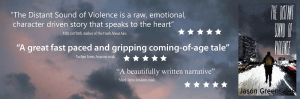
 Many thanks to Jason Greensides for hosting this original post on his blog on 6/29/15. Jason is the author of the acclaimed novel The Distant Sound of Violence. Visit Jason today!
Connect with Jason on Facebook.
Follow Jason on Twitter.
On Goodreads.
~ ~ ~ ~
by anesamiller_wuhi6k | Jul 5, 2015 | Blog, Issues in Our Orbit -- Substance Abuse & Recovery
 Several topics drive the story of my novel Our Orbit. Discrimination and religious issues play a major role in the plot. To open the way for conversation on these matters, I offer the following guest post from the blog of John Pavlovitz, Stuff That Needs to Be Said, first published on March 28, 2015. John wrote this piece in response to Governor Mike Pence’s signing of Indiana’s “Freedom to Discriminate” Bill. Although much has changed in the months since, notably the recent Supreme Court decision on same-sex marriage, John’s essay reminds me that we humans have a ways to go in terms of accepting ourselves, our common interests, and one another.
John Pavlovitz writes—
Dear Christians In Indiana (and those elsewhere, who might read this),
I’ve seen what’s been going on there lately. Actually, I’ve been watching you all along and I really need to let you know something, just in case you misunderstand:
This isn’t what I had planned.
This wasn’t the Church I set the table for.
It wasn’t the dream I had for you, when I spoke in those parables about the Kingdom; about my Kingdom.
It was all supposed to be so very different.
It was supposed to be a pervasive, beautiful, relentless “yeast in the dough” that permeated the planet; an unstoppable virus of compassion and mercy spread person-to-person, not needing government or law or force.
It was supposed to be that smallest, seemingly most insignificant of seeds, exploding steadily and gloriously with the realized potential of my sacred presence, becoming a place of safety and shelter for all people.
It was supposed to be something so very precious, such an obvious, invaluable treasure, that it would make all those who discovered and experienced it, feel like it was worth selling everything they had to hold onto it.
It was supposed my very body, here in your very flesh.
You were designed to do this, to be this.
My kindness, my goodness, my forgiveness; you were created to be the method of transportation for all of it.
You were made to deliver the greatest good news to a world so desperate for it.
This wild, extravagant, world-altering love I have for my people, was intended to travel from my aching heart, through your trembling hands, to my hurting people.
This has always been your calling. It has always been your purpose.
It still is. This very second it is.
I have placed you here at this exact place and time in the history of creation, not to defend me, as I need no defense; not to protect me, since I have already willingly laid my life down; not to judge others on my behalf, as this is far beyond your capacity and my instruction.
My beloved, I placed you here, not to defend or protect or replace me, but simply toreflect me.
That has always been my most critical commandment and your most pressing obligation; loving God and loving others. I thought that I was clear on that, when I was asked this before.
I showed you how to move in this world.
I kept company with priests and with prostitutes. I touched lepers and washed feet and dined with sinners, both notorious and covert. I served miraculous free meals to starving masses, and I allowed myself to be touched and kissed and betrayed and slandered and beaten and murdered… and I never protested.
All that is happening these days, all the posturing and the debating and the complaining; does this really look like love to you?
Do you really think that the grandstanding and the insult-slinging and the side-choosing, that it feels like me?
Do you truly believe that the result of your labors here in these days, is a Church that clearly perpetuates my character in the world?
Is this the Gospel I entrusted you with?
To be honest with you, I simply don’t see it.
How did you drift so far from the mission?
How did you become so angry, so combative, so petty, so arrogant, so entitled?
When did you begin writing your own script for this story?
When did you turn it into your story?
My children, here’s what you may not realize, being as close as you are to all of this. You may not be able to see it clearly anymore.
You certainly don’t have the perspective that I do, and here from my vantage point, this is what I do see:
You are driving people from me.
You have become an unbreachable barrier between myself and those who most need me.
You are leaving a legacy of damage and pain and isolation in your path.
You are testifying loudly, not to my love, but to your preference.
You are winning these little violent battles, and you are losing people; not to Hell or to Sin, but to all of the places outside of you, where they go to receive the kindness and decency and goodness that you should be showing them.
This life is not about your right to refuse anyone. If I wanted to avoid serving those I found moral faults with, I would have skipped the planet altogether.
I came to serve.
Your faith in me, cannot be an escape clause to avoid imitating me.
Asserting your rights, was never greater than following my example.
Your religious freedom, never more important than loving the least.
Your central cause, should be relentlessly conforming to my likeness, despite the inconvenience and discomfort that it brings.
When I commanded you to deny yourself, I was speaking about the times when it is most difficult to do so, because that is when “self” is the most distracting, the most dangerous, the most like an idol.
Obedience to me, usually comes with sacrifice to you.
I can’t force you to reflect upon these words, and I can’t make you live as I lived or love as I love. This was never the way I worked or will ever work.
I can only tell you that you have surely drifted from the course I started you on, and as often is the case in long journeys, it is a divergence that unfolds by the smallest of degrees, almost imperceptible while it’s happening.
That is why what feels like victory to you, is really another slight but definite movement away from me, and from the reason you are really here at all.
Not long after I walked the planet, as my Church was just beginning to blossom and my Kingdom was truly breaking out, a Greek writer named Aristides, wrote these words about those who bore my name then:
“It is the Christians, O Emperor, who have sought and found the truth, for they acknowledge God. They do not keep for themselves the goods entrusted to them. They do not covet what belongs to others. They show love to their neighbours. They do not do to another what they would not wish to have done to themselves. They speak gently to those who oppress them, and in this way they make them their friends. It has become their passion to do good to their enemies.
They live in the awareness of their smallness.
Every one of them who has anything gives ungrudgingly to the one who has nothing. If they see a travelling stranger, they bring him under their roof. They rejoice over him as over a real brother, for they do not call one another brothers after the flesh, but they know they are brothers in the Spirit and in God. If they hear that one of them is imprisoned or oppressed for the sake of Christ, they take care of all his needs. If possible they set him free. If anyone among them is poor or comes into want while they themselves have nothing to spare, they fast two or three days for him. In this way they can supply any poor man with the food he needs. This, O Emperor, is the rule of life of the Christians, and this is their manner of life.” *
– Aristides, 137 AD
* taken from Jesus For President, By Shane Claiborne and Chris Haw
To the Christians in Indiana, and those beyond who are still listening today; you would do well to hold these words up daily as a mirror to your individual lives, and to the expression of me that you make together in this place.
Is this what you see when you look at yourself?
Is this what the world sees when it looks at you?
In your words and in your ways, Church; do they see me?
If not, then regardless of how it seems to you, you haven’t won anything.
May this be truth, that truly sets you free.
~ ~ ~ ~

Visit the blog of John Pavlovitz — Stuff That Needs to Be Said.
~ ~ ~ ~
Many thanks for visiting my blog today! Please browse the website and let me know if you like what you see, or if you have suggestions. You can reach me by leaving a comment in the box below or by clicking the Contact link at upper right (or just click here). Consider subscribing to my blog or newsletter. And stop by again soon!



 (When Miriam’s foster father, Rick, takes her back to visit her home church, Holy Redeemer Tabernacle, we see the tradition through his eyes.)






 Many thanks to Jason Greensides for hosting this original post on his blog on 6/29/15. Jason is the author of the acclaimed novel The Distant Sound of Violence.