by anesamiller_wuhi6k | Jul 23, 2015 | Blog, Series: Drawer no more!, Writing & Publishing
This post by friend and author Anne Leigh Parrish first appeared on Women Writers, Women’s Books on December 15, 2014. Thanks for sharing, Anne!
 As the fiction editor for Eclectica Magazine, it’s been both a privilege and pleasure to read story submissions. Finding the handful of pieces that take my breath away is what it’s all about. The good ones shine through, those that are brilliant positively sparkle.
That said, it’s too bad that so many stories that come my way miss the mark. These are usually decently written, no obvious grammatical errors, no huge prose clunkers. What they fail to do is hold my interest and make me care about the outcome. I see the same mistakes over and over. I thought I’d make a list of these, as a sort of guide to aspiring authors.
~ Not telling a story.
So many writers don’t seem to know what a story is, and isn’t. A story is not a nice description of how things are. It’s not a sensibility, or a mood. While those elements surely contribute to a story, a story itself is a narrative where there must be a change in the reader’s understanding of the events, or in the protagonist’s understanding. You leave a story seeing something you didn’t see at the outset, something that makes sense of what’s come before.
~ Trying to tell too many stories at once. In a short story, you need to figure out what the core is – the central theme, event, action, upheaval etc. All other story lines wrap around that central core, supporting it, or opposing it as a way to further illustrate what you’re driving at. Keep it simple. Don’t have too many characters, or an overly complicated plot. As you write, it’s very tempting to bring in an element that seems really interesting or colorful, but unless it fits with the whole, leave it out.
~ Characters with no inner life. A lot of stories that come through my queue feature people I couldn’t care less about, because I don’t know what makes them tick. I see what they do and where they live. I hear their conversations. But what do they feel? What do they care about? What are they most afraid of losing, or willing to fight for? If I don’t know what a character has at stake, I stop reading. So, make me care. Show me your character in a moment of crisis. She doesn’t have to act bravely or wisely, but in a way I recognize as a fellow human being.
~ Dialog that’s stiff or unnatural. Think about how people really talk to each other. They often don’t use complete sentences. Sometimes they swear. Are they cynical, sarcastic? Are they barely holding themselves together under an emotional strain? Make note of funny, strange, or colorful things you overhear people say, and find a way to work them into your fictional exchanges. One of my stories has my protagonist overhearing two strangers talking, and one says, “She’s as crazy as a box of hair.”
~ Bad pacing. Nothing kills a story faster for me than bad pacing. I give any piece about five pages, and if the action hasn’t gotten off the ground, I bail out. Equally bad is pacing that races along, skimming crucial scenes. Figure out what’s most important in your story, and spend enough time on it, but don’t drag it out. You have to keep moving.
~ Keeping the reader at arm’s length. Beginning writers tend to over-explain, as if they’re afraid that their readers won’t “get it.” Readers are asked to trust authors and suspend their disbelief; and writers must trust readers to be smart enough to fill in a few gaps for themselves. If you think you have to spell everything out, you may be assuming that your reader is pretty dumb. You need to show, not tell. Draw the reader in; let her experience what’s going on right up front, not from some cozy seat up in the balcony.
~ An ending that’s too neat. When I come to the end of a story, I like something left to my imagination. Maybe the protagonist will get the boy back, after all. Maybe she’ll get to a point where she can really move on with her life. Maybe she’ll meet someone even better. I want to decide for myself what happens. At this point, the author no longer gets to call the shots. It’s okay to leave some ambiguity and room for interpretation. You don’t need to tie everything up and have your characters live happily ever after, and in fact, it’s a lot better if you don’t.
I close with what someone once told me about the goal of fiction: “To lift us off from reality, and startle us into recognition.” Avoid mistakes, write the story only you can write, and do it brilliantly!
~ ~ ~ ~
 Anne Leigh Parrish’s debut novel, What Is Found, What Is Lost, came out in October 2014 from She Writes Press. Her second story collection, Our Love Could Light The World (She Writes Press, 2013) was a finalist in both the International Book Awards and the Best Book Awards. Her first collection, All The Roads That Lead From Home (Press 53, 2011) won a silver medal in the 2012 Independent Publisher Book Awards. She is the fiction editor for the online literary magazine, Eclectica. She lives in Seattle.
Check out Anne’s debut novel What Is Found, What Is Lost.
Visit Anne’s blog and connect with her on Facebook.
Follow Anne on Twitter.
On Goodreads.
And on Pinterest.
~ ~ ~ ~
Many thanks for visiting my blog today! Please browse the website and let me know if you like what you see, or if you have suggestions. You can reach me by leaving a comment in the box below or by clicking the Contact link at upper right (or just click here). Consider subscribing to my blog or newsletter. And stop by again soon!
by anesamiller_wuhi6k | Jul 20, 2015 | Blog, Series: Drawer no more!, Writing & Publishing

Wild dreams….
A long-awaited milestone, such as the publication of a novel, brings both joy and reflection. Mine, Our Orbit, was published last month by Booktrope of Seattle after years of work and (often frustrated) hope. Questions come to mind, some my own and others posed by friends or fellow writers: What do we accomplish by writing books in the digital age? Why crank out hundreds of pages in the days of 140-character tweets? And is the “game worth the candle” in terms of rewards, whether tangible or otherwise—to borrow a phrase from an era when reading had less competition as a form of entertainment and enlightenment?
My favorite uncle, a student of art history in his youth, always affirmed the adage that, “Truth is beauty and beauty, truth.” With a smirk, he would add, “That’s all you need to know!” My truth in writing a novel of social conflict set in the notorious swing state of Ohio involves such controversial matters as abortion and prejudice based on class, race, and sexual orientation. The effort to treat these issues with a fictional type of truth earns me no love from certain quarters, including a few branches of my own family.
Was it worth it? Does publishing a book justify losing friends and alienating people? I don’t expect fame or life-altering royalty checks. So the question leads me to ponder the notion of a “writing career.” Actually, that’s been on my mind for 50 years as the highest achievement I could possibly attain! Social media reveals that this goal is shared by tens of thousands of people in the English-speaking world. But I’m not sure how most would define the term “career.”

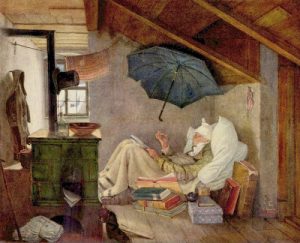
“The Poor Poet” by Carl Spitzweg
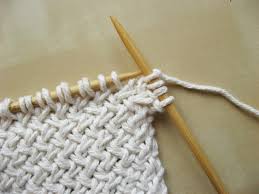
One obvious question is whether a career must produce monetary income. Things we do, no matter how we love them, tend to be called a “hobby” if they fail to bring in at least as much money as required for ongoing practice. No doubt hobbies get an unfairly negative rap. Still, the word has a connotation of triviality or light amusement. Distraction for dilettantes: knitting today, decoupage tomorrow.
 This is nothing like the attitude of most writers toward their craft. The inner voice that guides the pen (or fingers on keyboard) is an intimate part of our selfhood. Writing expresses a quality of the author’s mind that seems to embody a higher personality. Even a soul. Until we frame experience in words, we hardly know what happened or what to think. At the same time, writing is a way of reaching out to people we could never meet in our physical lives, a point of contact with humanity. Or at least a hope for contact if we succeed in finding readers.
Eventually, we couldn’t switch to another “career,” or even another “creative outlet,” if we wanted to. As writers are known to declare in moments of despond, “I’m entirely unfit to do anything else!” (Although some have done quite well, after all. Bless their hearts.)

From The TELEGRAPH, Watercolor believed to portray the Brontë sisters
Throughout history, writers have failed to earn enough money to shake a quill at. Yet many of these wound up contributing to the canon of world literature and belatedly entered the hearts of more readers than they dreamed of finding while they wrote and struggled. Among the members of this special club are Thoreau, Dickinson, Poe, Kafka, at least two of the Brontës, and John Kennedy Toole (the posthumous Pulitzer Prizewinner for A Confederacy of Dunces).
And it should never be forgotten that others have paid the ultimate price for stubbornly practicing their craft under totalitarian regimes. Not merely denied a living wage, these writers were hounded and killed for the truth of their words: Osip Mandelstam, Nikolai Gumilyov, and Víctor Jara. Still more were marginalized and persecuted: Anna Akhmatova, Theodor Kramer, Boris Pasternak, Alexander Solzhenitsyn.

Solzhenitsyn: Gulag mug shot
The PEN International Writers in Prison Committee reminds us that persecution continues around the world today. American writers may have little more to fear than being ignored and unsupported, but we share the dedication to a practice that often resembles a calling more than a career. We feel an inner drive to seek perfect self-expression despite the lack of material reward. Or reward of any kind: Praise, recognition, a place in society, even self-respect. When our work is such a profound reflection of our minds, affirmation is a persistent craving, but all may be withheld by the cruel muse. Not to mention a society with “other priorities.”
But writers persevere.
Having known a good number of aspiring authors, I feel qualified to insist that few are hoping for lifetime poverty followed by posthumous fame. In fact, few appear to give any thought to what might become the “great works” of the future. Most would like to realize a small profit on book sales, or at minimum, break close to even on their investment in materials and services such as editing, proofing, and design. Our wildest dreams may involve the sale of film rights, which might at least begin to pay down an English major’s student loans. Only those who mimic the style or genre of popular authors like Stephen King or Danielle Steel seriously imagine that their work will bring riches or renown.
Samuel Johnson would say that the world has grown crowded with blockheads. (He of the famous quote, “No man but a blockhead ever wrote except for money.”) True, Mr. Johnson lived in an illiterate age, when the slightest skill with letters carried a premium. It’s far easier today to go broke amid a crowd of scriveners than it was in the 18th century. Nonetheless, this deters few from trying to distinguish themselves. Ourselves. So again, I ponder, why do we do it? How do we go on?
It’s hard to turn away from a true calling. What’s often termed “the writing life,” in which daily practice takes precedence, requires an almost spiritual discipline. When it may take years to “finish” a book and longer to perfect it, deferred gratification is the order of the day. But for a writer striving to publish, it’s even more essential to “sit with” your ego, in the Buddhist sense: to tolerate its flights of arrogance without succumbing to them. To use that energy while resisting its delusions of grandeur.
Why do we do it? How do we go on?
You must believe in your skills enough to keep applying words to page, but not so much as to allow specific hopes—This agent will take me! That magazine will feature me!—to outgrow the proverbial, tiny mustard seed. Disappointment is always around the corner…though fresh efforts are available as well.
 And so, many of us content ourselves with a monkish satisfaction and careful management of our own expectations. A life of self-denial? To keep faith with one’s artistry, always striving in uncertainty to bring forth greater truth, is a type of loyalty to one’s humanity. To all of humanity.
Then comes the occasional word of thanks from a reader: your story touched a chord, raised a memory, sparked new ideas! Or a reviewer demonstrates a deep engagement with the work—”Yes! That’s what I was trying to say all along.” For a moment, drudgery vanishes, and the calling becomes a blessing we cannot fail to answer. The effort was worth every word: all the words on the page and the thousands more crossed out like submerged stones that let you walk on water.
~ ~ ~ ~
Many thanks to Anne Leigh Parrish for hosting this original post on her blog on 6/30/15. Anne is the author of the acclaimed novel What Is Found, What Is Lost. Visit Anne today!
Connect with Anne on Facebook.
Follow Anne on Twitter.
On Goodreads.
And on Pinterest.
~ ~ ~ ~
And thanks for visiting my blog today! Please browse the website and let me know if you like what you see, or if you have suggestions. You can reach me by leaving a comment in the box below or by clicking the Contact link at upper right (or just click here). Consider subscribing to my blog or newsletter. And stop by again soon!
by anesamiller_wuhi6k | Jun 28, 2015 | Blog, Series: Drawer no more!
Summer memories—or memories in the making—become more golden as the years reel in. Here’s one that is especially precious to me, an excerpt from my first self-published book, To Boldly Go: Essays for the turning years. The events recounted in “Dancers in the Wheat” date back before the days of GPS and cell phones. Please imagine a remote corner of the Great Plains with no motels and few signposts. And in case you’re wondering, yes—the title is a deliberate riff on Catcher in the Rye.

…Under a wind-scoured Kansas sky, blue and gold with post-thunderstorm sun, Jaak and I headed west on US Highway 50 into the shortgrass country near Dodge City. Here we turned north to locate an old friend I’d last seen twelve years ago, when she and I both still lived in the eastern part of the state. I knew from letters that Linda now resided on a farm near the Nebraska border. It proved impossible to reach her by phone, but in Wichita, I spoke with her mother who assured me Linda would be glad for us to visit.
As students of anthropology at Emporia State University, Linda and her husband Bryce worked among the Southern Cheyenne and became adopted members of that nation. They choose to live outside the mainstream of American culture. They make their home in a sparsely populated region on land Bryce’s German ancestors homesteaded a century ago. Returning to some of his grandfathers’ ways, Bryce has let the years of “chemical enhancement” fade from the soil and now practices organic farming. He sits on the Board of Certification for the Organic Growers of America. Linda teaches at Colby Community College and manages their unconventional household.
Together Linda and Bryce home-birthed four children and continue to homeschool them, encouraging independent thinking and resistance to consumerism. They have no television and got a computer with internet access only two years ago (a gift from Bryce’s mother). Of course, the children also work on the farm, which produces beef, milk, chickens, turkeys, honey, and strawberries—all primarily for home consumption—as well as the main cash crop, organic wheat.
Despite high winds and hail the previous night, which broke windows and flattened fields on their farm, Linda and Bryce took time from chores to meet us outside the tiny town of Jennings. They took us on a tour of places Linda visits with her students for a class she calls “The Great Plains Experience.” We saw the now-vacant one-room school that children of Czech and German settlers attended through the eighth grade as well as cottonwood draws and upland sites where remains of mammoths have been unearthed. Most prized are remains found alongside stone tools, which some consider proof that the land has supported human habitation for at least ten millennia.
Bryce says, “Half the farmers in this county have mammoth teeth stashed in a box in the barn. What’s rare is to find them with clear signs of human life.”
“People didn’t leave a lot of signs,” Linda explains. “That’s a mark of sustainability—an efficient ecosystem.”
These are controversial matters. Not unlike the Boers of South Africa, some residents here prefer to believe the prairie wilderness was uninhabited when their ancestors arrived. Popular history, which my friends dispute, asserts that marauding bands of Cheyenne warriors invaded from the north to massacre peaceable white farmers. It’s a belief that’s used to dismiss native claims to the land throughout northwest Kansas.

2007 National Pow Wow, Grass Dancers, Washington, DC.
“In fact, they had always hunted here,” Linda says. “And there’s evidence of managed horticulture from before the days of the horse. This land was sacred for a long time.”
She explains that members of her adoptive family make annual trips from Oklahoma to Bear Butte in South Dakota to maintain centuries-old rituals. “When the people come up this way, they sometimes stop for groceries or gas. They may need to find some local plants or special rocks. Or to see a particular place and take care of it personally. They don’t want locals to be afraid of them or hate them when they do these things.”
Linda shares these views with her students, some of whom find the Cheyenne-friendly perspective challenging.
“It’s the same with people who give you bad looks when you start raising buffalo,” Bryce says. He recently bought a pair of the animals at auction in Oklahoma. “Indians are supposed to be part of the distant past. But if the buffalo can start coming back, then you-know-who might not be far behind.”
Linda exclaims, “Whatever happened to Earth Day? What happened to civil rights?”
“People get distracted,” Jaak says. “They need reminding.”
In the course of our almost twelve-hour talk, Linda and Bryce also discussed midwifery, wood-burning stoves, biodynamic methods, and depletion of the Ogallala Aquifer. In fact, they talked like they would never shut up! Like they were starved for intellectual conversation, as Jaak said later.
I kept a low profile. Writing a dissertation on Russian literature or failing to publish a novel didn’t seem nearly so compelling as joining the Cheyenne Nation and advocating on the front lines of cultural conflict. But finally, as the evening wound on, I found a way to capture everyone’s attention, thanks to the charms of Memory Lane.
“Remember that time we danced in the wheat field?” I asked.
 When Linda and I were nineteen years old, we lived together for a summer in a one-bedroom cottage on the back lot behind an old rooming house in downtown Wichita. In those days, we were both vegetarians (a practice Linda maintained until she and Bryce began raising their own grass-fed beef). Linda and I also baked our own bread, composted all biodegradable wastes, and picked up aluminum cans for recycling whenever we found them littering the streets of our neighborhood.
We may sound like ultra-serious young women, but when Linda’s birthday came along, we were ready to cut loose. At my parents’ house, in their well-stocked kitchen, I baked a carrot cake and swiped a bottle of wine. I remember it was called Vin Rosé d’Anjou and came in a shapely bottle we cherished as a vase for months afterward.
I refused to drive a car at that righteous time of life, so a friend picked me up and helped bring the refreshments downtown where Linda was due home from work, suspecting nothing. Most of our old crowd was unavailable—working nights or gone to Oregon—but one close pal named Nell was back in town after a year at Oberlin College as a violin performance major. Nell held the rest of us in awe because her family came from Boston and were all accomplished musicians. Her appearance for Linda’s party would be part of the surprise.
I told Nell to be sure to bring her violin.
First off, a mishap. When we got downtown, I cleverly placed the carrot cake—an elegant layered and frosted affair—on the sidewalk while unloading other things from Nell’s car. She managed to find the cake with her foot, leaving a rounded heel mark down one side, like a cookie with one bite gone. I was distraught, but Nell couldn’t stop laughing. Her humor set a tone of high spirits for the evening.
Linda was taken completely unawares. Delight and amazement covered her face when we shouted, “Surprise!”
“I’m sorry I stepped on your cake!” Nell gasped between guffaws.
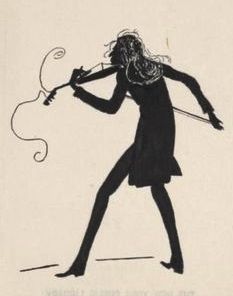
Not that the footprint kept us from eating it. We devoured large portions, drained the wine, and demanded gypsy music. Nell broke out her violin and played waltzes, while Linda and I danced around our tiny house. When the mood called for moving on, instead of more drinking (back then Kansans enjoyed the privilege of buying 3.2 beer at age eighteen), we decided to drive out to the country.

Photograph of a full moon amid passing clouds
It was a lovely summer night. A full moon reflected off sparse clouds. Nell parked on the side of a graded sand road by a hedge of Osage orange. We sat on the hood of the car, basking in silver light.
“Play another song,” Linda said. “Let’s hear what it sounds like, here in the open.”
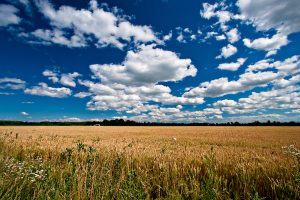
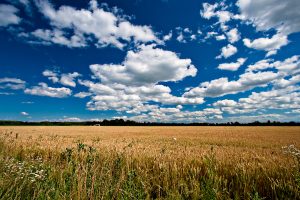
 Nell treated us to a mazurka. It was so inspiring, Linda and I drifted into the wheat field across the road. I don’t know who started it, but first we slipped off our shirts, then our bras, then our jeans. We glided between thigh-high rows of grain, brushing seed-beards with our fingertips. When she finished playing, Nell joined the fun. Our skins tanned an impossible bluish gold, we danced to a tune that lingered over the field, singing snatches of melody.
I think I was first to catch the flash of a shifting light beyond the hill nearby. I called to the others, “Look out—a car!”
“Hit the dirt!” Linda cried.
A pick-up crested the rise to the east and came rattling over sand. We crouched as low as we could, bare skin braving the raspy stems of nearly ripened wheat. We had danced our way well back from the road, but there was Nell’s car by the hedge—testimony for the curious that someone must be close by.
“Shit,” Nell hissed. “My violin…”
She had left it on the hood of the car. It lay in the open case by the near fender.
Did Nature lead us astray with moonshine drunkenness? Was comeuppance in store for immodest young women trespassing on farmland? We couldn’t make out figures in the pick-up, but they obviously took an interest. They rolled to a stop, lingered long minutes, no doubt wondering whose car that could be and where the occupants had gone.
In spite of anxiety, hunkered naked in the field, we struggled to keep our laughter below the hearing range. At least, two of us did. Linda and I leaned together, shaking with the effort. Maybe I gloated a little at Nell for making light of the damage to my fancy cake. Understandably, she saw less humor with a valuable instrument on the line.
We all peered to see if these were the kind of people to molest a carelessly reposing violin.
Lucky for us, and for this cherished memory, they were a better kind.
“So that’s about it.” I concluded the story for Linda and our husbands, who were hearing of that birthday celebration some twenty-five years ago for the first time. “Once that car drove off, we figured it was time to get dressed. But didn’t we wind up leaving some undies behind?”
“Yeah,” Linda said, “we couldn’t find everything scattered in the dark.”
Bryce cracked a toothy smile. A grizzled German-Cheyenne farmer’s grudging smile after a damaging hail storm.
I was so happy to give him a moment’s cheer.
It was full dark when Bryce and Linda drove us back to Jennings, where Jaak and I had left our car. We said good-bye under the Milky Way with exchanges of hugs, heartfelt good wishes, and promises to keep in touch. From there, Jaak and I journeyed on to Colorado. Further stops on our trip included Rocky Mountain National Park, Mount Rushmore, and the Black Hills. But nothing impressed me like the time we spent catching up with old friends, renewing contact with the ways of life they’ve chosen to follow.
 I guess this is the best I can do to account for why I’ve turned down the thermostat, joined a food co-op, and started recycling things they don’t even pick up at the curb. That visit to my homeland, emerging onto the blue landscape of sky over grass and listening for the songs of youth—it worked a magic that gives joy, as well as a bit of a guilt trip. There are so many ways to honor the places we love, it’s tragic if we don’t at least embrace the ones that cost only minor sacrifice.
And then I heard the Ohio Department of Transportation wants to pave miles of farmland to widen a highway that parallels the Turnpike. But don’t get me started on that…
~ ~ ~ ~
To hear a reading of another excerpt from To Boldly Go: Essays for the turning years, click here.
Many thanks for visiting my blog today! Please browse the website and let me know if you like what you see, or if you have suggestions. You can reach me by leaving a comment in the box below or by clicking the Contact link at upper right (or just click here). Consider subscribing to my blog or newsletter. And stop by again soon!
by anesamiller_wuhi6k | Jun 25, 2015 | Blog, Series: Drawer no more!
What an Honor!
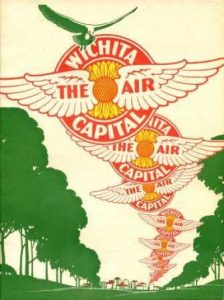
Historic Logo of Wichita, Kansas, courtesy KS Historical Society
It was an honor to chat with published author Leta Hawk at her blog Hawk Happenings! She kindly let me rattle on about Our Orbit, Ohio heritage, growing up in the “Air Capital of the World” during the Cold War, and many other topics! Visit Leta’s site and find out what comic-book spies were really up to back then!
A selection from the interview—
Anesa Miller says: My novel, Our Orbit, embodies a lot of my own heritage in fictional form. My parents came of age in the Depression and went through some very hard times. …Over the years, I came to understand that my mother’s family moved “from pillar to post” and finally lost their home altogether.

The Midwest Warnocks in the 1930s
Learning about my background was an enlightening experience. It inspired me to look deeper into genealogy and history. One of the things I discovered is that a tiny village in southeastern Ohio still bears the name of my mother’s family: Warnock village. My ancestors had a dairy farm in that region. I have since visited and found the site of their farm and the church some of them attended, not to mention a beautiful countryside! So understanding our Appalachian roots became an important part of creating the story of Our Orbit. . . .
Read the full interview at Hawk Happenings.
Thank you, Leta!
Many thanks for visiting my blog today! Please browse the website and let me know if you like what you see, or if you have suggestions. You can reach me by leaving a comment in the box below or by clicking the Contact link at upper right (or just click here). Consider subscribing to my blog or newsletter. And stop by again soon!
by anesamiller_wuhi6k | Jun 22, 2015 | Blog, Series: Drawer no more!
The following does not fit with any topics I usually discuss here, except maybe “writing in general”: As a writer, it’s my duty to use words to make sense of the senseless. So for my peace of mind and for anyone else who happens by—
Please don’t misread: I am NOT saying that one crime is worse than another. Families shot at a block party, women shot in a gym, and, certainly, children shot while they attend school—all are heinous and heartbreaking crimes. But honesty compels me to admit that, regarding some of them, I’ve learned to take refuge in comforting excuses. Only a sicko would fire upon children! Only fanatics would shoot a doctor at prayer, or dozens of teens at summer camp, or peaceful citizens at a Unitarian Church.
Something is blatantly wrong with those people. Their attitudes are certifiably outside the norm of human behavior. Psychological science might even develop a test to find and treat this illness…
These comforting excuses allow me to distance myself from such crimes. To shield myself from the pain forced upon victims’ families and witnesses. Yes, bona fide mental illness is often involved. Still, the idea of illness as a cause for crime becomes a refuge, even a delusion, that grants me a false sense of personal safety.
Avoid crazy people, and all will be fine. Sickos aren’t that hard to spot. They can be locked away.
Those comforts fail me when I hear about the attack at the Mother Emanuel Church in Charleston, South Carolina. It is tempting to call the blatant racism behind this crime “sick.” It might bring some comfort to deem the killer another lunatic, outside the norms of society.
But by all accounts, Dylann Roof made rational choices, acted methodically, considered NOT going through with his plan…and yet elected to kill. He embraced the beliefs of many older (supposedly wiser) people across the nation who’ve shown fear and disgust with the first non-white President of these United States. Never mind that this President was elected twice by large majorities of fellow citizens. Dylann Roof chose hate, and it led him to take the lives of people who, he admitted, had been kind to him.
I find no refuge from this.
True, Roof appears to be a fanatic, not unlike the murderer of Dr. George Tiller in a church in my hometown of Wichita, Kansas, back in 2009. Apparently, Roof convinced himself that black people are “taking over” America. That is strong evidence of delusional thinking, in light of recently publicized police killings of black persons, often unarmed. Not to mention disproportionate incarceration. So indeed, Roof may be mentally unstable.
But for a young person to choose such a warped view of the world, and such a pointed, intentional way to act out his hatred on innocent people…
This one breaks my heart even worse than the others.
 The only possible comfort at this moment comes with the news that services went forward at Mother Emanuel yesterday. That thousands turned out on Sunday to march across the Ravenel Bridge, to show support for the victims and families. That survivors have declared, “Hate will not win,” amid their choice of forgiveness. These responses bring a glimmer of hope that outrage at this crime may strengthen the quest to overcome the gaping wounds of racism and gun violence in America.
Hope—your name is one with these good Christians who lost their lives: Tywanza Sanders, Ethel Lance, Cynthia Hurd, Rev. Sharonda Singleton, Myra Thompson, Susie Jackson, Rev. DePayne Middleton-Doctor, Rev. Clementa Pinckney and Rev. Daniel L. Simmons Sr.
Broken or not, my heart goes out to their friends and families.
by anesamiller_wuhi6k | Jun 8, 2015 | Blog, Series: Drawer no more!

The fiction bug bit hard, back when I was employed as a foreign-language teacher and should have been working on my dissertation on Tolstoy. Call it procrastination, but nothing brought me so much delight as a couple of stolen hours with a legal pad and row of needle-sharp pencils.
The short stories and novellas I produced in those early years were mostly unreadable. Surely, the way to prove that one is a writer is to use lots of long and difficult words! Or so I opined at the time. Steeped in academic language, I struggled to keep my sentences down to half a dozen dependent clauses, max.

Ah, the days when every word was precious!
Once I finally climbed down from the ivory tower, it was time to improve my style. I read Alice Munro and began to grasp how to shape a sentence, read Carolyn Chute and sensed the chemistry between characters, read Marquez and grappled with the dream that is an enthralling narrative. Small vignettes and short-shorts proved a good place to hone my craft. Several of those found homes in literary magazines—a thrill for the starry-eyed novice.
The short story form remained my nemesis. To this day, I consider it a lofty pinnacle of prose artistry, and have often said I hope to never write another.
But while ideas continued to swarm, and before I worked up the nerve to tackle a larger project, I labored in the fields of short fiction. I longed make readers pause and see fellow humans in a new way. Don’t people drive us crazy with anger, love, hysteria, amazement, and every possible emotion! I struggled to present characters that would help readers recognize their fellows—our fellows—with a bit more compassion than before.
One of my short stories at this time went by the cumbersome name “Gravitation of the Spheres.” Please be kind and consider it a throwback to my academic career. Other titles came and went, all equally bad. Despite the abstractly philosophical name, the tale was a simple one: a nine-year-old girl loses her parents and is thrust into foster care. A kind family takes her into their home. Connection ensues along with various conflicts. Crisis, resolution, THE END.
But this story gave me no rest. In one draft, I expanded the plot with new episodes. Then cut every expendable word to tighten things up. “Leaner and meaner” was supposed to be better and better, or so minimalists would have us believe. I revised that story so many times, my head began to spin. I had no idea which version might be better than another.
Realizing I needed professional help, I applied to The Kenyon Review Writer’s Workshop for my first class in creative writing.
Kenyon College had the advantage of being within a 3-hour drive of my town. More importantly, this is the home of the prestigious literary magazine that launched work by such luminaries as Alan Tate, Robert Penn Warren, Robert Lowell, and many others. If Ohio has a literary Mecca, I reasoned, this must be it!
All a-tremble with excitement, I joined a group of 12 acolytes studying with Nancy Zafris, a winner of the Flannery O’Connor Award for short fiction and a formidable presence. She forced us to realize the power of each word while becoming attached to none (Kill those darlin’s). Awed by Nancy’s skill with tone and structure, I felt no one could better advise me how to transform my troublesome story into the brilliant narrative it was meant to be.

But are they “Gravitating”?
Nancy graciously agreed to read “Gravitation of the Spheres.” She convinced me to reconsider the title and gave some pointers on focusing the plot. But it was her parting remark that helped me keep faith with the story for years to come: “Brush it up and send it out.”
So my strange little tale was in the ballpark of publishable material!
This 4800-word opus acquired the name “Our Orbit.” Not sure why I was determined to stick with cosmic imagery when this theme is not essential to the plot. I’ve gotten a bit of criticism despite the great improvement over previous titles. One widely published author told me that first person (“Our…”) was inappropriate, given that the story is written in third. And a couple of readers said they were misled to expect a sci-fi tale.
I hoped my eventual readers would accept the metaphorical sense of an “orbit.” Then I stumbled upon this same small phrase in Harper Lee’s To Kill a Mockingbird. There it’s used to describe Scout and Jem’s daily routine of play and exploration. This is not a major passage in the classic book, but it seemed so resonant with my story, I wasn’t about to give up the title from then on.
As for sending it out—first, I tried journals at the top of my wish list: Pleiades, Five Points, Prairie Schooner, Agni. Guess what happened! Soon moved on to a slightly humbler tier: Ascent, Spindrift, The Green Hills Literary Lantern. Eventually, I was scraping the bottom of the litmag barrel: Dodohebdo, DoTell Motel, Tales from the Hip, and FicLines. (Not their real names!) As discouragement set in, it was back to the legal pad many times over. For the next eight years, I sent the story to at least 50 different magazines, several of them more than once.
“No surprise for the writer, no surprise for the reader.” —a favorite saying from Kim Barnes, author of In the Kingdom of Men and professor in the University of Idaho creative writing program
Luckily for my flagging spirits, I succeeded in publishing other stories during this time—even one at The Kenyon Review. So what was the problem with “Our Orbit”?
No other story of mine garnered so many comments from editors scribbled at the bottom of rejection slips. One apologized for keeping “Our Orbit” on his desk for 8 months. He felt it wasn’t “ripe for acceptance” but couldn’t quite bear to reject it either. He found his mind “cycling back to it.”
At least half a dozen editors wrote that the story needed further development. Independently, several agreed that it could—even should—be expanded.
It had the makings of a fine novel.
This was not something I wanted to hear. Already at work on a novel, I had gained insight on the time and effort required for such a project. “Our Orbit,” by contrast, was just a practice piece. Not bad, but no major opus. Something to get off my desk and onto my publication list—not a sinkhole for endless tinkering, a baby bird demanding food to grow.
But art is like a higher power. Not unlike God, it “disposes,” regardless of what we humans propose.
Soon enough, I had finished two other novels. With no agent or publisher in sight, discouragement set in hard this time. Fiction was a cruel master. I tried writing essays and poetry: anything to keep up my skill with words. Then, my husband was invited to apply for a job in the Pacific Northwest, 2000 miles from our home. This opened an opportunity for me to enter an MFA program in creative writing.
One more way to keep working, to stop myself from giving up.
So in August 2005, we were preparing to relocate across country. In our Ohio backyard one warm night, I wondered how I would get along without my garden. I looked up at the sky, but didn’t focus on the stars until I realized that they were falling. It was the Perseiad meteor shower that comes every year in late summer.

What are they, really?
Beautiful lines of light streaked the sky. And with them, a thought popped into my head. A perfect scene for “Our Orbit”: My fictional family hurries outside to see the meteors. The children ask questions…parents try to explain so the little ones can understand.
So many falling stars—is it an omen, or a mere fact of nature?
This unfolded into a scene for Our Orbit the novel. Same plot as the story, but with more people, more fully fleshed characters interacting in more complex ways. It became my thesis in the MFA program at the University of Idaho. It took 5 years to create a complete draft. I was convinced it would become my first mainstream, publishable novel. For 2 more years, I would search for an agent—would give up, try again, and give up again.
“Now, Our Orbit will be re-issued by Sibylline Press in 2025.”
Now, Our Orbit will be re-issued by Booktrope Publishing on June 23, 2015.
~ ~ ~ ~
Thank you so much for visiting my blog today! Feel free to nose about the website and let me know if you like what you see, or if you have suggestions. You can reach me by leaving a comment in the box below or by clicking the Contact link at upper right (or just click here). Consider subscribing to my blog or newsletter. Stop by again soon!


 As the fiction editor for Eclectica Magazine, it’s been both a privilege and pleasure to read story submissions. Finding the handful of pieces that take my breath away is what it’s all about. The good ones shine through, those that are brilliant positively sparkle.
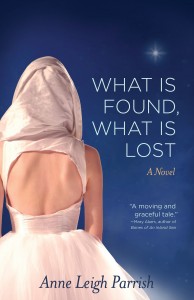 Anne Leigh Parrish’s debut novel, What Is Found, What Is Lost, came out in October 2014 from She Writes Press. Her second story collection, Our Love Could Light The World (She Writes Press, 2013) was a finalist in both the International Book Awards and the Best Book Awards. Her first collection, All The Roads That Lead From Home (Press 53, 2011) won a silver medal in the 2012 Independent Publisher Book Awards. She is the fiction editor for the online literary magazine, Eclectica. She lives in Seattle.
 This is nothing like the attitude of most writers toward their craft. The inner voice that guides the pen (or fingers on keyboard) is an intimate part of our selfhood. Writing expresses a quality of the author’s mind that seems to embody a higher personality. Even a soul. Until we frame experience in words, we hardly know what happened or what to think. At the same time, writing is a way of reaching out to people we could never meet in our physical lives, a point of contact with humanity. Or at least a hope for contact if we succeed in finding readers.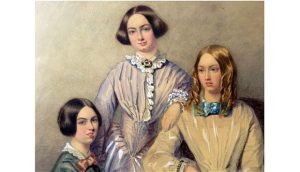



 When Linda and I were nineteen years old, we lived together for a summer in a one-bedroom cottage on the back lot behind an old rooming house in downtown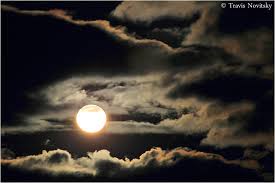
 Nell treated us to a mazurka. It was so inspiring, Linda and I drifted into the wheat field across the road. I don’t know who started it, but first we slipped off our shirts, then our bras, then our jeans. We glided between thigh-high rows of grain, brushing seed-beards with our fingertips. When she finished playing, Nell joined the fun. Our skins tanned an impossible bluish gold, we danced to a tune that lingered over the field, singing snatches of melody.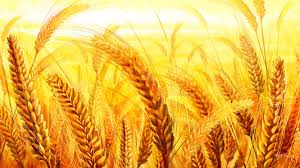



 The only possible comfort at this moment comes with the news that services went forward at Mother Emanuel yesterday. That thousands turned out on Sunday to march across the Ravenel Bridge, to show support for the victims and families. That survivors have declared, “Hate will not win,” amid their choice of forgiveness. These responses bring a glimmer of hope that outrage at this crime may strengthen the quest to overcome the gaping wounds of racism and gun violence in America.