by anesamiller_wuhi6k | Apr 24, 2015 | Blog, Issues in Our Orbit -- Substance Abuse & Recovery
 Substance abuse is an issue that I’ve been discussing with friends and visitors here on the blog lately. I have confronted this problem in my own life and wouldn’t wish the harm that drug abuse brings in its wake on anyone. But in the spirit of making lemonade when lemons come along, I have called upon those difficult experiences in my creative writing.
Today, a person close to me (who will remain anonymous) has agreed to tell her story of how drugs affected her family. As you would imagine, it was a painful journey for everyone. Scroll down, below the testimonial, for several links to resources that can be useful to those facing a similar challenge.
A Mother’s Struggle —
About 12 years ago a member of our family got into using drugs. At first, it was just experimenting. It probably started her first day of high school: out of the house, on her own more or less, because we sent her to a church school half an hour from our home (not to our local school). That space between home and school turned into a big enough crack for her to slip through.
Okay, I will say that this person was my own beloved daughter—the eldest of my three children. I won’t say more than that.
Over time when I became suspicious of what she was getting up to, I started searching her room and reading her notebooks. I did feel it was wrong to snoop through her personal things. At first I felt bad about that. You can imagine how a 14-year-old would scream about her privacy being invaded. Lucky for me, she never found out. Unlucky that I never found anything clear enough to bust her and try to put a stop to it. Not that I would have succeeded.
The trouble was that my daughter became a good liar. She could spin convincing tales of where she’d been after school, who she went with, etc., until I became desperate for any grain of truth. Of course, I could tell things were not right. Her personality was changing. In middle school, she had often been irritable, but now she would blow up over any tiny thing. She refused to help around the house, like she always did before, and her grades fell from excellent to okay to fair, and then poor.
It’s hard for me to think about those times. I feel guilty that I failed to nip problems in the bud. I knew she was getting up to something, even though her denials were always believable. But even when I KNEW her clothes smelled of pot or her words got slurred, she could put a good face on it. She would claim that she just tried a bit of beer or marijuana because other people she knew were trying them. Not her real friends—Oh, no! Her friends were not “like that,” they never would use nasty stuff. “Nasty” because she hated it when she tried it, and now that she knows what it’s like, she will never touch it again. YUCK!
Like, What’s wrong with people, Mom? Why do they do that?
She was much too clever to leave anything in her room or backpack or even a pocket. Never so much as one rolling paper or a bottle buried in the trash. Nothing definite, that’s what I’m saying.
I know that some parents have seen deceit like this, based on half-truths that pull you in. Other parents have not, because their kids are still reachable. My daughter had an instinct for what I would believe and what I would want to believe. It broke my heart to think that I could not get through to her, could not convince her to fess up and start fixing the problem. We used to be close. Couldn’t I still be her friend, somehow make her realize that I was on her side, even if she wasn’t a little girl anymore?
Before I wised up, it was like she had already come to believe that getting high was on her side. Drugs were on her side, her real friends. Not mom or family or people, at all.
 One time I slapped her in the face. She was bragging to a friend on the phone, using slang that I didn’t understand, but it was obvious she was bragging about something she had bought: What she had bought was expensive and important and a big secret. It sounded like she pooled money with a few others from her school. They would be selling it off in smaller bits to cover the cost. In other words, dealing. I was not in the room at the time, but her little sister was there and was overhearing the whole story. As I passed by the door, I caught on.
I saw that my older girl knew her sister could hear it all. She was bragging about this very bad thing in front of her sister, and she knew it.
That’s what hit me so hard.
I confronted my daughter. As usual she snowed me with lies. I slapped her in the face. 3 times I slapped her. I demanded she admit what she’d done. It was that desperate. She called me abusive and ran out of the house. It’s one of my most awful memories. I hate to think of it.
By the end of that day, I managed to get her set up in counseling. Sounds good, right? But this was at least the third time, over her junior high and high school years, that I got her into professional counseling. Something always came up to block any progress. For one thing, I know she tried to snow the counselor: She would talk about how unfair everyone was to her, and slip-slide over the heart of the matter. Or else she decided she hated the counselor (of which we had little to choose from), or my kids’ father refused to take part in the process.
This testimonial continues here. Links below provide helpful information on addiction and recovery. If you need to do additional reading, I’m offering a chance to receive $50 in free books through the month of April 2015. Click here for details.
Visit the Harvard Help Guide
Visit SoberNation
Visit Parent Treatment Advocates
Visit Gabbertsite from mental health counselor Gail Gabbert
And here’s a recent article from the New York Times on teenagers discussing what might have stopped them from using drugs.
by anesamiller_wuhi6k | Apr 22, 2015 | Blog, Issues in Our Orbit -- Substance Abuse & Recovery

The world awaits you…
Recovery Please, a haiku —
~ ~ ~ ~
Murmurs extending
into screams that can’t be quashed
recovery please!
~ ~ ~ ~
Thank you, Juan !
Here on the blog, I’ve branched out to a few new topics including recovery and substance abuse, which figure significantly in my writing. Other posts in this series maybe found here. (Scroll down for titles… and thanks for visiting!)
by anesamiller_wuhi6k | Apr 20, 2015 | Blog, OMG—It's CELEBRITIES!
This post is part of an ongoing series, OMG—It’s CELEBRITIES!, presenting well-known actors to play parts in (a fantasy) movie version of the novel Our Orbit. Click here for other items in the series.

Feisty?
Maybe I have mentioned that Our Orbit has a good-sized cast. In fact, I’ve been accused of featuring an ensemble at the expense of any one main character. That may be a discussion for a highbrow coffee klatch, but frankly, I fail to see the problem. There is no dead wood among the dramatis personae, by which I mean there are no characters who stand about like posts for the plot to race past, no so-called supporting figures who merely play straight man to the stars.
At least, that’s what I was aiming for. As to the outcome, you be the judge—please!
More to the point, the character I’d like to introduce today is one who plays a crucial role in several key scenes of the novel. She reveals a major secret, struggles to protect her loved ones, and stays true to herself as a nonconformist amid the staunch traditions of small-town Ohio. Her name is Claire Winslow, the only living first cousin of lead characters Miriam and Rachelle.

Cover design by Renee Garcia
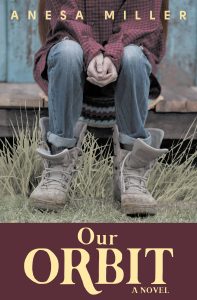
Our Orbit has a new cover, fully re-designed for the Booktrope edition!
My difficulty in casting the part of Claire for the imaginary film of Our Orbit lies in a notorious Hollywood tendency that one of our commenters noted a couple of weeks ago: Women are expected to please the eye and avoid expressing too much personality. This doesn’t suit Claire one bit! She tends to flaunt her inability to quite fit into social expectations: a fashion maven who wears a little too much gold jewelry but doesn’t boast a pretty face or sexy figure in the customary sense.
In short, women who might be a shoe-in for the part have largely been kept out of the American film industry, or have at least been kept off-screen! Even so, I considered the “available” talent, and here’s what I came up with—
Star of Orlando, The Chronicles of Narnia, and The Grand Budapest Hotel, the amazing Tilda Swinton has an unconventional face, angular form, and spiritual quality that would fit Cousin Claire to a T. Ms Swinton (pictured above) manages to convey inner strength even in scenes of remarkable vulnerability. I would LOVE to see her bring Claire Winslow to life…except for the inconvenient fact that she is simply too gorgeous! And maybe not feisty enough.
No doubt a more obvious choice would be Taryn Manning who portrays the colorful meth addict Pennsatucky in Netflix’ hit series Orange is the New Black—

A definite maybe
Taryn’s got the Appalachian chops, no question, and she has done dramatic work in Hustle & Flow and other films. I’m just not sure those big plusses are enough to outweigh the fact that, while she can certainly do feisty, she’s quite a tiny woman. Claire needs to be an imperious figure, certainly taller that her 14-year-old cousin Rachelle. So the creator of my favorite ONB player might not fit in the movie, after all.
Which brings me to that 2nd-youngest-ever Oscar winner (for The Piano, 1994), as well as most intrepid X-Woman and vampire, Anna Paquin. Talk about range of acting ability! I think Ms Paquin has surprised us all by her skill in appearing lovely and graceful while sporting such unconventional features (in Hollywood, at any rate) as gap teeth. These are promising qualities for the woman to portray Claire. Definitely my best candidate!

Chills!
~ ~ ~ ~

I must add a brief tribute to one of the world’s most beautiful actresses, who hid her own dazzling eye-candy for the sake of a challenging role. Kudos to Charlize Theron for revealing the frightening humanity of Aileen Wuornos in the film Monster. I’m sure it was a tough job, but she had the courage to do it. (Sorry, I can’t seem to find a “non-proprietary” photo of the actress as herself. Better google it!)
~ ~ ~ ~
What do you think? Share your thoughts, impressions, complaints, and candidates for these movie roles in the Comments section below. Thanks for visiting my blog today! Feel free to nose about the website and let me know if you like what you see, or if you have suggestions. You can reach me by clicking the Contact link at upper right (or just click here). And please consider subscribing to my blog or newsletter. Stop by again soon!
by anesamiller_wuhi6k | Apr 17, 2015 | Blog, Issues in Our Orbit -- Substance Abuse & Recovery
Imaginative writing is often inspired by the conflicts of everyday life. In our society, where we may find ourselves stressed to a breaking point, conflict can reflect pressures we don’t even understand. In an effort to reach beyond fiction toward the real-world tensions that inspired my novel, Our Orbit, I’m introducing a few new topic categories here on the blog. You’ll continue to find items on the craft of writing, literature, and publishing. But since Our Orbit delves into the challenges of family life, I’m also branching out to parenting, including addiction and recovery among teenagers. Here is an offering on this topic, along with links to sources of help and information.
 The painful question in the title of this post is one that worried parents ask each day in thousands, if not millions, of homes across all continents. This timely article is was written by Mr. Robert Hunt, a youth recovery coach and wellness advocate, re-posted from SoberNation by permission of Mr. Tom Stoddard, founder of that website, which is dedicated to building community by and for people in recovery from addictions and related problems.
From Recovery Coach Robert Hunt —
Adolescent drug addiction treatment can incorporate a number of different approaches, procedures, and timelines, depending on the adolescent. In our experience, the most effective treatment plans are those that are holistic and individualized, meaning they incorporate different approaches and therapeutic processes, all dependent upon the specific adolescent’s individual symptoms, needs, and unique situation. Three of the most important aspects of an adolescent’s experience that should always be incorporated into a treatment plan include Co-Occurring Disorders, academic struggles and support, and family support.

CLICK THE PIC FOR DETAILS.
First of all, it’s extremely common for adolescents who struggle with drug or substance abuse to also suffer from a Mental Health disorder or learning challenge. At times, these symptoms may overlap with those of the drug abuse addiction and effects, thus making it difficult to know which symptoms are attributed to which disorder. Because of this, unfortunately it’s common for teen Co-Occurring disorders to go undiagnosed and consequently untreated. In these cases, teens may recover from their addiction and abuse but still be suffering from the other disorder, which will leave them vulnerable to stress that can trigger relapse. Therefore, the importance of careful evaluation and thorough diagnoses in Adolescent Drug Addiction Treatment can’t be stressed enough, as it’s the foundation upon which recovery is built.
Secondly, adolescents living with addiction and/or abusing drugs often are struggling in school. Because school is such a central part of adolescents’ lives, experiencing such struggles or failure can quickly lead to serious loss of self-esteem, and together with drug use, can add to the adolescents’ withdrawal from others. These academic difficulties will hopefully be realized within talk therapy sessions and careful consideration of possible learning disabilities should be made as well. While in treatment, adolescents should be provided real-life academic support such as tutoring, to help get the students back on track. For adolescents, success at school is pivotal to success in their lives.
Lastly, Adolescent Drug Addiction Treatment plans should include the family members, to help heal what damage and hurt has been done, re-build relationships, and create a healthy environment for everyone to thrive in together, amidst the adolescent’s recovery. In our treatment plans, we always provide parents with individual and group family sessions, in order to provide parents the support necessary to move forward.
Again, because Adolescent Drug Addiction Treatment is different for every adolescent, there is certainly no one right way for it to be done. However, in our experience these three aspects prove consistently important in supporting our adolescents to achieve true and lasting sobriety.
 About the author – Robert Hunt is a recovering addict of 20 years. He has devoted his life to helping others suffering from chemical addictions as well as mental health challenges. Robert maintains many blogs on drug addiction, eating disorders and depression. He is a sober coach and wellness advocate and a prominent figure in the recovery community.
Visit Robert Hunt’s blog | Follow him on Twitter @RecoveryRobert
Visit SoberNation | Follow @SoberNation
Visit Parent Treatment Advocates
♥ Don’t forget to sign on for the great GIVEAWAY through April 2015: Win $50 in free books from Powell’s of Portland! Support indie writer & bookstore.Click here! ♥
by anesamiller_wuhi6k | Apr 14, 2015 | Blog
Author, author!
Take heart, Gentle Reader! Author and recovering print & broadcast journalist Sarah Scott is here to rap all our knuckles, er, to provide a pep talk on proper English. “Read & Lerrn”: that’s my motto!
Sarah Says —
What grammar goof sets your teeth on edge, makes you seethe with snobbish intolerance? If you’re coming up with nothing, then you might want to stop reading at the end of this sentence. If you are in the other camp, the one pitched on the temple grounds of correct usage of our mother tongue, then please read on and offer your own grimace-inducing examples in the comments section below.
Throughout the month of April, each comment on the blog earns a chance to win $50 in free books from Portland’s indie store, Powell’s City of Books. Over 4 millions titles to choose from — no downside! Click for details—
Before I list mine, let’s begin with the (yeah, yeah) agreement that English isn’t sculpted in marble, never to be improved upon, revered in its fixed state forever. We all know that what once was acceptable (e.g., “ain’t” and double negatives) is no longer considered appropriate. It’s also true that the stickler choice isn’t always the best. If I were to say, “It’s not I,” you might well think I am a pompous tush, with said tush as stiff as a week-old cadaver’s. “It’s me,” just sounds better, doesn’t it?
That caveat out of the way, I offer my grammatical equivalents of nails on a blackboard:
1) “More unique” or “rather unique” or any qualifier at all before unique. Either it is or it isn’t.
2) “More (or most) importantly” rather than “more (or most) important” in a sentence such as this: “Most importantly, we have to consider that we should be grateful people still use the spoken word to communicate anything at all these days.” Most important, it’s not an adverb we’re after.

SUPPORT INDIE WRITERs & BOOKSTORE! CLICK THE PIC FOR DETAILS—
3) Okay, here’s a really picky one. I was reared to make a distinction between “healthy” and “healthful.” (And I was reared to say one rears children and raises tomatoes.) Back to my whine. A human being is healthy, because his or her diet is healthful, full of vitality. I suppose a carrot could be both healthful and healthy, depending on its condition.
4) “Who” when “whom” is warranted. This blunder appeared in a recent online article in The New York Times: “Ms. Lazarus, who [sic!] New York magazine called ‘the Martha Stewart of weed baking’ makes confections….” Perhaps this writer should be excused for delving too deeply into the subject matter. Some grammarians claim this one doesn’t matter anymore. My retort: for whom?
5) “Less” when “fewer” is correct. The most pervasive usage of that goof, of course, is at any grocery store’s checkout section: “Express Line: 12 or Less Items.” If anyone knows of a grocery that uses “fewer,” please gladden my heart by telling me. I’ll write the manager a thank-you note.
6) This last one probably is on your list too. It’s the one NPR’s listeners chose as their most detested grammar peeve. Yep, it’s using “I” instead of “me” as the object of a preposition. “Would you like to come to dinner with Jim and I?” “She sat next to Mary and I.” “Could you bring around the car for Ed and I?” Sadly, the mistake is made by people who want to sound intelligent and literate, poor dears, and are convinced “me” is substandard English. These well-meaning folks would never say, “Come to dinner with I” or “Sit next to I.” In a phone call not long ago, I heard myself say defensively, “That will work for my husband, and it will work for me too,” just so the customer service guy on the other end wouldn’t think I was ignorant and stupid to boot!
If you’ve read this far, you too might be aware of a recently published book by Mary Norris, copy editor for The New Yorker, titled Between You & Me: Confessions of a Comma Queen. It’s said to be as funny as Eats, Shoots & Leaves by Lynne Truss, but presumably with fewer punctuation errors than that book on punctuation contained.
My blog host Anesa might want to throw in a few of her own grammar gripes in the comments, and I know we both want to hear yours. As for any errors you might find in this guest blog that you think are my failings, they were inserted by the NSA during email transmission.
Sarah Scott is the author of the mystery Lies at Six: “A thriller’s pacing. Vivid Southern locales. Witty dialogue and wry observation about what passes for news on TV…and truth in our lives,” available as an e-book and in print. She lives in remote Ashford, WA, at the entrance to Mt. Rainier National Park. Her husband Bill Compher has been recognized worldwide for his imaginative treehouse designs: Visit cedarcreektreehouse.com for lodging and tour information.
♥ Don’t forget to sign on for a great #GIVEAWAY through April 2015: Win $50 in free books from Powell’s of Portland! Support indie writer & bookstore.Click here! ♥


 Substance abuse is an issue that I’ve been discussing with friends and visitors here on the blog lately. I have confronted this problem in my own life and wouldn’t wish the harm that drug abuse brings in its wake on anyone. But in the spirit of making lemonade when lemons come along, I have called upon those difficult experiences in my creative writing.
 One time I slapped her in the face. She was bragging to a friend on the phone, using slang that I didn’t understand, but it was obvious she was bragging about something she had bought: What she had bought was expensive and important and a big secret. It sounded like she pooled money with a few others from her school. They would be selling it off in smaller bits to cover the cost. In other words, dealing. I was not in the room at the time, but her little sister was there and was overhearing the whole story. As I passed by the door, I caught on.






 The painful question in the title of this post is one that worried parents ask each day in thousands, if not millions, of homes across all continents. This timely article is was written by Mr. Robert Hunt, a youth recovery coach and wellness advocate, re-posted from
 About the author – Robert Hunt is a recovering addict of 20 years. He has devoted his life to helping others suffering from chemical addictions as well as mental health challenges. Robert maintains many blogs on drug addiction, eating disorders and depression. He is a sober coach and wellness advocate and a prominent figure in the recovery community.