The fiction bug bit hard, back when I was employed as a foreign-language teacher and should have been working on my dissertation on Tolstoy. Call it procrastination, but nothing brought me so much delight as a couple of stolen hours with a legal pad and row of needle-sharp pencils.
The short stories and novellas I produced in those early years were mostly unreadable. Surely, the way to prove that one is a writer is to use lots of long and difficult words! Or so I opined at the time. Steeped in academic language, I struggled to keep my sentences down to half a dozen dependent clauses, max.
Ah, the days when every word was precious!
Once I finally climbed down from the ivory tower, it was time to improve my style. I read Alice Munro and began to grasp how to shape a sentence, read Carolyn Chute and sensed the chemistry between characters, read Marquez and grappled with the dream that is an enthralling narrative. Small vignettes and short-shorts proved a good place to hone my craft. Several of those found homes in literary magazines—a thrill for the starry-eyed novice.
The short story form remained my nemesis. To this day, I consider it a lofty pinnacle of prose artistry, and have often said I hope to never write another.
But while ideas continued to swarm, and before I worked up the nerve to tackle a larger project, I labored in the fields of short fiction. I longed make readers pause and see fellow humans in a new way. Don’t people drive us crazy with anger, love, hysteria, amazement, and every possible emotion! I struggled to present characters that would help readers recognize their fellows—our fellows—with a bit more compassion than before.
One of my short stories at this time went by the cumbersome name “Gravitation of the Spheres.” Please be kind and consider it a throwback to my academic career. Other titles came and went, all equally bad. Despite the abstractly philosophical name, the tale was a simple one: a nine-year-old girl loses her parents and is thrust into foster care. A kind family takes her into their home. Connection ensues along with various conflicts. Crisis, resolution, THE END.
But this story gave me no rest. In one draft, I expanded the plot with new episodes. Then cut every expendable word to tighten things up. “Leaner and meaner” was supposed to be better and better, or so minimalists would have us believe. I revised that story so many times, my head began to spin. I had no idea which version might be better than another.
Kenyon College had the advantage of being within a 3-hour drive of my town. More importantly, this is the home of the prestigious literary magazine that launched work by such luminaries as Alan Tate, Robert Penn Warren, Robert Lowell, and many others. If Ohio has a literary Mecca, I reasoned, this must be it!
All a-tremble with excitement, I joined a group of 12 acolytes studying with Nancy Zafris, a winner of the Flannery O’Connor Award for short fiction and a formidable presence. She forced us to realize the power of each word while becoming attached to none (Kill those darlin’s). Awed by Nancy’s skill with tone and structure, I felt no one could better advise me how to transform my troublesome story into the brilliant narrative it was meant to be.
But are they “Gravitating”?
Nancy graciously agreed to read “Gravitation of the Spheres.” She convinced me to reconsider the title and gave some pointers on focusing the plot. But it was her parting remark that helped me keep faith with the story for years to come: “Brush it up and send it out.”
So my strange little tale was in the ballpark of publishable material!
This 4800-word opus acquired the name “Our Orbit.” Not sure why I was determined to stick with cosmic imagery when this theme is not essential to the plot. I’ve gotten a bit of criticism despite the great improvement over previous titles. One widely published author told me that first person (“Our…”) was inappropriate, given that the story is written in third. And a couple of readers said they were misled to expect a sci-fi tale.
I hoped my eventual readers would accept the metaphorical sense of an “orbit.” Then I stumbled upon this same small phrase in Harper Lee’s To Kill a Mockingbird. There it’s used to describe Scout and Jem’s daily routine of play and exploration. This is not a major passage in the classic book, but it seemed so resonant with my story, I wasn’t about to give up the title from then on.
As for sending it out—first, I tried journals at the top of my wish list: Pleiades, Five Points, Prairie Schooner, Agni. Guess what happened! Soon moved on to a slightly humbler tier: Ascent, Spindrift, The Green Hills Literary Lantern. Eventually, I was scraping the bottom of the litmag barrel: Dodohebdo, DoTell Motel, Tales from the Hip, and FicLines. (Not their real names!) As discouragement set in, it was back to the legal pad many times over. For the next eight years, I sent the story to at least 50 different magazines, several of them more than once.
Luckily for my flagging spirits, I succeeded in publishing other stories during this time—even one at The Kenyon Review. So what was the problem with “Our Orbit”?
No other story of mine garnered so many comments from editors scribbled at the bottom of rejection slips. One apologized for keeping “Our Orbit” on his desk for 8 months. He felt it wasn’t “ripe for acceptance” but couldn’t quite bear to reject it either. He found his mind “cycling back to it.”
At least half a dozen editors wrote that the story needed further development. Independently, several agreed that it could—even should—be expanded.
It had the makings of a fine novel.
This was not something I wanted to hear. Already at work on a novel, I had gained insight on the time and effort required for such a project. “Our Orbit,” by contrast, was just a practice piece. Not bad, but no major opus. Something to get off my desk and onto my publication list—not a sinkhole for endless tinkering, a baby bird demanding food to grow.
But art is like a higher power. Not unlike God, it “disposes,” regardless of what we humans propose.
Soon enough, I had finished two other novels. With no agent or publisher in sight, discouragement set in hard this time. Fiction was a cruel master. I tried writing essays and poetry: anything to keep up my skill with words. Then, my husband was invited to apply for a job in the Pacific Northwest, 2000 miles from our home. This opened an opportunity for me to enter an MFA program in creative writing.
One more way to keep working, to stop myself from giving up.
So in August 2005, we were preparing to relocate across country. In our Ohio backyard one warm night, I wondered how I would get along without my garden. I looked up at the sky, but didn’t focus on the stars until I realized that they were falling. It was the Perseiad meteor shower that comes every year in late summer.
What are they, really?
Beautiful lines of light streaked the sky. And with them, a thought popped into my head. A perfect scene for “Our Orbit”: My fictional family hurries outside to see the meteors. The children ask questions…parents try to explain so the little ones can understand.
So many falling stars—is it an omen, or a mere fact of nature?
This unfolded into a scene for Our Orbit the novel. Same plot as the story, but with more people, more fully fleshed characters interacting in more complex ways. It became my thesis in the MFA program at the University of Idaho. It took 5 years to create a complete draft. I was convinced it would become my first mainstream, publishable novel. For 2 more years, I would search for an agent—would give up, try again, and give up again.
“Now, Our Orbit will be re-issued by Sibylline Press in 2025.”
Now, Our Orbit will be re-issued by Booktrope Publishing on June 23, 2015.
~ ~ ~ ~
Thank you so much for visiting my blog today! Feel free to nose about the website and let me know if you like what you see, or if you have suggestions. You can reach me by leaving a comment in the box below or by clicking the Contact link at upper right (or just click here). Consider subscribing to my blog or newsletter. Stop by again soon!
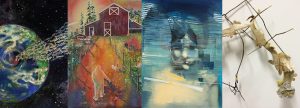
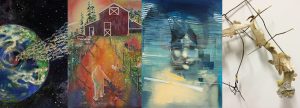
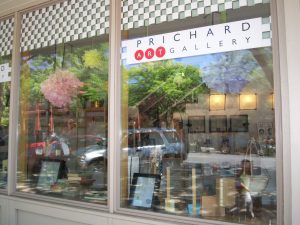
Poet Georgia Tiffany and the multitalented Ryan Lawconceived an unusual brain child in Endangered, a collaborative project of visual arts and poems by 30 participants. The poets and artists, all of whom live and work on the Palouse of eastern Washington and north-central Idaho, were asked to freely interpret the concept of being “endangered.” An exhibit of the resulting works opens on May 21st, 2015, at the Prichard Art Gallery under the auspices of the University of Idaho College of Art & Architecture. A reading and reception are scheduled for the 21st from 5 to 7 p.m. with music provided by John Paul Shields. The exhibit will remain open through June 6th.
Downtown Moscow, Idaho
~ ~ ~ ~
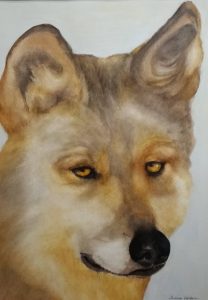
Poets and visual artists worked in pairs on Endangered, drawing inspiration from one another. Anesa Miller was assigned to work with the painting “Mexican Gray Wolf” by Jeanne Wallace. Anesa says, “It’s a remarkable portrait, just as one would see a commemorative likeness of a human face. I began to hear poetic rhythms the moment I saw this painting.” See this pairing of poem and artwork below.
~ ~ ~ ~
Listen to the poem Homo Sapiens Under Siege
by Anesa Miller (1 minute 16 seconds)
The wolf is at the door.
Keep your weapons near.
They’ll overrun
the land we love.
Our children shake with fear.
“Mexican Gray Wolf” by Jeanne Wallace
The wolf lurks just outside—!
They range around the yard.
We’ll know no peace
until they cease.
Be always on your guard.
Let’s take them from above,
from the safety of a plane!
We’ll lay them low
in fields of snow,
their fight and speed in vain.
Because—
They hound the innocents,
rapacious woodland gang.
The doe knows dread
till her throat runs red.
None can outpace the fang.
The wolf is on the prowl.
They howl beneath the moon.
They rip the sky
with yip and cry.
They’ll feast upon us soon!
Their hunger never ends.
They bound behind the sleigh.
Toss the baby overboard—!
to keep blood lust at bay.
~ ~ ~ ~
Click here for directions to the Prichard Art Gallery in Moscow, Idaho. Visit Endangered between the evening of May 21st, 2015, and June 6. Click here for hours.
Moscow, Idaho, has a population of approximately 25,000. The town is said to be named after the home city of a Russian immigrant who established a trading post in the area in the 1860s.
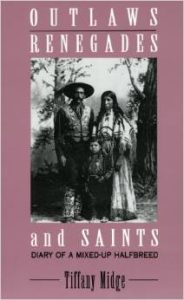
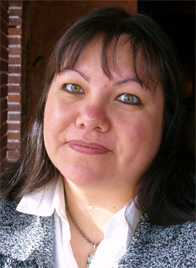
Tiffany joins me today for a chat about her new appointment— AM: Congratulations! April 2015 marked the beginning of your 3-year term as poet laureate of Moscow, Idaho. I have to admit, I was surprised when I heard about this—not that you would be appointed, but that Moscow even has a poet laureate! Is it common for a small city like Moscow to offer such a position?
Tiffany Midge (TM): I can’t say for certain, but I do know of a couple of other small-town poets laureate, and I know of several current and former state poets laureate.
AM: How long has Moscow has followed this practice?
TM: This is the first time! The arts council only recently created the post, and it was advertised for people to apply. I’ve always held that I aspired to be Poet Laureate but would settle for Poet-Want-Fries-With-That. And, of course, I often joke about holding the Distinguished Writer in Residence at Moscow/Pullman Highway’s Jack–n-the Box. But this is for realz. I’ve come up in the world!
AM: What are some of your responsibilities as poet laureate?
TM: (Refers to a printout.) Okay, my mandate is “to raise the visibility of poetry and other literary arts within the community through outreach, education, and other programs.” Part of what that means is, I’ll be offering at least one public poetry workshop per year; I’ll be writing and sharing at least three poems per year that “speak in some way to the distinctive character” of Moscow; and I’ll give two or more local readings at “civic functions” like the Art Walk.
AM: Sounds like a busy agenda but pretty good fun.
TM: That’s what I said!
AM: I want my readers to know that you’re an enrolled member of the Standing Rock Sioux Reservation and you’ve always taken a big interest in Native American authors and artists, among other contemporary work. Is Moscow a positive locale for such artists to present and share their creativity?
TM: There have always been events here on the Palouse that celebrate indigenous culture.
“The Palouse” refers to a geographical region characterized by a unique geological history. It spans much of southeastern Washington state and north/central Idaho. The name is derived from the French for “grass” in probable combination with the name of the Palus or Palusha tribe.
TM: One of the more exciting and interesting events took place in 2011, when UI’s English Department and other community folks organized Hoopaloosa.
“The name, HooPalousa, is a play on words, Hoops and Palouse, basketball and the region where the university is located and appropriate for a game of hoops with writers known for playing with words.” Hoopaloosa has been described as “a fun [basketball] game between the Moscow SuperSonnets, representing the University of Idaho, and a team from the Spokane area called the Spokane Dirty Realists.” The purpose was to raise money towards funding an annual Graduate Writing Fellowship for a Native American student/writer. The game was organized by novelist and memoirist Kim Barnes of the University of Idaho creative writing faculty. Star attraction of the game was National Book Award winner Sherman Alexie who came to Moscow from Seattle to play on the Spokane team.
TM: Also, last spring Natalie Diaz—a sensationally talented poet—was invited and came here to give a reading. And last fall our local bookstore, BookPeople of Moscow, hosted a launch reading of Yellow Medicine Review—an Indigenous literary magazine that I guest-edited and which featured several local writers.
AM: How about your own work as a writer? What have been doing lately, and will it tie in with your new public role?
TM: I’m looking forward to my collection of poetry The Woman Who Married a Bear coming out next year—March/April, 2016, from the University of New Mexico Press.
TM: That’s right. But more recently I have been writing prose—a couple of novels and some essays. I expect my poetry will tie in with the laureate post, the three or more poems per year that I’ll present at public events. I’m looking forward to a couple of events coming up this spring: The first is the Endangered Project, which is a collaboration between visual artists and poets to be presented in May.
The Endangered Project is an undertaking of visual arts and poetry organized by local artists in the Moscow area. The theme of “endangerment” was interpreted freely by each participant. Works will premier at a public opening and reading to be held in downtown Moscow at the Prichard Art Gallery on Thursday, May 21, 2015. The exhibit will run through June 6.
TM: Then in June, is the launch of another project that’s new to Moscow: poetry bus broadsides. Several broadside posters are being created by the very well-known Broadsided Press.Elizabeth Bradfield is producing mine: it’s a sonnet about Spring Valley Reservoir [just south of Moscow] and the bird life one encounters there. The artwork is by Ryan Law. There will be a launch event on June 12 at 4PM at the transit station where the broadsides are to be hung (or they might be on the inside of buses, that’s still unclear). This will be part of the Moscow Art Walk.
“’Smaller communities can give the art a more intimate feel because you’ll often know the artists or author of the work you see on the side of the bus,’ says Elizabeth Bradfield, founder and editor-in-chief of Broadsided Press. Bradfield is excited to have the partnership with Moscow, because it blends the local and national side of art”. — The Daily Evergreen,Washington State University’s student newspaper, 4/22/15
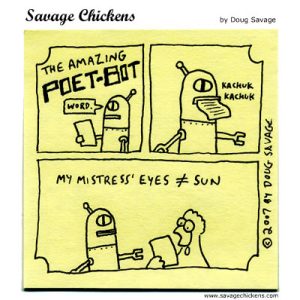
With thanks to www.savagechickens.com!
AM: I have to confess, you are such a great humorist, that when I first saw your post on Facebook where you mentioned becoming Poet Laureate of Moscow, I thought it might actually be a parody or joke of some kind. Don’t get me wrong: I love Moscow, and I’m thrilled that we now have you to be our special poet. It’s just that I tend to think of public poets as establishment figures—reading on solemn occasions with no hint of comic relief. Can you set me straight on this?
TM: One of the characters in my novel said, “humor is a veil for fury.” I’m still sorting out exactly what that means. In response to your idea that public poets are “establishment figures—reading on solemn occasions without any irony,” I find that in and of itself very funny: as if life should be a humorless occasion!
I was always that kid who was stifling my giggles in church. I once published a humorous essay about attending my mother’s funeral. Irreverence. Sad clowns. There is so much atrocity and brutality in the world, I can’t help but want to pursue the flip side to that, especially in my writing, if for no other reason than to maintain my sanity.
So often we hear that people don’t like poetry. That poetry doesn’t make sense. I once had a high school student say that poetry was pretentious. I think that using humor in poetry helps to debunk those kinds of notions. Humor potentially takes out the “Ivory Tower” mystique and makes poetry relatable to everyday life, because it can and does bear witness to our everyday activities. It heightens and enlarges them, endowing them with purpose and meaning. Humor invariably disarms us, catches us off guard, and brings the pleasure of connection.
AM: There are, no doubt, many details of a public poet’s role that I don’t even know to ask you about. What would you want people to understand about this role?
TM: A poet whose name I can’t remember said something to the effect that poetry should be a dance around the fire. And in many other countries the role of a poet is very highly regarded. Poetry is consciousness-raising. It incites, it reckons, it entertains, it educates. It’s reportage. It acts as a thousand and one things, but it remains marginalized within our broader mainstream culture. Yet, we use language constantly! We are speaking in pure poetry every moment and aren’t even aware of it! Our most mundane activities are relayed to the people around us, and there are so many gems to be mined in those exchanges.
AM: Tiffany Midge, congratulations for serving as our first poet laureate of Moscow, Idaho. Thank you, and thanks, too, for speaking with us today.



 Tiffany joins me today for a chat about her new appointment—
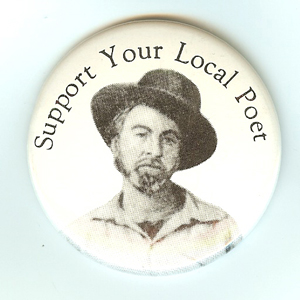 AM: What are some of your responsibilities as poet laureate?