by anesamiller_wuhi6k | Mar 13, 2014 | Blog, Series: Drawer no more!
My first adventure in self-publishing dates back to the mid-1990s. Under heartrending circumstances (more on that later), my fiancé at the time offered to pay for printing a small book of my poems. I had written several poems for him, addressing his sorrowful circumstances, which partly motivated his offer.
Even so, his generosity blew me away.
In a whirlwind of action, I reconsidered all the verses I’d ever penned that remotely fit the poetic topic of loss. I contacted a printer in the nearest town of sufficient size to have a printer. Prevailing on friendship, I recruited a local artist to create illustrations and advise me on stock, color, fonts, illuminated letters, and all such visual elements. Within weeks, I had selected a manuscript of 20 poems and made plans for a 64-page perfect-bound chapbook to showcase them.
With eager anticipation, I showed these plans to my fiancé, Jaak (pronounced Yahk, it’s a common name in Estonia, where he was born). He smiled and nodded until I whipped out the printer’s quote. This marked a shift in attitude, almost like a sudden drop in temperature. I had kept him up to date on every step of the planning process. But now, he seized a handful of paper from his inkjet printer and proceeded to demonstrate how efficiently one can fold several 8.5 x 11″ sheets and tape or staple them by hand. Voilà! A nice little booklet! Illustrations? How convenient they’re pen-and-inks—a cinch to photocopy! No, no, sweetheart—you didn’t waste time driving 50 miles to the printer to pore over expensive papers. It’s always worthwhile to see how professionals operate.
But let’s be reasonable, can’t we?
I’m afraid not. First, you urge a hungry writer to picture her name on the cover of a perfect-bound book, then you break the news that what you really meant was a home-assembled saddleback?
I’m afraid the scene wasn’t pretty. Language was used that I prefer not to remember as I accused Jaak of backing out after he—and he ALONE, with no wheedling on my part!—had raised my hopes to the lofty level of 64 pages and a card stock cover. That was an especially bitter pill: in order to keep the price down to (what I took as) a reasonable figure, I had foregone the fancy C1S (coated 1-side) cover, virtues of which my salesman refused to shut up about. AND NOW YOU’RE SNATCHING THOSE PRETTY DREAMS AWAY, LEAVING ME TO STAPLE LOOSE-LEAF COPIES FROM THE XEROX SHOP?!!
How could I claim that the book was really even “published” if it were a mere mock-up like I often made for my children, decorated with crayon drawings? How could I put an ISBN on that?
So my first self-publishing venture was marked by painful conflict.
This being a true confession, I must return to the fact that Jaak was deeply bereaved. At the time I’m harking back to, a couple of years had flowed under the bridge since the terrible night when his teenage daughter, Tiina, was killed on the highway south of town by a drunk driver. But the death of a child is a blow from which a parent never fully recovers, so that dreadful night was still fresh for my man, and my poems were meant to aid his healing. Instead, there I was putting vanity above compassion as I protested his stinginess after the fact.
(In my defense, I had sacrificed my eyesight, going from 20/20 vision to my first-ever pair of prescription glasses, helping Jaak put out his book, which I edited developmentally over a period of two years, then helped copyedit and proofread. Please bear this in mind before judging me harshly…)
Heaven sent down a few mercies, and as it turned out, a small grant materialized. I got my perfect-bound booklet of 64 pages with 2-color cover and professionally photographed illustrations. The end result was quite lovely, and Jaak declined to hold a grudge over my petulant outburst. In fact, as my husband, he remains willing to this day to support my further adventures.
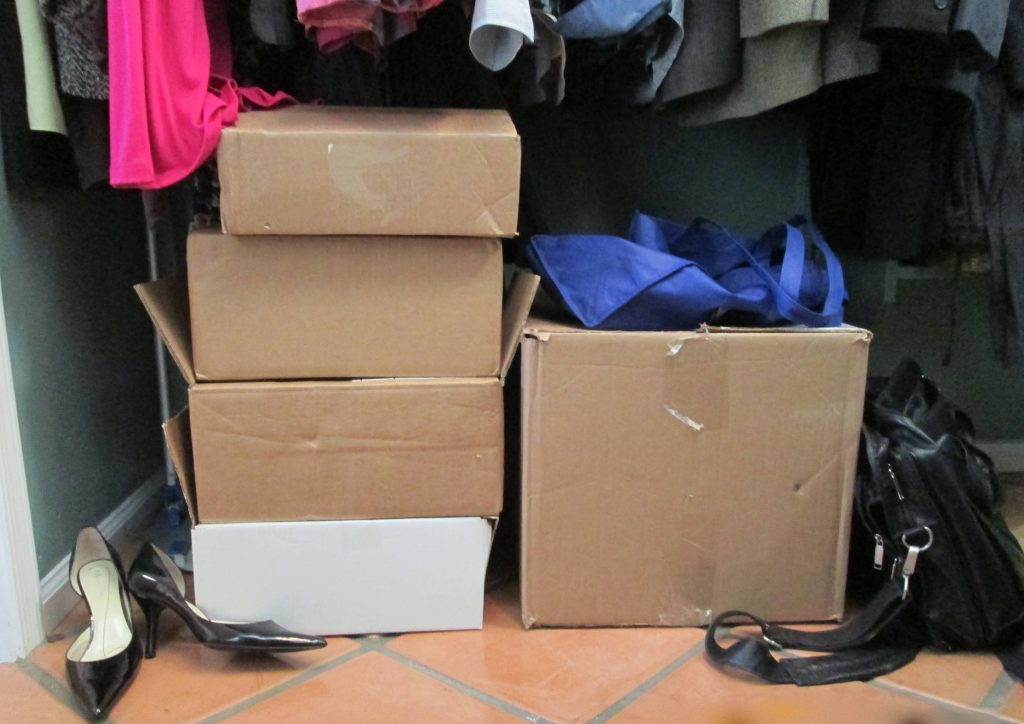
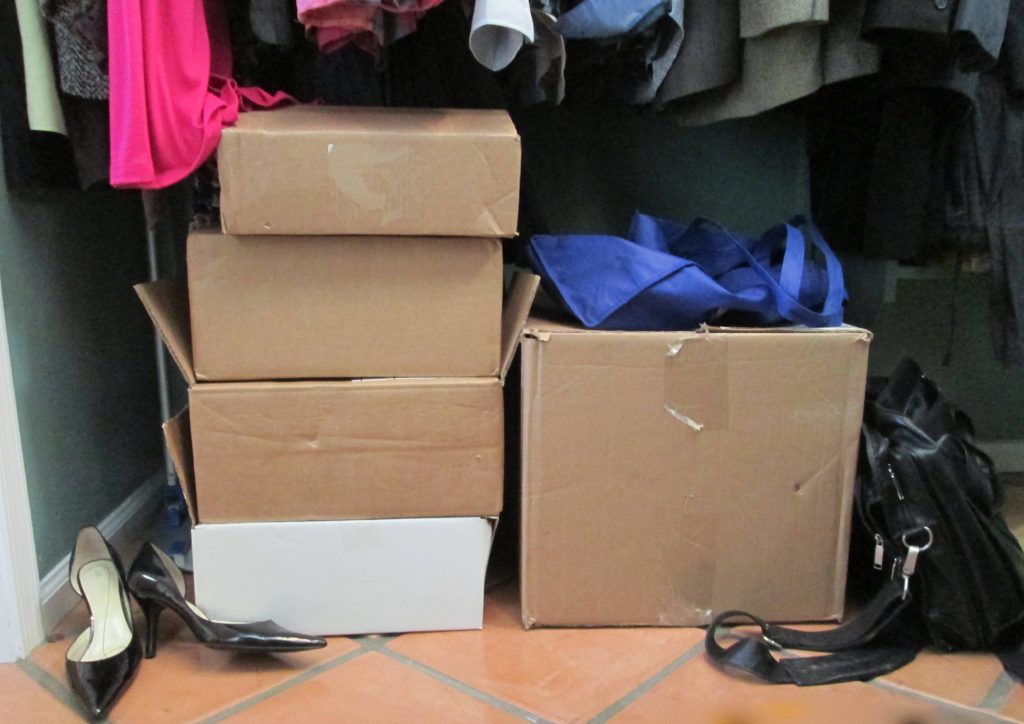
Nonetheless, that early foray still provokes nightmares. I mentioned the difficult decision of turning down the C1S cover, despite the claim that it would lead to “reliably brisker sales.” How embarrassing to admit that I, a sane and relatively well-educated adult, believed my poetry book would sell! Everyone familiar with self-publishing in that pre-electronic era knows my next confession: I have nightmares of posthumous embarrassment, imagining how my descendants will find those cartons of books stacked in the garage. Oh—and here’s another pile in the attic! And, my gosh—even more in the hall closet!
You mean they didn’t fly off the shelves, after all?
Self-publishers used to hock hard copies of books from the trunks of their cars. Now there’s been a revolution with the advent of e-readers and online retail bringing costs down and boosting accessibility. Has this solved the problems of sales and distribution? Tell me what you think—please feel free to comment on these or related matters.

by anesamiller_wuhi6k | Mar 5, 2014 | Blog, Series: Drawer no more!
As you can easily figure, through all the years of submissions and rejections, publishing a book was my ultimate goal. Or my pipe dream, as it seemed. I produced two full-length manuscripts of poetry, one of short stories and one of essays. I attended writers’ groups and book clubs. I wrote three novels, appealed to agents and editors, researched small presses (which always seemed to cut off submissions the week before I discovered them), and I paid tidy sums for critiques of my work and my query letters.
All to no avail.
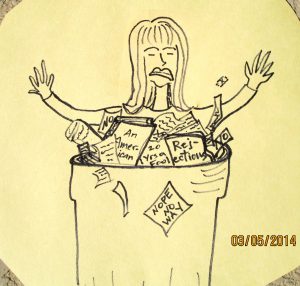
One bright morning, sometime after my collection of rej slips topped 2000, I opened the manuscript drawer and started shoveling. All those pulped trees and heartfelt phrases that no one cared about (except me, who didn’t seem to count) weighed like an albatross around my neck. A ton of stuff that didn’t deserve to see the light of day went straight to recycling.

But as I wheeled the last bits—the best of my rejected work—down to the curb, a fresh thought dawned in my sorrowful brain.
Why not publish some of it myself?
Please bear in mind: self-publishing is not what I had ever wanted. Well, okay, here’s a true confession: for one minute, almost 20 years earlier, I did want to self-publish a book. My fervent desire to NEVER do so again is a direct result of that ill-fated experiment. I have spent nearly every day of the subsequent decades yearning for the other kind of publication: the knight-in-shining-armor kind, where my work, on its own stellar merits, attracts a caring agent who finds an intelligent editor at a major publishing house just dying to produce my work and promote it to all the world, which of course comes flocking to buy and read!
Oh, God—Farrar, Strauss & Giroux! Yes, yes—W. W. Norton! Don’t stop—Knopf, Penguin, Random House! Such was my fantasy life, year after year after year. (Dare I imply that these Great Houses f*ck their writers? Do writers delude themselves into believing traditional publishers offer the best arrangement since wine started coming in bottles?)
In short, after all that unrequited lust, you can imagine how hard it was to accept the new idea dawning upon me. I resisted furiously, drummed up excuses why self-publishing was wrong for me—even if other writers were embracing the process left and right. For example—
I hate e-books.
I don’t speak mobi and don’t intend to learn.
Arcane formatting makes me break out in a rash.
Don’t trust the term “creative team.” Don’t work well with others after years in that lonely garret.
Can’t find a competent copyeditor, proofreader, designer, illustrator, or other members of that team I don’t trust.
Can’t tell a shyster from a legit author’s services company.
POD what?
And on and on.
But more compelling than any excuses, all the while I wallowed in my stalling tactics, the characters in my latest novel kept speaking in my ears. Their babble of voices told me, “You owe it to us to try! We want out to see the sunlight! You know people will love us if they only get the chance. We don’t care if it’s not Knopf—just publish us. We’ll do the rest.”
What could I possibly say to that?
Tell me what you think: Does corporate publishing make off with too much of the pie while writers starve in their garrets? Is it fair for the house to take the major cut even on low-overhead e-books? Please feel free to comment on these and related matters.
by anesamiller_wuhi6k | Feb 19, 2014 | Blog
Kim Barnes is a much-loved and critically acclaimed author. She has published major work in both fiction and non-fiction. Her memoir, In the Wilderness: Coming of Age in Unknown Country, received a PEN/Jerard Fund Award and was nominated for the Pulitzer Prize. Her most recent novel, In the Kingdom of Men, was listed among the Best Books of 2012 by several major newspapers. Kim teaches in the graduate program in creative writing at the University of Idaho, where she was my thesis advisor. —Anesa Miller
AM: Thanks so much, Kim, for agreeing to talk about literary matters with me today.
KB: Happy to take part!
AM: I’ve been struggling with issues related to publishing and changes in the industry. One aspect that troubles me is how books get slotted into marketing categories. Misconceptions can crop up when back-cover copy or front illustrations don’t really match the content. This is nothing new, but recently I’ve encountered reviews by bloggers who felt so misled by a book description that their expectations were dashed, and their overall impression was not what it might have been otherwise.
One example is Allison Hiltz’s review on her blog The Book Wheel of your novel, In the Kingdom of Men. Allison felt she’d been set up for a murder mystery—a genre with its own specific conventions. She was miffed to find that Nadia’s death did not fill the central role it might have played in a plot-driven story.
Allison writes:
In the Kingdom of Men was both fantastic and disappointing all at the same time. It was fantastic because the story was great, the characters (mostly) real, and the premise wonderful. It was disappointing because the advertised portion of the book was such a minute detail that I felt a little bit shafted…the whole reason I picked up the book was because of a murder, and it was such a small piece of the book that it was almost inconsequential. >> Read more of Allison’s review of The Kingdom of Men.
I was intrigued by these remarks because I had a similar reaction to the publisher’s description of The Woman Upstairs by Claire Messud. (More on that later.) Granted, a bit of hyperbolic language may be needed to grab readers’ attention in this era of so many entertainment options. But surely it’s a mistake for marketing to set up false expectations that lead to reader disappointment.
Any thoughts on this? Is it a pitfall of literary fiction to use cover copy that disguises our books as some other genre? (And I realize most authors don’t control their cover copy.)
KB: I think that each reader brings different expectations to every book. If you look back at various editions of Hemingway, Fitzgerald, and other literary authors of past decades, you find covers and copy that look and read like Hollywood movie posters.
Perhaps today’s readers have, in their way, become more aware of what differentiates writing that is character driven from action-oriented writing that is plot driven. But the more realistic aspect of this is one you point out: most authors who work with large publishing companies have very little say about what cover and copy are used for their books. We are asked our opinion, but it has always seemed to me a kind of courtesy. It’s marketing, sales, promotion, and publicity people who make the final determinations.
More often than not, I’m surprised to see the images and language that are used to promote my novels. They are seldom in keeping with my sense of the story. Publishers are always seeking a book that will “cross over” and engage the reader of “literary” fiction as well as book clubs and a more popular audience. Many decisions are based on trying to accomplish that.
Another aspect that must be taken into consideration is gender. Novels by women are marketed quite differently than are novels by men–a fact that has gotten a great deal of attention lately, as it should. The ongoing debate between Jennifer Weiner and Jonathan Franzen is an informative and entertaining example.
For background on this debate, check out these articles on The New Yorker, Salon.com and The Huffington Post.
AM: Correct me if I’m wrong, but I seem to remember that during the process of writing ITKOM, you considered different trajectories for the plot. Would Gin’s relationship to Mason and the evolution of the marriage be central, or would Gin’s personal growth overshadow the men in her life entirely? Did you entertain a scenario in which the events surrounding Nadia’s death might have been a more central factor? How did you eventually focus on the plot you chose?
KB: My sense of the story is that Nadia’s death IS a central factor in the novel. It defines everything that comes before and after. The book isn’t, however, a “who done it.” If anything, it’s a tragedy in the classical sense, which is what I was after.
Aristotle declared that women can’t be tragic figures because they do not possess sufficient nobility and complexity. What I see in our culture and society is an unwillingness to allow our female characters–daughters, wives, mothers, sisters–to become complex, to make terrible errors in judgment and then have to pay the price for those errors. As Andre Dubus has written, we cannot bear their “passion.” One of my goals as a writer is to present female characters who might prove Aristotle wrong.
AM: That must make it a hard row to hoe! I was told by an agent who read my whole novel and loved it that it was just “too tragic” to sell.
KB: I’m sure that happens a lot. What I’ve come up against is that many readers expect women writers to offer stories that aren’t “too dark” and that have happy “takeaways.” This is not at all what we demand of our male authors. If a male protagonist acts with hubris and creates chaos before coming to recognition of his blindness and doing penance—who is surprised? If a female protagonist embarks upon this course of action, we deem her not tragic but selfish and ignorant.
But to reply to your earlier question, I did experiment with various plot movements in ITKOM at the behest of my agent. The final story is the one I had first imagined and follows the trajectory of Gin’s hubris, errors, recognition, and penance. It is a voice-driven character study, a kind of fictional memoir defined by the lament that defines the tragic sequence.
AM: I love the black-and-white photos on your website of your aunt’s time as a young bride in Arabia, back in the early days of international development over there. Seeing them reminded me that ITKOM contains many elements of family story for you, a factual story that you studied and researched. Does plot become a means to inject intrigue into an interesting—but perhaps uneventful–true story, converting it to fiction?
KB: Although I used many of the descriptions and details that my aunt and uncle shared with me, the interior plot is completely fictional. (The larger plot elements that involve the country and the company are things I gleaned via years of research.) The truth is that, if I had written the story of my aunt’s life as nonfiction, it would have been teeming with conflict, tension, and catastrophe. If you’re writing nonfiction well, it doesn’t need to be “injected” with fiction because the details of any single life are endlessly complex and fascinating. What is more dramatic than “quiet desperation”?
AM: Would you care to tell us a bit about your current project(s)? Fiction or non-fiction?
KB: I have two projects I’m working on right now: pulling together my collected essays that span three decades, and a new novel that I began this past year. The novel is contemporary—a first for me.
AM: I can hardly wait to read it! Thanks so much, Kim, for sharing your thoughts.
>> Learn more about Kim at KimBarnes.com.
by anesamiller_wuhi6k | Jan 30, 2014 | Blog
 Have you ever been to Powell’s City of Books in Portland, Oregon? It’s incredible! The book store covers two whole city blocks. You can wander for hours from room to room where new and used books are sold side-by-side.
I’m raffling away a $20 gift card to folks who join my email list. Don’t worry! Even if you don’t live in driving range to Portland, you can redeem this gift card online.
by anesamiller_wuhi6k | Jan 27, 2014 | Blog, Series: Drawer no more!
What does the image of a drawer bring to mind?
A disarray of socks and underwear with no connection to literature or new technologies? True, but before computers became the storage unit of choice for years’ worth of old text files, a drawer jammed with manuscripts represented a serious backlog of unpublished material.

In Russian (one of my former professions), there was a saying in the days of universal censorship: “This one’s for the drawer.” Or, “He writes strictly for the drawer”—i.e., with no hope of publication. Even in the era of samizdat, a practice of illegal home-based publishing, writing for the drawer meant that an author was brave enough to put unflattering ideas about the Soviet system down on paper. Sadly, his or her readership remained limited to a circle of trusted friends.
In an American context, where being ignored is far more likely than being censored, writing “for the drawer” suggests the author has lost the will to keep seeking the golden fleece of publication. Given up on sharing his or her work with anyone, anywhere. In my case, some 2000 rejection slips from magazines and agents all over America (plus a few in other countries) accumulated in my desk drawers before I called it quits.
My skin was thick as a rhino’s. Several times I did savor the thrill of seeing my stories and poems in print. But there was little satisfaction to be had. No one ever said, “I saw your piece in the Texas Review—that’s great!” Never a “Like” or a +1 in those days. Even the editors who accepted my work rarely doled out compliments; with one or two exceptions, it was all form letters. And the lag time between acceptance, publication, and anyone actually reading the magazine was measured in light years. Not conducive to building a sense of connection, much less community.
(I can hear high-minded protesters defending the volunteer editors who devote themselves to literary publications. Certainly, they work hard and face many challenges. Now that I’ve sworn off submitting, I give sincere thanks and praise for the lovely journals they produce. But the disaffected writer finds it hard to keep the editor’s perspective in mind.)
Moreover, I was paying two-way postage for all those rejection slips, not to mention envelopes, cover letters, and manuscripts, at least a dozen of which got pulped for every acceptance. Sure, I bought supplies with recycled content, but even so, my non-profit writing career came to feel like a deforestation project with a steep price tag. No longer a sacred vocation, creativity devolved into my own private vanity press—and still no book to show for it! I reached a point where the thought of sending out one more submission made my stomach queasy.
Tell me what you think: Should artists overcome the desire for an audience and just be satisfied with the creative process? And if so, how? How can we do that?
Electronic magazines make publication simpler and speedier than in the old world of print. But is this a mixed blessing for literary journals? There are more submissions than ever, but it’s still a tough job choosing “the best.” And how about prestige—have online journals caught up?
Please feel free to comment on these and other matters.