by anesamiller_wuhi6k | Mar 27, 2015 | Blog
Guilty as charged! Yes, gentle reader, I’ve committed several of these sins over the years but pledge to avoid them in future! Many thanks to multilingual author and mentor Lee Kofman for helping us all clean up our act. This fine and entertaining list was created by Lee and appeared on her blog The Writing Life on January 21, 2015 and previously on Writers Victoria from the land down under. Enjoy —
♥ Sign on for my excellent GIVEAWAY throughout April 2015: WIN $50 in books from Powell’s Independent Bookstore! Click for details! ♥
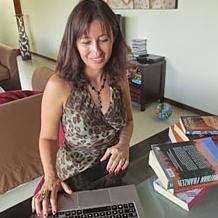
 Even a writer is not an island. Most of us mix with other writers, either out of want or necessity. However, unsupervised encounters between writers may result in unintended injuries – external and internal. So here are some suggested rules for harm minimisation when associating with fellow scribes.
1. Don’t tell a writer suffering from writer’s block that you have never understood this concept, because for you writing is so effortless that you often feel like a medium through whom your characters speak.
2. Don’t give your work to someone to read and say “enjoy”, even if personally you find your story highly entertaining.
3. Don’t give your published (or unpublished) book as a birthday gift – even if you’re certain that mankind will be infinitely enriched by reading it.
4. Don’t ask other writers when the book they’re writing will be published, unless you are prepared for an untimely death.
5. Don’t email, tweet or facebook other writers (or anyone, for that matter) asking them to buy your book. And if you really must do so, don’t use CAPITAL LETTERS in your requests.
6. Don’t ask writers more successful than you to refer you to their agent, at least not during the first decade of your acquaintance.
7. While staying in a shared writers’ retreat, don’t suggest a night of readings, then go first, read half your novel, yawn, say you’ve had too much wine and go to bed.
8. On that last point, when going to a writers’ retreat, don’t show up with bottles of wine and finish them all by yourself.
9. Still at a retreat – don’t dominate the dinner conversation by discussing your dilemma of which publisher to choose out of the twelve fighting over your book.
10. Don’t answer questions about your book by saying “You’ll have to read the book to find out”.
11. Don’t tell memoirists that you find memoir writing self-indulgent.
12. Don’t tell novelists that contemporary novels suck.
13. Don’t tell poets anything. Of all creative species, poets live the shortest and most troubled lives – there is research to prove this. I must reinforce this point: tell poets nothing. Just listen. They need you.

Check out Lee’s new book, The Dangerous Bride, and connect with her at her lovely website here. Also, of course, on Twitter .
“Writers’ Social Etiquette” reposted with much gratitude.
by anesamiller_wuhi6k | Mar 23, 2015 | Blog, Series: Drawer no more!
Just over a year ago I started the DRAWER NO MORE! series on this blog to record my journey on the path of self-publishing (SP). That jaunt led to the creation of two books—an achievement both thrilling and frustrating—usually, in that order. At the time, like so many contemporary writers, I had struggled for over a decade to get a foot in the door of traditional publishing, honing my craft, perfecting query letters, researching markets, and pitching my work to agent after agent. All to no avail.

So even though SP was not my first choice, I embraced the option and gave it my all. Of course, the “vertical learning curve” presented a challenge. Like all independent authors, I grappled with the ins and outs of ISBNs, e-book formats and conversion, design, POD, marketing and distribution—enough new concepts to fill a dictionary.
My head was spinning for months with no comfort zone in sight. But in the immortal words of Édith Piaf, “I regret nothing!”

“Rien de rein!”
True, my SP journey brought disappointments. In the beginning, I was planning to launch three books with more to follow. Instead, I’ve called a halt after the first two. That’s because an unforeseen development has now occurred along the publishing path—a very exciting development, but one that entails its own new concepts and challenges.
I’m back at square one, but this time, it’s a whole new world.
My old dream has come true at last: I have a publisher! Two of my books have been accepted, and one is already in production.
Isn’t there a proverb about wishes coming true when you finally give up striving? That’s more or less how it happened. Within weeks of saying, “No publisher? No more self-pubs? So be it. Back to the drawer…” I received an acceptance from Booktrope Publishing of Seattle. No, the news didn’t fly out of a clear blue sky; I had submitted work and  gotten a recommendation from one of their long-time authors. But I had trained myself to harbor so little hope for good things that the acceptance knocked me over with the proverbial feather.
I’ve featured discussions of Booktrope here on the blog before, but—truth be told—I didn’t understand how it worked until I signed my contract and found myself admitted to the online inner sanctum of Teamtrope, where authors recruit managers, editors, and designers to help bring their books to fruition. This process is complex and can be confusing. I have yet to master all of the details, but already I can energetically dismiss the most common misperceptions—
BOOKTROPE IS NOT A VANITY PRESS. REPEAT: NOT A VANITY PRESS.
In other words—
 Booktrope does NOT require or accept upfront fees of any kind from authors.
Booktrope does NOT keep an unduly large share of net revenues. In fact, at 30%, they keep far less than traditional publishers.
Booktrope does NOT allow poorly edited books to go to press. Nor do they accept every manuscript that comes over the transom from writers unprepared for the publishing process.
Some of my fellow self-publishers may ask, “But why give away almost one third of the proceeds when you could run the show yourself and keep it all?”
The answer, of course, is that I get something valuable in return: an imprint, a reputation, a well-informed and readily available staff, an advertising budget, and access to media opportunities I could never dream of on my own. Does this mean I’ll sell exponentially more books than I did as a self-publisher? I have to admit the answer is, “Hopefully, yes…but not necessarily.”
Now, however, I’ve got my team all invested with me and ready to navigate the rough seas of marketing. None of us will make a penny unless we all make sure the book finds readers. Even more important, I’m no longer alone on the daunting journey of self-expression. Experienced professionals have considered my work and said, “Absolutely! We want to bring this to the world.”
No guarantees, but no regrets. I’m still at Square One with Booktrope, head spinning as I adjust to new procedures. No one knows how the venture may unfold. Even so, as the Russian saying goes, I like the “feel of a shoulder” beside me. I’m not alone, and that feels like a whole new world.

by anesamiller_wuhi6k | Jan 19, 2015 | Blog, Series: Drawer no more!

Don’t get me wrong: I love singing in choirs, and I’m all about the mutual back-scratching that group support implies. In terms of publishing and social media, this means retweeting, following back, posting comments, inviting guests to contribute to blogs, or simply clicking the ol’ LIKE button. At the high end of the scale, this list includes downloading freebies or purchasing books, reading and posting reviews on Amazon.
♥ Sign on for my excellent GIVEAWAY throughout April 2015: WIN $50 in books from Powell’s Independent Bookstore! Click for details! ♥
Over the past year, I’ve done all these things as often as I honestly could without lapsing into obsession. Well, okay, I admit I did become obsessed with socmed for several months—bewitched by its alleged potential for launching my self-published books beyond the circle of personal acquaintance. I craved a wider readership of people who’d never heard of me before. I wanted to launch off the ground, if not into the stratosphere.
If tweeting and posting could help me achieve that, then I was more than willing to try. I gave it my all.
At one point, Twitter suspended me for seeking new followers “too aggressively.” Even then, I made an effort to exchange individual messages and welcome every new follower who joined my flock. For weeks on end, I issued 30 tweets a day or more on an array of topics aimed to engage a diverse range of folks, many of whom were (Surely!) just waiting to “convert” into readers of my books.

There were rules to follow: I never tweeted promos more often than 3:1, the magic formula. And I kept it up in spite of a growing sense of nausea as I struggled to devise clever ways of saying, “Check out this great read!” In fewer than 140 characters, of course.
I had consulted a PR guru. Social marketing was the tsunami of the future: the quickest, cheapest, and most surefire way to establish my reputation as a writer and promote my books throughout the virtual universe. Expectations were high since I got onto Twitter not long after Bella Andre and others made their big splash. Everyone was hoping a reliable strategy had emerged—”Grow your online tribe!” Sales and readers were sure to follow.
Once the euphoria began to wane, it was important to remember that success still depends on genre, luck, and elusive factors like one’s affinity for self-promotion.
No doubt it’s obvious that this account of my socmed career entails a trek down the stony path of disappointment. Did all those tweets and posts sell books? In a 14-month period, between two titles, I sold just under 300 copies. Scarcely a handful of those sales can be credited to socmed activity of any kind. Instead, my family-wide email campaign generated numbers, as did face-to-face events like festivals and signings.
And yes, I tried an online giveaway.
Really, I don’t mean to whine. I am grateful for every purchase, every comment, every review. Still, fellow writers may want to realize that I fell far short of my dream: the great majority of my customers are folks who already knew me, or knew of me through secondhand acquaintance. Ongoing word-of-mouth did not take off, however, and my work remains earthbound.
Basically, a failure to launch.

“Indie authors” are supposed to be entrepreneurs, dividing our time between creativity and marketing. For me that balance has become precarious. Call me old-fashioned, but tweeting and posting are incompatible with writing as I once knew it. While thousands of us send out the same plea, day after day—”Buy me! Read me! Ditto all your friends!”—socmed has recruited precious few readers to my cause. So I hereby announce an extended vacation. The air waves will be a tiny bit less crowded with @anesam98 no longer adding to the clamor.
This blog has been great fun and will still enjoy a future. Please feel free to weigh in below with comments, disagreement, or personal experience. I love to host debate in these pages.
Disappointment means nothing when I recall the wonderful people I’ve met online. In the course of my socmed career, I enjoyed these encounters more than I ever expected. Connection has brought me delight and a sense of genuine, if intangible, success. Sincere thanks to all, especially—
The generous and brilliant writers who contributed posts to this blog and made my website a far more interesting place than it could have been otherwise. These include @jbchicoine @BradParker @thesuzettebrown @dumbbumcomics and @PMCoomer
Thoughtful and compassionate commenters who made my day, time and again, creating a priceless sense of engagement: @KVaselopulos @hectorhoraciova @Micsova @AyersEdits @PinchinLane @TerryTyler4 @PoeticFlow310 @Karenlsullivan9 @JacqueeT @medarlinv @TreeTop Orchid @mikeydbii @markvanderpool and, of course, the intrepid @FredWebster10
Tweeps who reached out to me across continents, from entirely different walks of life, with humor, fellow-feeling, and encouragement. The list would quickly cover this page, so forgive me if I mention just a few shining examples: @Corkytp @TamieDearen @ALittleMissie @tomkohlt @KlaraCharlton @MarkTheShaw @seams16 @Kindlemojo @JAEL488 and @Billward10Bill
Also, special thanks to Sage Adderley and all the wonderful bloggers who took part in my online tour. Each feature was a treasure and much appreciated.
Best wishes to all. I hope we’ll be tweeting together again in the literary choir some day soon.

by anesamiller_wuhi6k | Dec 17, 2014 | Blog
Most of us find ourselves beset by a dreary attitude once and a while. The holidays—with all the stress, family obligations, and expectations good or not-so-good—can pack a hefty punch to one’s psychic equilibrium. But things get especially dire when the season delivers a double whammy, like like when you’re trying to launch a new project amid the post-partum blues. The year’s end itself can sometimes bring on that post-partum feeling of emptiness and dislocation.
If these are troubles you deal with, you are certainly not alone. All kinds of endings (and beginnings, too, come to think of it…) plague me with despondency. Having been there many times, I’ve got a few helpful hints to share. Please add your own suggestions in the comments section. We need all the tools we can get to keep our productivity going!
As writers, we know it’s not fun to find ourselves stumped on a scene halfway through a book that’s been going well (more or less) up to that point. When this happens to me, it usually means I’ve procrastinated on some essential piece of research that can’t be delayed any longer. For example, 200 pages into my novel, Our Orbit, it came time to write the scene in which two young girls visit their father in prison. I had put off drafting this episode as long as possible, but once I got out from behind my desk and went to visit a prison myself, that influx of information gave me the confidence to send words flowing freely out my fingers and onto the page.
Such blocks to the writing process are bad enough. What’s even worse—in my case, at any rate—is the paralyzing letdown that lies in wait after the completion of an important project. I call this “post-partum writer’s block.” It can devolve into a fallow period of months’ duration.
This is understandable up to a point: there’s bound to be a sense of dangling at loose ends after a big job that has occupied one’s mind for a long time, perhaps years. One positive interpretation is that the springs of creativity need to recharge before one feels ready to start something new. Unfortunately, a chorus of nagging voices may tend to overwhelm the mind:
Why aren’t you writing? How long can this drag on, this doing-nothing?? You really don’t have another book in you, after all! I knew it—everybody always knew it!!
 On & on, ad nauseum…
Some of my writer-friends swear by planning ahead for these pitfalls: keep the next project simmering on the back burner—make notes, maybe an outline, engage with the characters just enough so they’re ready to pop when the time is ripe. As soon as a front burner frees up, move the simmering project forward and carry on like nothing has changed.
Voilà —post-partum blues outsmarted!
This is surely sage advice…indeed, it’s a bit too wise for the likes of me. My psyche seems to require a fallow time to grieve, as it were, for the fruit of my imagination that is now separate and independent. For the characters that have grown up and moved on. Or maybe for my unrealistic expectation that life would glow forever golden once I managed to publish the novel. This grieving process seems to entail a very low word count for as long as it takes.
I don’t mean to discount my friends’ advice. Shifting a new project rapidly to the front burner may prove very helpful for some. I’ve actually followed this advice as best I can. But when I need more time to get the next creative endeavor up and going, here are some of the things that make my days pass productively and hopefully hasten the joy of finding my way back to the writing zone—
• Don’t begrudge yourself plenty of rest. Other obligations permitting, sleep as much as you like at least a few nights per week. Ditto on relaxation. I would recommend avoiding addictions (especially electronic ones), but if TV dramas help you unwind, now’s a fine time to soak up that expert plotting without self-reproach.
• Go outside for a few minutes every day, minimum. It’s true that winter is setting in across North America, but try to find a sheltered place to get a bit of sunshine on your skin.
• In a related move, get some exercise whether indoors or out. Your next book is likely to require a lot of unhealthful sitting, so shape up now in order to withstand those long writing sessions to come.
• It’s fashionable these days to recommend meditation for whatever ails us. Personally, I never cared for it—in the past when I tried it, I always fell asleep, or just wound up fretting over the same problems I’d fretted over all day without benefit of meditation. More recently, though, I’ve allowed myself to sit and count breaths for a modest ten minutes at a stretch without any big expectations. I find it does give rise to a serene state of mind.
• Indulge yourself in something you’ve never done before: try a new craft or sport, listen to some foreign-language lessons, visit a place you’ve never seen. Or if novelty doesn’t attract you, page back to an old neglected hobby, a creative road perhaps tried but not taken in the past: quilt a pillow, build a birdhouse, bake a pie.
• And no matter what, keep journaling! It doesn’t matter what you write—some of it will no doubt be drivel, but the first sentence for your next book may turn up there soon. And your fingers will stay limber for the words you’ll eventually want to share with the world.
by anesamiller_wuhi6k | Dec 8, 2014 | Blog
 In the mid-1990s (way back in my early childhood—lol), I completed a graduate program in Russian literature. To prepare for comprehensive exams, I devoted three years to reading my way through a list of novels, short stories, and poems by such luminaries as Pushkin, Tolstoy, Dostoevsky, Turgenev, and others. Once I had passed the exams and found a spare moment to think back, I came to a startling realization: it had been ages since I last read a book by a woman.
Aside from a tiny handful of poets (poetesses, as they were often called at the time), the classics of Russian literature included no women.
Of course, I loved the Russian masters just as I’ve loved and enjoyed many other books by male authors over the years. I wouldn’t dream of boycotting them, but it did seem appropriate to play a bit of catch-up by making a point of reading more books by women.
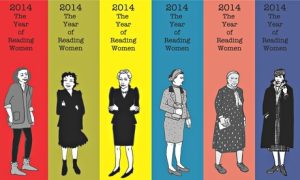
Now that 2014 has entered its final season, I want to remind readers of a special meme that aims to correct the ongoing gender imbalance among reviewers and books selected for review at major newspapers and literary magazines. Variously known as #readwomen2014 and #ayearofreadingwomen, this meme originated last January with blogger, writer, and illustrator Joanna Walsh. The purpose has been to introduce more readers to fantastic work by female authors.
The bookmarks Walsh created to promote #readwomen2014 appear above, featuring Anne Carson,Djuna Barnes, Gertrude Stein, and others. She celebrates a newer set of authors in more recent designs here. And click here to read her introduction to the project overall.
Since I’ve always been intrigued with world literature and foreign lands, I’d like to share a short list of novels I’ve enjoyed this year by women writers of diverse international heritage. All of them count English as heir native language, so these are not works in translation. From crime and intrigue to spiritual redemption, each of these books offers a thrilling glimpse into different ways of life. And, of course, each provides a wealth of reading pleasure—
A Tale for the Time Being by Ruth Ozeki
A strikingly original and evocative story. Chapters alternate between a schoolgirl’s journal, washed ashore on an island off British Columbia, and the novelist (not coincidentally named Ruth) who finds the journal and tries to discover what became of the author. Zen Buddhism, World War II history, and Japanese pop culture all come to bear on the young girl’s struggle to overcome bullying at school and mental illness in the family. A backdrop of natural disasters and the Fukushima reactor meltdown heightens the drama. In recounting dire and serious problems, the narrative voice strikes an endearing harmony of flippant and childlike tones, by turns depressive and humorous.
Americanah by Chimamanda Ngozi Adichie
This celebrated novel tells the story of a star-crossed Nigerian couple. Zed and Ifemelu are lovers as well as best friends, but the oppressive effects of corruption and organized crime drive them apart like powerful ocean currents. Ifemelu emigrates to America and finds professional success but can’t bring herself to put down roots. Back home, the friend she remembers so tenderly struggles to make a living without losing his soul. Gradually, the two resume contact as the heroine ponders a return to her troubled homeland.
The Lowland by Jumpa Lahiri
Action shifts between Calcutta and the rural campus of an unnamed university in Massachusetts as we follow the lives of two brothers, Subhash and Udayan. They are intimates and confidants until Subhash—the elder by one year—goes abroad for postgraduate education. He leaves behind a staid and traditional family profoundly challenged by the Maoist rebellion that flourished briefly in the 1960s. This movement attracts and ultimately destroys the younger brother. The novel’s social material is informative, but even if one knew all the historic details in advance, Lahiri’s narrative skill could make any tale engrossing. She favors extensive development of character and leisurely unfolding of events, yet manages to build these elements into scenes of stunning emotional power.
Kinder than Solitude by Yiyun Li
Here again is a story that spans continents. Three friends grapple with the aftermath of a mysterious death that claimed one of their friends in the prime of youth. Two emigrate to America, while the third manages to make a life in Beijing, but all are marked by doubt and a sense of dislocation. With international and psychological twists on the crime/mystery genre, Li creates a gripping intrigue and moving story. A native of China who now makes her home in the United States, Li has published several acclaimed books of fiction.
** English is so widely spoken in our day and age, there are more writers around the world working in the language than ever before. With so many unusual stories to choose from, don’t let 2014 come to a close without picking up at least one new book by a woman! (A version of this post first appeared on the lovely blog SHELF PLEASURE. I remain grateful for that opportunity!) **

 Even a writer is not an island. Most of us mix with other writers, either out of want or necessity. However, unsupervised encounters between writers may result in unintended injuries – external and internal. So here are some suggested rules for harm minimisation when associating with fellow scribes.



 gotten a recommendation from one of their long-time authors. But I had trained myself to harbor so little hope for good things that the acceptance knocked me over with the proverbial feather.