by anesamiller_wuhi6k | May 20, 2015 | Blog, Series: Drawer no more!
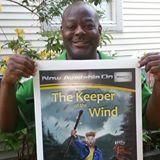
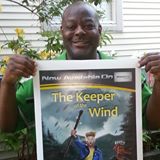
Most self-published, or otherwise independently published, authors are aware of the phenomenon known as #IndieBooksBeSeen. This movement of mutual support originated with one creative and energetic individual—Mark Shaw. A YA and fantasy author, Mark is known in the world of social media as “Keeper of The Wind,” after the title of his book.
Mark is a native of Baltimore MD and now resides in Vancouver BC. I was flattered when he reached out to me in the summer of 2014—as he reached out to many other authors, as well—inviting us to take part in the first Indie Pride Day. He urged us all to take a photo of ourselves with our book covers, then to tweet these and RT others on July 1st. Voilá #IndieBooksBeSeen.
I asked Mark to comment on his experience with independent publishing and the need for mutual support.
Mark says—
Since releasing my first novel, The Keeper of The Wind, one thing I noticed on social media was the frenzied way everyone seemed to be promoting their books. It seemed crazy how indie authors were basically begging for someone to either buy their book or take a look at it for free. Social media is saturated with this. I found it discouraging and wondered how I could compete amid such chaos.
I’m sure many new authors feel the same way. As a creative person, I started thinking of ways to get around the frantic hustle of endless promotions. There must be alternatives for getting my book to the hands of readers.
A few days after putting my book out, I received a note from another indie author asking how my book was selling and what I was doing to promote it. He told me his current book wasn’t selling well at all. Even so, he was in the process of releasing his 4th novel.
I thought this was crazy.
Soon after, I read an article titled “Keep Your Day Job.” It broke down how very few indie authors are making money at their craft. The chances of being able to make a decent living from writing are slim to none. This pissed me off, and I saw it as challenge for change.

Mark Shaw
With this notion, I came up with the #IndieBooksBeSeen movement. The first thing I set out to do was to make July 1st of every year #IndieBooksBeSeen day, a day when indie authors show the world that we’re united and proud to be indie. It started with posting a picture of ourselves holding up our indie titles and then retweeting everyone’s else’s book for the world and all social media to see—one grand gesture to show the world that we’re here and strong together.
It was a bigger success than I thought it would be, and I was very moved by others’ warm sentiments and sense of pride. This gave me hope, and I felt encouraged to forge ahead with a new plan while the momentum was still strong. I decided to try giving struggling authors a boost by challenging others to review their books. I know what it’s like to just start out and struggle for reviews, unless you pay for them.
So I felt this would be an easy challenge, but boy was I wrong! I urged several participants to give it a try on our indie pride day, thinking they were still feeling the love from #indiebooksbeseen a couple of weeks before. Right away one person said she felt like she was getting spammed by me. I thought, wow! But it wasn’t spam when tons of others spent hours retweeting your title. To make things worse, the review challenge never took flight. Out of all the people I reached out to, only a few took part.
What this said to me was that most indie authors will only get involved in projects that are self-serving to their own cause, unless they’re part of a group. I want indie books to be the cool alternative to mainstream books. The only way I can see this happening is if we become one voice for the industry itself. I’m not saying don’t promote your book, I’m just asking you to give some of your energy to boosting our industry. Because when the light shines on our industry, it’ll shine on all of us.
A couple of questions—
Anesa: Will the #IndieBooksBeSeen event happen on Twitter again this year?
MarktheShaw: Yes our Indie Pride Day is coming around again and I’m excited! My hope is that people will see us as an olive branch for hope.
Anesa: The point you raise about reviews is very important. I totally agree that we must support each other with reviews as best we can because the traditional media is obviously not going to do it! But in all honesty, we know there are many unedited books out there, some of which were mainly published for the writer’s family and not so much for the public at large. Wading through many books to find one that we can give a good review can take up a good deal of time…
MarktheShaw: When indie authors decide to put out a book, we want them to know right away that we’re here for them to help on all levels.
Thanks so much Mark for your positive attitude and energy. I hope we can bring a bit more attention to the cause this year. Best wishes to you always–
* * * *
Connect with @MarkThe Shaw on Twitter
and on Facebook.
Visit his Amazon author page.
Search the hashtag for an overview of #IndieBooksBeSeen.
by anesamiller_wuhi6k | Mar 23, 2015 | Blog, Series: Drawer no more!
Just over a year ago I started the DRAWER NO MORE! series on this blog to record my journey on the path of self-publishing (SP). That jaunt led to the creation of two books—an achievement both thrilling and frustrating—usually, in that order. At the time, like so many contemporary writers, I had struggled for over a decade to get a foot in the door of traditional publishing, honing my craft, perfecting query letters, researching markets, and pitching my work to agent after agent. All to no avail.

So even though SP was not my first choice, I embraced the option and gave it my all. Of course, the “vertical learning curve” presented a challenge. Like all independent authors, I grappled with the ins and outs of ISBNs, e-book formats and conversion, design, POD, marketing and distribution—enough new concepts to fill a dictionary.
My head was spinning for months with no comfort zone in sight. But in the immortal words of Édith Piaf, “I regret nothing!”

“Rien de rein!”
True, my SP journey brought disappointments. In the beginning, I was planning to launch three books with more to follow. Instead, I’ve called a halt after the first two. That’s because an unforeseen development has now occurred along the publishing path—a very exciting development, but one that entails its own new concepts and challenges.
I’m back at square one, but this time, it’s a whole new world.
My old dream has come true at last: I have a publisher! Two of my books have been accepted, and one is already in production.
Isn’t there a proverb about wishes coming true when you finally give up striving? That’s more or less how it happened. Within weeks of saying, “No publisher? No more self-pubs? So be it. Back to the drawer…” I received an acceptance from Booktrope Publishing of Seattle. No, the news didn’t fly out of a clear blue sky; I had submitted work and  gotten a recommendation from one of their long-time authors. But I had trained myself to harbor so little hope for good things that the acceptance knocked me over with the proverbial feather.
I’ve featured discussions of Booktrope here on the blog before, but—truth be told—I didn’t understand how it worked until I signed my contract and found myself admitted to the online inner sanctum of Teamtrope, where authors recruit managers, editors, and designers to help bring their books to fruition. This process is complex and can be confusing. I have yet to master all of the details, but already I can energetically dismiss the most common misperceptions—
BOOKTROPE IS NOT A VANITY PRESS. REPEAT: NOT A VANITY PRESS.
In other words—
 Booktrope does NOT require or accept upfront fees of any kind from authors.
Booktrope does NOT keep an unduly large share of net revenues. In fact, at 30%, they keep far less than traditional publishers.
Booktrope does NOT allow poorly edited books to go to press. Nor do they accept every manuscript that comes over the transom from writers unprepared for the publishing process.
Some of my fellow self-publishers may ask, “But why give away almost one third of the proceeds when you could run the show yourself and keep it all?”
The answer, of course, is that I get something valuable in return: an imprint, a reputation, a well-informed and readily available staff, an advertising budget, and access to media opportunities I could never dream of on my own. Does this mean I’ll sell exponentially more books than I did as a self-publisher? I have to admit the answer is, “Hopefully, yes…but not necessarily.”
Now, however, I’ve got my team all invested with me and ready to navigate the rough seas of marketing. None of us will make a penny unless we all make sure the book finds readers. Even more important, I’m no longer alone on the daunting journey of self-expression. Experienced professionals have considered my work and said, “Absolutely! We want to bring this to the world.”
No guarantees, but no regrets. I’m still at Square One with Booktrope, head spinning as I adjust to new procedures. No one knows how the venture may unfold. Even so, as the Russian saying goes, I like the “feel of a shoulder” beside me. I’m not alone, and that feels like a whole new world.

by anesamiller_wuhi6k | Jan 19, 2015 | Blog, Series: Drawer no more!

Don’t get me wrong: I love singing in choirs, and I’m all about the mutual back-scratching that group support implies. In terms of publishing and social media, this means retweeting, following back, posting comments, inviting guests to contribute to blogs, or simply clicking the ol’ LIKE button. At the high end of the scale, this list includes downloading freebies or purchasing books, reading and posting reviews on Amazon.
♥ Sign on for my excellent GIVEAWAY throughout April 2015: WIN $50 in books from Powell’s Independent Bookstore! Click for details! ♥
Over the past year, I’ve done all these things as often as I honestly could without lapsing into obsession. Well, okay, I admit I did become obsessed with socmed for several months—bewitched by its alleged potential for launching my self-published books beyond the circle of personal acquaintance. I craved a wider readership of people who’d never heard of me before. I wanted to launch off the ground, if not into the stratosphere.
If tweeting and posting could help me achieve that, then I was more than willing to try. I gave it my all.
At one point, Twitter suspended me for seeking new followers “too aggressively.” Even then, I made an effort to exchange individual messages and welcome every new follower who joined my flock. For weeks on end, I issued 30 tweets a day or more on an array of topics aimed to engage a diverse range of folks, many of whom were (Surely!) just waiting to “convert” into readers of my books.

There were rules to follow: I never tweeted promos more often than 3:1, the magic formula. And I kept it up in spite of a growing sense of nausea as I struggled to devise clever ways of saying, “Check out this great read!” In fewer than 140 characters, of course.
I had consulted a PR guru. Social marketing was the tsunami of the future: the quickest, cheapest, and most surefire way to establish my reputation as a writer and promote my books throughout the virtual universe. Expectations were high since I got onto Twitter not long after Bella Andre and others made their big splash. Everyone was hoping a reliable strategy had emerged—”Grow your online tribe!” Sales and readers were sure to follow.
Once the euphoria began to wane, it was important to remember that success still depends on genre, luck, and elusive factors like one’s affinity for self-promotion.
No doubt it’s obvious that this account of my socmed career entails a trek down the stony path of disappointment. Did all those tweets and posts sell books? In a 14-month period, between two titles, I sold just under 300 copies. Scarcely a handful of those sales can be credited to socmed activity of any kind. Instead, my family-wide email campaign generated numbers, as did face-to-face events like festivals and signings.
And yes, I tried an online giveaway.
Really, I don’t mean to whine. I am grateful for every purchase, every comment, every review. Still, fellow writers may want to realize that I fell far short of my dream: the great majority of my customers are folks who already knew me, or knew of me through secondhand acquaintance. Ongoing word-of-mouth did not take off, however, and my work remains earthbound.
Basically, a failure to launch.

“Indie authors” are supposed to be entrepreneurs, dividing our time between creativity and marketing. For me that balance has become precarious. Call me old-fashioned, but tweeting and posting are incompatible with writing as I once knew it. While thousands of us send out the same plea, day after day—”Buy me! Read me! Ditto all your friends!”—socmed has recruited precious few readers to my cause. So I hereby announce an extended vacation. The air waves will be a tiny bit less crowded with @anesam98 no longer adding to the clamor.
This blog has been great fun and will still enjoy a future. Please feel free to weigh in below with comments, disagreement, or personal experience. I love to host debate in these pages.
Disappointment means nothing when I recall the wonderful people I’ve met online. In the course of my socmed career, I enjoyed these encounters more than I ever expected. Connection has brought me delight and a sense of genuine, if intangible, success. Sincere thanks to all, especially—
The generous and brilliant writers who contributed posts to this blog and made my website a far more interesting place than it could have been otherwise. These include @jbchicoine @BradParker @thesuzettebrown @dumbbumcomics and @PMCoomer
Thoughtful and compassionate commenters who made my day, time and again, creating a priceless sense of engagement: @KVaselopulos @hectorhoraciova @Micsova @AyersEdits @PinchinLane @TerryTyler4 @PoeticFlow310 @Karenlsullivan9 @JacqueeT @medarlinv @TreeTop Orchid @mikeydbii @markvanderpool and, of course, the intrepid @FredWebster10
Tweeps who reached out to me across continents, from entirely different walks of life, with humor, fellow-feeling, and encouragement. The list would quickly cover this page, so forgive me if I mention just a few shining examples: @Corkytp @TamieDearen @ALittleMissie @tomkohlt @KlaraCharlton @MarkTheShaw @seams16 @Kindlemojo @JAEL488 and @Billward10Bill
Also, special thanks to Sage Adderley and all the wonderful bloggers who took part in my online tour. Each feature was a treasure and much appreciated.
Best wishes to all. I hope we’ll be tweeting together again in the literary choir some day soon.

by anesamiller_wuhi6k | Jul 28, 2014 | Blog, Series: Drawer no more!
Part 1
I suspect I’m not the only one who has mixed feelings about Kirkus Reviews. Specifically, their practice of charging independent authors $425 for a “book review” of 400 words or less. Many have suggested that such services are not only overpriced but also pointless for the majority of authors whose readership couldn’t care less about endorsements (or lack thereof) from an 80-year-old magazine. But I write literary fiction, which means my readers tend to count themselves among the discerning crowd, rightly or wrongly, and here Kirkus enjoys a good deal of prestige.

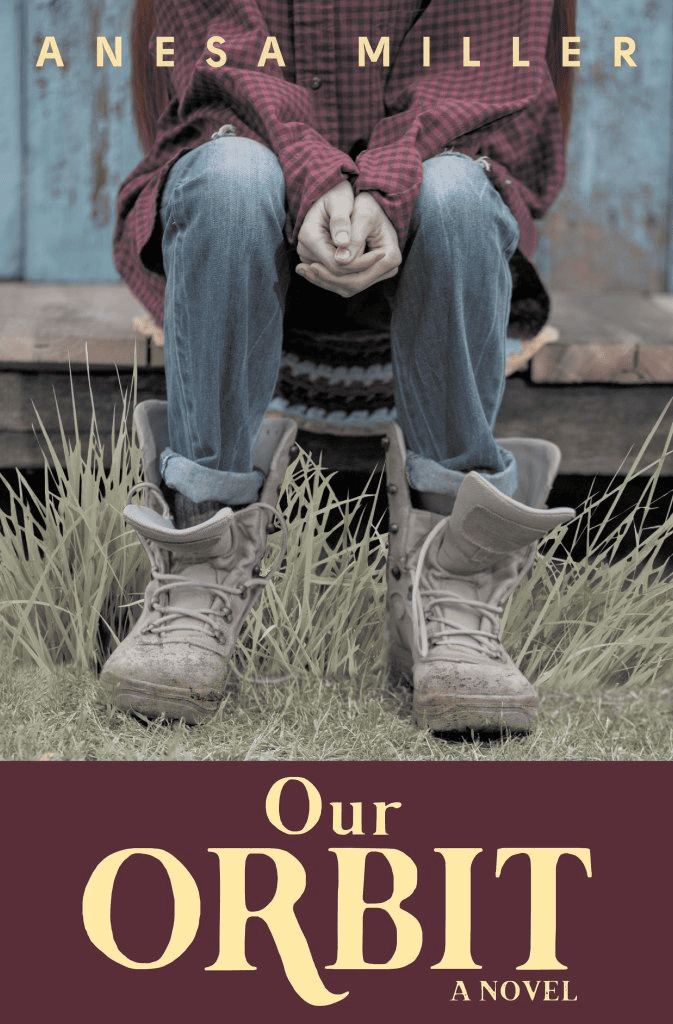
Cover design by Renee Garcia
Besides, I thought, Our Orbit is not only the culmination of many years’ work on my part. It really is a good novel! It deserves the attention of a professional. Kirkus states that their commentaries are thoughtfully penned by “librarians, business executives, journalists from national publications, PhDs in religion and literature…[and] other professional reviewers.”

What’s more, they followed me wherever I went! Not PhDs and professionals (unfortunately) but Kirkus Reviews. Their banner ads pop up at Salon.com, Poets & Writers, The NYT—every bookish site I frequent. You would almost think they were targeting me (lol—I know they were), claiming that they’d consider my book for some major award if only I bought a review. Long story just a bit shorter, I succumbed to seduction. Guess they somehow knew it’s been my lifelong dream to sell books beyond the circle of my personal acquaintance.
And surely a national-level review could only help.
~ ~ ~ ~
Through 4th of July, 2015 – Join a great GIVEAWAY to celebrate my new novel! Many prizes – gift cards, crafts & a signed copy of OUR ORBIT, finalist for “Best Regional Fiction” Click here to join !
~ ~ ~ ~
I knew that Kirkus is notorious for producing harsh reviews. But the “kill clause” put me at ease: If they panned my book, at least they offered the option of keeping it in the dark. So long as I opted not to quote any portion of the review on my website, back cover, or any public place, the review as a whole would remain unpublished forever. Of course, I would be down $425, but my book would not suffer. And since I felt confident that Our Orbit could withstand even a snarky reviewer, I chose to gamble.
So began the proverbial crap-shoot, like so many of the services on offer for writers today, which might or might not help sell a single book.
Some five weeks later, with quaking fingertips, I eagerly downloaded my very own review from Kirkus, the venerable authority. One minute later, dismay set in. That’s how long it took to read the 348 words my reviewer saw fit to devote to my novel. But wait! 89 of those were actually my words, quoted from my own book! Unnecessarily, it seemed to me: Quoted like a freshman English student dutifully includes a citation in a book report. So my review came in at just 263 original words. About a buck-80 per word.
What did they say, those precious bon mots?
Typically, for Kirkus, there was a 2-line plot summation, followed by a paragraph of more detailed plot summary. Perhaps readers look for this, but it wasn’t useful to me since I had, naturally, already created my own synopsis. Next came another brief paragraph, heavy on the above-mentioned quotations, giving yet more details on the characters
The review closed with one brief sentence—9 words—that might be worth quoting on my book cover or elsewhere. But in order to use those few words, I would have to agree for them to publish the entire review on their website, if they chose, as per the Kirkus policy.
And there’s the rub.
Because in that second paragraph detailing my characters, the reviewer decided to drop a major spoiler. If this were part of a serious discussion, I might decide the revelation was worthwhile. But instead, it was tossed off in passing, making no real point. To use any part of the review I paid for, I would have to consent to unknown numbers of potential readers encountering a spoiler that does nothing to enhance the commentary on my book.
Thanks for nothing, Kirkus!
To Kirkus or not to Kikus? Part 2
In fairness to Kirkus Reviews, I’ll readily admit that they have some fine employees. When I wrote to express my disappointment with the review I’d purchased of my novel, Our Orbit, I was surprised to encounter a very helpful young man. I assume he was young since he was working as a first-line responder to email inquiries like mine. I’ll call him Thad.
Among Thad’s helpful reminders was this: “Our reviews are required to meet a minimum word count of 250 words.” So at 348 words, my review was laden with gravy.
Point taken, Thad…although nearly 100 of those words were mine rather than the reviewer’s—quotations from Our Orbit padding the lukewarm remarks.
~ ~ ~ ~
Through 4th of July, 2015 – Join a great GIVEAWAY to celebrate my new novel! Many prizes – gift cards, crafts & a signed copy of OUR ORBIT, finalist for “Best Regional Fiction” Click here to join !
~ ~ ~ ~
Nonetheless, in spite of my jaundiced attitude, I was impressed when Thad stated that he would, “present your concerns to our editors.” After all, my primary complaint was that the review I’d bought so dearly contained a spoiler revealing a major plot point. I felt this made the whole thing unusable due to Kirkus’s policy requiring permission to publish the complete review if the buyer quotes so much as one phrase (which is, of course, the whole purpose in purchasing).
So I pricked up my ears when Thad suggested that senior editors might actually consider the issues I’d raised and offer some solution. Three weeks went by without further word. When I wrote again to ask Thad if I should expect a reply, his answer came the next day:
“The Indie Editors … have decided that we cannot alter the review. It is Kirkus Indie’s policy to only address those matters related to factual inaccuracies …
“Regarding the point about the [spoiler], very often our reviewers are not able to elaborate on each and every plot point found in a given work… However, they must inform a reader of certain points… We do understand your frustration and disappointment, but we have certain editorial guidelines that we follow.”
Do I detect a bit of circular reasoning? Kirkus reviewers cannot elaborate every plot point, but they must inform readers about certain points. And just because I withheld a plot twist until page 191, treating it as an elaborate family secret, that was apparently no reason for them to select some other point to elaborate for those demanding readers.
Hmmm…
…Much ado about very little? Are spoilers such a serious thing?
Okay, okay. As friends have assured me, I’m making much ado about very little. Are spoilers such a serious thing? Goodreads.com accommodates spoiler alerts on reader reviews, but Amazon has discontinued that practice. Even if an author objects to revealing statements in a review, Amazon will do nothing to post an alert. (Guess how I know.)
Moreover, millions of people know how such books as To Kill A Mockingbird and The Great Gatsby turn out. Or Gone Girl or The Secret History or The Hunger Games. And that does nothing to keep new readers away. So, yes—I’m overreacting. I should be so lucky as to have fans clamoring over Our Orbit, discussing the plot twists and characters, accidentally spilling the beans about what happens on page 191.
Maybe I’ll go ahead and put that brief, mildly flattering, quote from my Kirkus review on the back cover of my book. Maybe I’ll even publish it here on my blog.
If Kirkus responds by putting up the full review, complete with spoiler, in some obscure corner of their website—so much the better. If one or two people stumble upon it and find the secret—don’t tell anybody, please?
And thank you, Thad, for making an effort to talk to those scrupulous “Indie Editors” on my behalf.
~ ~ ~ ~
In the end, I decided to both quote and publish my review in full. You can read it here along with a far more gratifying (and unpaid) commentary from The Midwest Book Review.
~ ~ ~ ~
Through 4th of July, 2015 – Join a great GIVEAWAY to celebrate my new novel! Many prizes – gift cards, crafts & a signed copy of OUR ORBIT, finalist for “Best Regional Fiction” ! ! ! Click here to join !
~ ~ ~ ~
Many thanks for visiting my blog today! Please browse the website and let me know if you like what you see, or if you have suggestions. You can reach me by leaving a comment in the box below or by clicking the Contact link at upper right (or just click here). Consider subscribing to my blog or newsletter. And stop by again soon!
by anesamiller_wuhi6k | Jan 13, 2014 | Blog, Series: Drawer no more!
 How did an old-school scribbler—a garret-sitting recluse and hater of newfangled technology—make the leap to electronic publishing, social networking, and that bête-noire of all things authentic, self-promotion?
The leap is not complete. Right now, I’m skidding between safe harbors, grappling my way up the slopes of a “vertical learning curve.” Whether I manage to touch down lightly in the high-tech literary world remains to be seen. You’re invited to watch the virtual Reality Show of my struggle, right here on the Blog at the website I never thought would bear my name!
What forces a formalist poet and literary novelist like yours truly to attempt such a jump in the first place? Short version: I found myself at a crossroads where I had to make a drastic change. I needed to take my artistic future in my own hands, or else do something destructive—reject my identity as a writer: erase files, burn journals, rent out my office to a deserving graduate student.
As writers (or artists of any stripe) our own psychology is no doubt our greatest asset. It can also become a terrific stumbling block. Before I began inching forward with self-publishing plans, I had hit an all-time low. I fell into a depression and suffered from agoraphobia, refusing to leave the house for days on end.
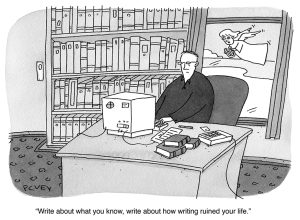
One of my favorite cartoonists, Peter Vey (www.pcvey.com), brilliantly captures aspects of those feelings in an item I ran across in The Funny Times (www.funnytimes.com)—

Writing can be a lonely business. For almost two wasted years, I DID feel that writing had ruined my life: While others engaged with the world, teaching children to read, growing food, or building cars, I sat in my garret pondering a fuzzy navel. I had dedicated my “talents”—paltry as they seemed—to a cruel muse who offered fewer satisfactions with each passing year. Self-expression was my be all and end all, but if no one beyond the self takes the slightest interest, what’s the point in expressing anything?
What do you think: Is writing an isolating occupation, or does the exercise of imagination let you connect with all humanity? Are artists more prone to depression than people in other walks of life? Please feel free to comment on other relevant matters, as well.
Join me next time for further adventures in indie publishing!




 gotten a recommendation from one of their long-time authors. But I had trained myself to harbor so little hope for good things that the acceptance knocked me over with the proverbial feather.