
MUSIC — The ULTIMATE INSPIRATION
Many thanks to Dawn Brazil, an author and all-round great person, who not only provided the inspiration for this post but also shared it first on her blog, Dawn Brazil’s Brilliant Babbles about Books —
When I first visited Dawn’s website several weeks ago, I was impressed with her use of music: music video clips, playlists, and more. It made me realize what a special source of inspiration music offers for all the arts and for life, overall. We can turn to it any time to refresh our mood or energize our creativity. Songs that we love and melodies we remember from long ago yield rich imagery for many writers.
I took a look back at my novel, Our Orbit, and noticed that music plays an important part in the story.
The first instance comes in the opening scene. It’s just a small point, but I think it helps to reveal the main character. Miriam Winslow is a girl of nine, the youngest child of a close-knit working-class family. Before the plot takes off with Miriam’s forced removal from her home and placement in foster care, I wanted to give a glimpse of how her intimate family members knew her. Rather than spend a lot of space of this, I tried to choose a telling detail. Miriam’s feeling for music helped me out—
(As Miriam’s mother, Emaline, drives through a snowstorm to pick up an older daughter, they bypass the turn for their home at Friendly Village Mobile Home Park.)
Emaline suppressed a sigh. Instead of slowing for the turn, she tapped the horn and called out, “Hold the fort, Friendly!”
“Friendly, holding steady—” sang little Miriam from the back seat, quick to answer the cue in this family routine of forgotten origin, homage to the home where Emaline arrived as a bride half her life ago.
In this short passage, my aim was to show that Miriam is a happy child who enjoys melody and is not shy about sharing her voice. She expresses loyalty to her family by singing a “ditty” they invented for fun before she was born. As the story goes on, readers will learn that Miriam’s older brothers and sister have largely given up such family rituals as they began to deal with mainstream culture at school and among their peers. Miriam is the one who keeps family traditions alive, and she will bring them to her new foster family.
As a motif in our writing, music can play a wonderful role in revealing cultural differences between groups of people. Our Orbit explores these differences on a small, local scale: Miriam’s birth family and her foster family have a great deal in common, and yet they belong to separate groups with limited contact. Both families have lived in the same Ohio county for generations. They are of the same race and similar heritage from northern Europe. And both families are Protestant Christians of weekly church-going habits. Even so, the barriers between them are economic class and educational background.

When Miriam first attends church with her foster family, she is awed by the large building, bright chandeliers, and long hallways for Sunday school classes and meeting rooms. People are more dressed up than she is accustomed to, and all their clothes are new and brightly colored. But it is Miriam’s reaction to the music at this big, new church that makes clear to readers: She grew up on the other side of the tracks.
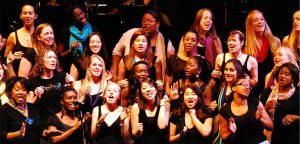
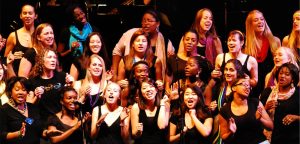
While Miriam ran up the church steps…she heard a choir strike up a song inside. Sounded like a hundred people! Across the bright lobby…you could see the flash of white-and-gold robes as the singers stepped left, right, back, front, clapping their hands on each move. A rock band with guitars and drums was playing along. Tambourines rattled…
This must be the hugest church in town, Miriam thought, All we have back at Holy Redeemer is one little piano. And even with every person singing, there were only a few dozen voices…
Miriam’s home church was a small, “backwoods” congregation without paid professionals to direct a choir or play instruments. Although she soon comes to appreciate the music at her foster family’s prosperous church, her first impression is mixed. Based on her experience, the “loud, peppy music” seems more like a performance than a call to worship. More like a “dance party” than an occasion to repent one’s sins.
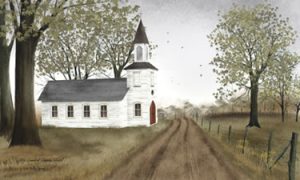 (When Miriam’s foster father, Rick, takes her back to visit her home church, Holy Redeemer Tabernacle, we see the tradition through his eyes.)
[It was] a tiny white-washed church on Key Ridge, south of town… The piano’s tinny chords rang out… There was no choir director and no hymnals, but harmony swelled from two to four parts. The voices were strong for such an elderly crowd—
To Canaan’s land I’m on my way,
Where the soul of man never dies,
And my darkest nights will turn to day,
Where the soul of man never dies…
People embraced. Some laughed, others wiped away tears…
Here is a list of a few songs that played in my head as I worked on Our Orbit. I’ve hunted up those I could find on YouTube to give an impression of how they sound. Some of the hymns are quoted in the book (as in the scene above), while others served more to set a mood for my writing.
“The Soul of Man Never Dies” performed by Tony Rice and Ricky Skaggs. From the DVD “Legends of Flatpicking Guitar.”
“There is a Balm in Gilead” performed by Mahalia Jackson.
“The Stable Song” performed by Gregory Alan Isakov.
And to close on a happy note, here is “Dreams” performed by the Cranberries. This is the favorite song of Miriam’s teenage sister Rachelle. It becomes embarrassing to Rachelle when her friends make fun of the band because they are Irish and “talk funny.” So we see that Rachelle’s musical taste is a bit more open-minded than some of the people around her!
~ ~ ~ ~

Visit Dawn Brazil at her blog, Brilliant Babbles About Books.
Connect with Dawn on Facebook, on Twitter, on Goodreads, Pinterest, and on Amazon.
~ ~ ~ ~
Thank you for visiting my blog today! Please check out the rest of the website and let me know if you like what you see, or if you have suggestions. You can reach me by leaving a comment in the box below or by clicking the Contact link at upper right (or just click here). Consider subscribing to my blog or newsletter. And stop by again soon!