
by anesamiller_wuhi6k | Jun 8, 2015 | Blog, Series: Drawer no more!

The fiction bug bit hard, back when I was employed as a foreign-language teacher and should have been working on my dissertation on Tolstoy. Call it procrastination, but nothing brought me so much delight as a couple of stolen hours with a legal pad and row of needle-sharp pencils.
The short stories and novellas I produced in those early years were mostly unreadable. Surely, the way to prove that one is a writer is to use lots of long and difficult words! Or so I opined at the time. Steeped in academic language, I struggled to keep my sentences down to half a dozen dependent clauses, max.

Ah, the days when every word was precious!
Once I finally climbed down from the ivory tower, it was time to improve my style. I read Alice Munro and began to grasp how to shape a sentence, read Carolyn Chute and sensed the chemistry between characters, read Marquez and grappled with the dream that is an enthralling narrative. Small vignettes and short-shorts proved a good place to hone my craft. Several of those found homes in literary magazines—a thrill for the starry-eyed novice.
The short story form remained my nemesis. To this day, I consider it a lofty pinnacle of prose artistry, and have often said I hope to never write another.
But while ideas continued to swarm, and before I worked up the nerve to tackle a larger project, I labored in the fields of short fiction. I longed make readers pause and see fellow humans in a new way. Don’t people drive us crazy with anger, love, hysteria, amazement, and every possible emotion! I struggled to present characters that would help readers recognize their fellows—our fellows—with a bit more compassion than before.
One of my short stories at this time went by the cumbersome name “Gravitation of the Spheres.” Please be kind and consider it a throwback to my academic career. Other titles came and went, all equally bad. Despite the abstractly philosophical name, the tale was a simple one: a nine-year-old girl loses her parents and is thrust into foster care. A kind family takes her into their home. Connection ensues along with various conflicts. Crisis, resolution, THE END.
But this story gave me no rest. In one draft, I expanded the plot with new episodes. Then cut every expendable word to tighten things up. “Leaner and meaner” was supposed to be better and better, or so minimalists would have us believe. I revised that story so many times, my head began to spin. I had no idea which version might be better than another.
Realizing I needed professional help, I applied to The Kenyon Review Writer’s Workshop for my first class in creative writing.
Kenyon College had the advantage of being within a 3-hour drive of my town. More importantly, this is the home of the prestigious literary magazine that launched work by such luminaries as Alan Tate, Robert Penn Warren, Robert Lowell, and many others. If Ohio has a literary Mecca, I reasoned, this must be it!
All a-tremble with excitement, I joined a group of 12 acolytes studying with Nancy Zafris, a winner of the Flannery O’Connor Award for short fiction and a formidable presence. She forced us to realize the power of each word while becoming attached to none (Kill those darlin’s). Awed by Nancy’s skill with tone and structure, I felt no one could better advise me how to transform my troublesome story into the brilliant narrative it was meant to be.

But are they “Gravitating”?
Nancy graciously agreed to read “Gravitation of the Spheres.” She convinced me to reconsider the title and gave some pointers on focusing the plot. But it was her parting remark that helped me keep faith with the story for years to come: “Brush it up and send it out.”
So my strange little tale was in the ballpark of publishable material!
This 4800-word opus acquired the name “Our Orbit.” Not sure why I was determined to stick with cosmic imagery when this theme is not essential to the plot. I’ve gotten a bit of criticism despite the great improvement over previous titles. One widely published author told me that first person (“Our…”) was inappropriate, given that the story is written in third. And a couple of readers said they were misled to expect a sci-fi tale.
I hoped my eventual readers would accept the metaphorical sense of an “orbit.” Then I stumbled upon this same small phrase in Harper Lee’s To Kill a Mockingbird. There it’s used to describe Scout and Jem’s daily routine of play and exploration. This is not a major passage in the classic book, but it seemed so resonant with my story, I wasn’t about to give up the title from then on.
As for sending it out—first, I tried journals at the top of my wish list: Pleiades, Five Points, Prairie Schooner, Agni. Guess what happened! Soon moved on to a slightly humbler tier: Ascent, Spindrift, The Green Hills Literary Lantern. Eventually, I was scraping the bottom of the litmag barrel: Dodohebdo, DoTell Motel, Tales from the Hip, and FicLines. (Not their real names!) As discouragement set in, it was back to the legal pad many times over. For the next eight years, I sent the story to at least 50 different magazines, several of them more than once.
“No surprise for the writer, no surprise for the reader.” —a favorite saying from Kim Barnes, author of In the Kingdom of Men and professor in the University of Idaho creative writing program
Luckily for my flagging spirits, I succeeded in publishing other stories during this time—even one at The Kenyon Review. So what was the problem with “Our Orbit”?
No other story of mine garnered so many comments from editors scribbled at the bottom of rejection slips. One apologized for keeping “Our Orbit” on his desk for 8 months. He felt it wasn’t “ripe for acceptance” but couldn’t quite bear to reject it either. He found his mind “cycling back to it.”
At least half a dozen editors wrote that the story needed further development. Independently, several agreed that it could—even should—be expanded.
It had the makings of a fine novel.
This was not something I wanted to hear. Already at work on a novel, I had gained insight on the time and effort required for such a project. “Our Orbit,” by contrast, was just a practice piece. Not bad, but no major opus. Something to get off my desk and onto my publication list—not a sinkhole for endless tinkering, a baby bird demanding food to grow.
But art is like a higher power. Not unlike God, it “disposes,” regardless of what we humans propose.
Soon enough, I had finished two other novels. With no agent or publisher in sight, discouragement set in hard this time. Fiction was a cruel master. I tried writing essays and poetry: anything to keep up my skill with words. Then, my husband was invited to apply for a job in the Pacific Northwest, 2000 miles from our home. This opened an opportunity for me to enter an MFA program in creative writing.
One more way to keep working, to stop myself from giving up.
So in August 2005, we were preparing to relocate across country. In our Ohio backyard one warm night, I wondered how I would get along without my garden. I looked up at the sky, but didn’t focus on the stars until I realized that they were falling. It was the Perseiad meteor shower that comes every year in late summer.

What are they, really?
Beautiful lines of light streaked the sky. And with them, a thought popped into my head. A perfect scene for “Our Orbit”: My fictional family hurries outside to see the meteors. The children ask questions…parents try to explain so the little ones can understand.
So many falling stars—is it an omen, or a mere fact of nature?
This unfolded into a scene for Our Orbit the novel. Same plot as the story, but with more people, more fully fleshed characters interacting in more complex ways. It became my thesis in the MFA program at the University of Idaho. It took 5 years to create a complete draft. I was convinced it would become my first mainstream, publishable novel. For 2 more years, I would search for an agent—would give up, try again, and give up again.
“Now, Our Orbit will be re-issued by Sibylline Press in 2025.”
Now, Our Orbit will be re-issued by Booktrope Publishing on June 23, 2015.
~ ~ ~ ~
Thank you so much for visiting my blog today! Feel free to nose about the website and let me know if you like what you see, or if you have suggestions. You can reach me by leaving a comment in the box below or by clicking the Contact link at upper right (or just click here). Consider subscribing to my blog or newsletter. Stop by again soon!
by anesamiller_wuhi6k | Mar 23, 2015 | Blog, Series: Drawer no more!
Just over a year ago I started the DRAWER NO MORE! series on this blog to record my journey on the path of self-publishing (SP). That jaunt led to the creation of two books—an achievement both thrilling and frustrating—usually, in that order. At the time, like so many contemporary writers, I had struggled for over a decade to get a foot in the door of traditional publishing, honing my craft, perfecting query letters, researching markets, and pitching my work to agent after agent. All to no avail.

So even though SP was not my first choice, I embraced the option and gave it my all. Of course, the “vertical learning curve” presented a challenge. Like all independent authors, I grappled with the ins and outs of ISBNs, e-book formats and conversion, design, POD, marketing and distribution—enough new concepts to fill a dictionary.
My head was spinning for months with no comfort zone in sight. But in the immortal words of Édith Piaf, “I regret nothing!”

“Rien de rein!”
True, my SP journey brought disappointments. In the beginning, I was planning to launch three books with more to follow. Instead, I’ve called a halt after the first two. That’s because an unforeseen development has now occurred along the publishing path—a very exciting development, but one that entails its own new concepts and challenges.
I’m back at square one, but this time, it’s a whole new world.
My old dream has come true at last: I have a publisher! Two of my books have been accepted, and one is already in production.
Isn’t there a proverb about wishes coming true when you finally give up striving? That’s more or less how it happened. Within weeks of saying, “No publisher? No more self-pubs? So be it. Back to the drawer…” I received an acceptance from Booktrope Publishing of Seattle. No, the news didn’t fly out of a clear blue sky; I had submitted work and  gotten a recommendation from one of their long-time authors. But I had trained myself to harbor so little hope for good things that the acceptance knocked me over with the proverbial feather.
I’ve featured discussions of Booktrope here on the blog before, but—truth be told—I didn’t understand how it worked until I signed my contract and found myself admitted to the online inner sanctum of Teamtrope, where authors recruit managers, editors, and designers to help bring their books to fruition. This process is complex and can be confusing. I have yet to master all of the details, but already I can energetically dismiss the most common misperceptions—
BOOKTROPE IS NOT A VANITY PRESS. REPEAT: NOT A VANITY PRESS.
In other words—
 Booktrope does NOT require or accept upfront fees of any kind from authors.
Booktrope does NOT keep an unduly large share of net revenues. In fact, at 30%, they keep far less than traditional publishers.
Booktrope does NOT allow poorly edited books to go to press. Nor do they accept every manuscript that comes over the transom from writers unprepared for the publishing process.
Some of my fellow self-publishers may ask, “But why give away almost one third of the proceeds when you could run the show yourself and keep it all?”
The answer, of course, is that I get something valuable in return: an imprint, a reputation, a well-informed and readily available staff, an advertising budget, and access to media opportunities I could never dream of on my own. Does this mean I’ll sell exponentially more books than I did as a self-publisher? I have to admit the answer is, “Hopefully, yes…but not necessarily.”
Now, however, I’ve got my team all invested with me and ready to navigate the rough seas of marketing. None of us will make a penny unless we all make sure the book finds readers. Even more important, I’m no longer alone on the daunting journey of self-expression. Experienced professionals have considered my work and said, “Absolutely! We want to bring this to the world.”
No guarantees, but no regrets. I’m still at Square One with Booktrope, head spinning as I adjust to new procedures. No one knows how the venture may unfold. Even so, as the Russian saying goes, I like the “feel of a shoulder” beside me. I’m not alone, and that feels like a whole new world.

by anesamiller_wuhi6k | Sep 29, 2014 | Blog
When Anesa Miller asked me to write about book publication—specifically hybrid presses vs. traditional publication/self-publishing—I realized that somewhere along the line I had begun to think this way. That is to say, I consider hybrid presses (I have recently learned that this is also called “third-way” publishing) to be the one and only road to publication and have lumped traditional presses and self-publishing in the same bucket: the one marked “Things I Don’t Want to Do.” In the case of traditional publishing, small presses are so overwhelmed by submissions that you can spend up a year sitting on your thumbs waiting for a response to queries and submissions. And it seems you have to be a blueblood to get noticed in New York. As for self-publishing, first of all, who has the money? And secondly—no. Just, no. Not for me. Might have been fine for Hank Thoreau and Jimmy Joyce, but I’m simply not that organized.

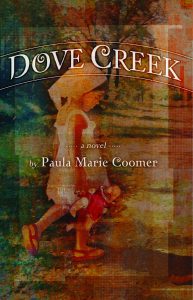
I was lucky enough to find Booktrope—or Booktrope found me; it’s still pretty magical, the way that all happened—at just the moment I had given up on finding a publisher for my novel Dove Creek. That poor book had been through the mill. Depending on how you counted it, 10+ years and 14 drafts. Forty-six rejections by agents and small presses. Tossed to the back of the closet in the early light of the 21st century only to be extracted in 2007, when a local indie-radio producer asked whether I had anything of book length that might work for serialized broadcast. In that form, Dove Creek had already had a nice run by the time I met up with Ken Shear and Booktrope, with thousands of episodes downloaded and no sign of stopping.
A ready-made audience.
Ken had this new thing going, this idea about how books should be published. It involved merging old traditions with new technology. Manuscripts carefully vetted for craft and storytelling. Agents welcome but not necessary. No capital outlay from the author. Other tasks accomplished via independent contractors—and only the best and the brightest—for editing, design, and marketing. Making good use of print-on-demand to keep overhead down. Meanwhile, supporting authors to go out and do what they do perhaps second best—because the writing is always first—meeting the public, by offering brick and mortar stores decent discounts and providing authors deep discounts so that signings and readings are affordable.
What sets Booktrope’s community aside, however, is that it is a community. There are hundreds of us—authors, editors, artists, designers, marketing folks—all full of the belief that books still matter, that good stories are meant to be shared, and that you change the world one syllable at a time. Thanks to technology, the Internet, we come together in a rather large central web space called Teamtrope, the techno-equivalent of someone’s back patio, where book deals are made and work plans tweaked and where we hold our collective breath while waiting for that first glimpse of a book’s cover. There are places to chat with other authors when you feel the need for support, places where you can see how your book is selling, rooms for training for all the production folks, for tracking that production, and all of it transparent and visible to the author. Books are created by equally-invested teams which means, except for a few paid employees, compensation comes primarily in the form of royalty shares—which means it’s in everyone’s best interest to take part in promoting books they’ve been involved with, but it also means divvying up the loot with people who matter to you when your book makes it big.
All this aside, perhaps Booktrope’s defining characteristic is their commitment to marketing and their heavy online presence. When Dove Creek came out (Booktrope’s first literary novel), all titles were available for reading in an online library. Ken’s theory was that people would read the first few pages of a book and then make the decision to buy. His theory was backed by such well-known authors as Neil Gaiman, whose video attesting to the advantages of giving away your work is featured on Booktrope’s website. All this turned out to be true. People sampled books and then bought them. With nearly three hundred books on the market, Booktrope no longer maintains its reading library, but this philosophy of giving first is ingrained in all of us as we are reminded not to hawk our books, but to give of ourselves by reaching out to people first, making our work available on free-reader sites such as Wattpad, keeping up with our own websites where we write about our lives and daily insights, in short, making shared humanity our first mission. “Book sales will come,” they tell us. And they do. Quite a number of Booktrope books have won awards or reached bestseller status, mine included.
In the end, selling books is also about making money—everybody has to pay rent—and since making money in our world is deeply connected to image, Booktrope is also deeply devoted to their image as a publisher committed to fine craft and the furtherance of their belief that readers don’t want Pablum, don’t want their prose diluted. From chick lit to sci-fi to erotica to literary prose to poetry, quality of writing and storytelling comes first. Most Booktrope authors are professional people, schooled at the graduate level and beyond. Many are academics. And you only have to cruise through the catalog to see that just in case a Booktrope book is ever judged by its cover that cover is going to make an unforgettable first impression.
Do I regret the fact that I somehow, after twenty years of trying, missed the boat to New York publishing? Not really, even if I did once envision myself as the next Irma Bombeck. In fact, a number of Booktrope authors have previously been published by the big dogs, and they all have the same thing to say: publishing with Booktrope is a much better experience; the support for authordom is invaluable; books never go out of print, and they are never remaindered—you’ll never see yourself in the ninety percent off bin. Not to mention the fact that New York seems to be asleep. None of us really knows what that crowd is thinking—or up to. To my experience, they are about the business of stealing postage, since none of my SASE’s ever come back.
It’s funny. Booktrope set out to do something legacy publishing (another way of saying traditional publishing) has never done—except in a very few cases—and that is to nurture authors in such a way as to promote creativity and productivity. So, the more books an author has on Booktrope’s list, the better. In this way, they are making authors into “legacies.” From what I was always told, the only thing harder than getting a first book published is getting a second book published. The hybrid philosophy is just the opposite. You also never hear the words, “We don’t know how we’d market it.” Instead you hear, “What are all the ways we can market this book?” The philosophy as I have experienced it with my “hybrid” press has been as much a merging of principles as processes, and unequivocal: give thrice as much as you ask for, and never seek a final answer; rather, always be working in anticipation of a new question, which is, invariably, “What will you be writing next?”
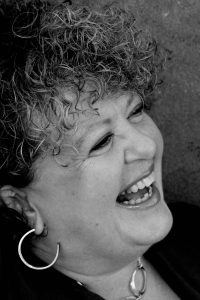
 Paula Marie Coomer, the daughter of many generations of Kentucky mountain people, lived most of her childhood in the industrial Ohio River town of New Albany, Indiana, dreaming of New York City and the glamour of the creative—art, literature, the theatre. A vision gleaned from the pages of magazines and catalogs. What she chose instead was a Westward-bound, vagabond life of part-time jobs and rootlessness until, in her early 20s, she began craving an education and made her way to a community college in Oregon, ostensibly to study writing. It took nearly 20 more years and a career in nursing before all the built-up stories and poems began making their way to the page. Those stories have appeared in many journals, anthologies, and publications, including Gargoyle, Knock, and the acclaimed Northwest Edge series from Portland’s Chiasmus Press. Ms. Coomer has been nominated twice for the Pushcart Prize, was the 2006 Writer-in-Residence for Fishtrap, Oregon’s much-loved advocacy program for literature in the West, and is the author of an array of books including Blue Moon Vegetarian, Dove Creek, and Nurses Who Love English. Ms. Coomer lives near the mouth of Hell’s Canyon in southeast Washington State and teaches English at Washington State University. www.paulamariecoomer.com









 gotten a recommendation from one of their long-time authors. But I had trained myself to harbor so little hope for good things that the acceptance knocked me over with the proverbial feather.

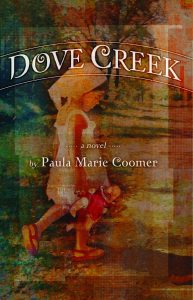
 Paula Marie Coomer, the daughter of many generations of Kentucky mountain people, lived most of her childhood in the industrial Ohio River town of New Albany, Indiana, dreaming of New York City and the glamour of the creative—art, literature, the theatre. A vision gleaned from the pages of magazines and catalogs. What she chose instead was a Westward-bound, vagabond life of part-time jobs and rootlessness until, in her early 20s, she began craving an education and made her way to a community college in Oregon, ostensibly to study writing. It took nearly 20 more years and a career in nursing before all the built-up stories and poems began making their way to the page. Those stories have appeared in many journals, anthologies, and publications, including Gargoyle, Knock, and the acclaimed Northwest Edge series from Portland’s Chiasmus Press. Ms. Coomer has been nominated twice for the Pushcart Prize, was the 2006 Writer-in-Residence for Fishtrap, Oregon’s much-loved advocacy program for literature in the West, and is the author of an array of books including Blue Moon Vegetarian, Dove Creek, and Nurses Who Love English. Ms. Coomer lives near the mouth of Hell’s Canyon in southeast Washington State and teaches English at Washington State University.