DRAWER NO MORE!
The Saga Continues and Miracles Happen
You mean they didn’t fly off the shelves, after all?
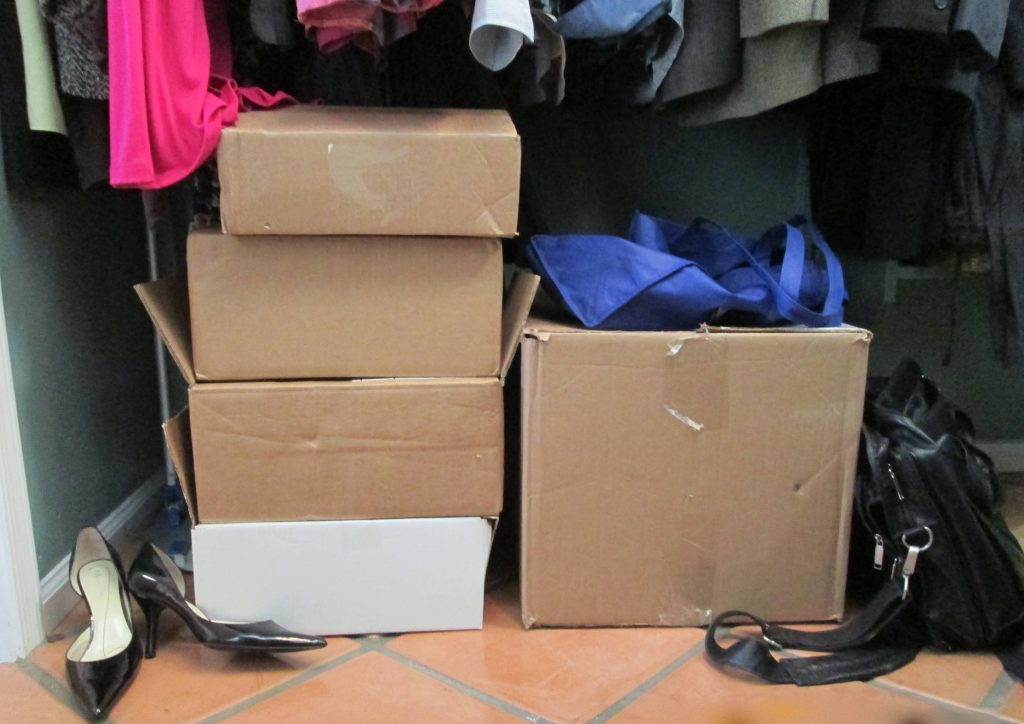
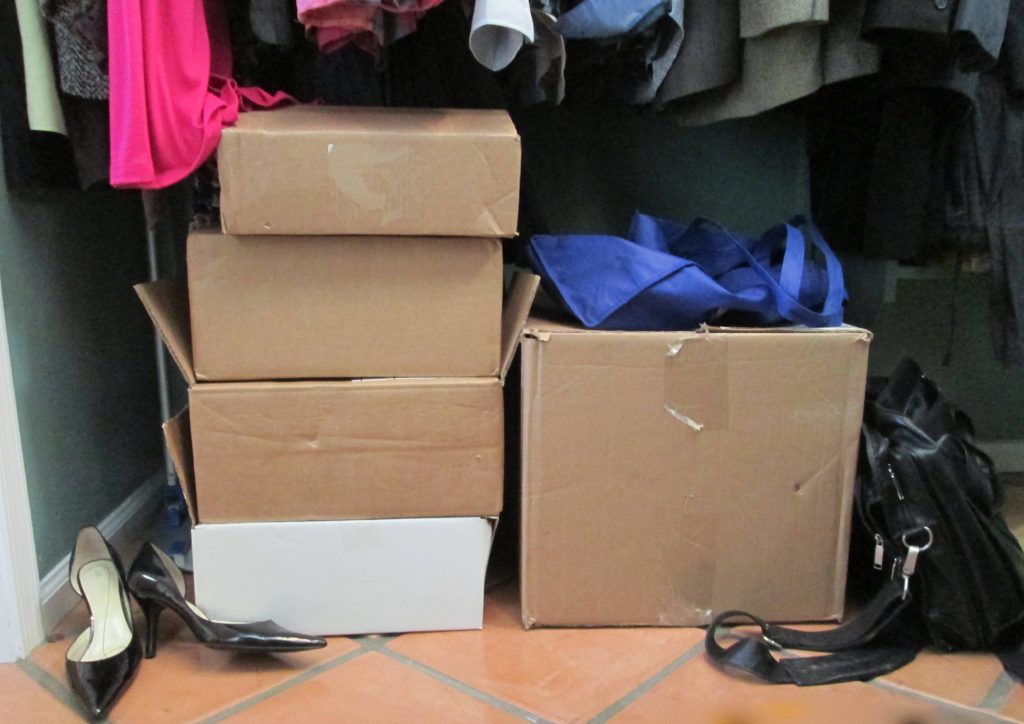
As mentioned in the last installment—way back in a previous era of self-publishing, I had wrangled a grant to fund the printing of my grief-themed poetry book. Numerous copies (let me save a bit of face by omitting an exact number) still languish in my garage and closets. It dawned on me that American poetry books, especially self-published ones, rarely fly off of shelves unless one lives in hurricane country.
So I confronted the fact that self-publishing equals self-marketing. Chief of Sales did not seem a promising role for me, considering that I became a writer to accommodate a tendency toward introversion bordering on agoraphobia. For the sake of my poetry, however, I bit down on the hardest object available—in this case, the hefty tome of Writer’s Digest’s Poet’s Market—and steeled myself for an exercise in self-promotion.
Leafing through the fine print, I compiled a list of publications that, allegedly, “Accept books of poetry for review.” How fitting! I thought. I’ll persuade a few of these folks to review my lovely book, thereby attracting others to purchase a copy! Of course, sending out review copies and receiving orders with checks enclosed would all take place via snail mail. So quaint! It’s almost as if I were Jane Eyre, posting inquiries for a situation as governess to a good family.
I organized my list of publications where I planned to request reviews in three categories. The “Prestigious” category included fancy quarterlies like Prairie Schooner that printed famous poets in every issue and reviewed books from presses like Copper Canyon and BOA Editions. Although I had already sent many individual poems to Prairie Schooner with much stubborn hope but no avail whatsoever, I couldn’t resist giving the book a try as well. Next, the category of “Not So Prestigious but Nice Enough” included journals of smaller print runs that published poets I hadn’t necessarily heard of, but that seemed to uphold high production standards like pretty cover art and perfect binding. Here I placed the River Oak Review, Kestrel, and others. That left the “Basic but Still Worthwhile” category, which covered the great many titles that cried out to me from the pages of Poet’s Market: The Old Red Kimono, Earth’s Daughters, Djinni. This included the hated saddlebacks (stapled booklets like I made at home with my children) and even several tabloids.
Was my attitude snobbish and deluded? Go ahead—you be the judge.
I mailed out thirty copies of my book: ten for each category of my list. I enclosed a personalized letter to the review editor of each magazine, along with a self-addressed postcard so he or she could let me know how quickly to expect the review of my book to grace their pages.
Out of thirty postcards, three came back. One bluntly stated that grief is a fitting topic for the world’s greatest poets. It behooves the rest of us to hold our tongues to spare insightful readers our sentimental clichés. Another informed me that the magazine was ceasing publication. And the third offered a balm of compliments (“What a lovely and deeply spiritual book you have produced”), while explaining that they had stopped reviewing books due to limited funds and space. God bless Kathy DiMeglio of Kalliope, wherever you may be today!
Thank God for the tabloids and saddlebacks! One of these finally published my only review. It wasn’t actually a litmag from my list—just a regional newspaper for the New York Finger Lakes resort towns that ran short poems as filler. Truth be told, they offered to print a review of my book if I took out an ad, which I did. Something irresistible like: GRIEF POEMS FOR YOUR LOVED ONES. JUST $6.95 ppd.
The review duly appeared, but I can’t find a copy in my records, even though I’m a notorious saver of everything. I think it ran about 20 lines and said some nice things. But despite my ad that appeared on the same page, I never received an order from the Finger Lakes region or from much of anywhere. Like the majority of poets throughout history, I sold a handful of books to people who knew me. Once, at a street fair, a woman stole five copies for reasons unknown. She slipped them under a hand-woven poncho and hurried away before I realized what she was up to. Dismayed at the time, I thank her today. Five less books in the garage!
As I said, these poems concerned grief and healing. I wrote many of them in response to my husband’s harrowing experience of the death of his teenage daughter. Others reflect losses in my own life. So it befits these themes, I think, that we wound up giving away many dozens of copies of the book. For a time, I was mailing them out to any locale where I happened to read of young people dying of illnesses or in unfortunate events. When my husband and I visited Denver, I took copies to all the churches I’d seen mentioned in the news in connection with memorials after the Columbine shootings.
I was pleased to receive occasional notes of thanks. Still, the excess boxes were beginning to molder.
And then, at some point along the years, a miracle took place.
My husband is a well-known scientist who attends a number of professional conferences. At one such conference, where I tagged along, we met a kindly older gentleman who owned a sales and distribution business for books related to alternative medicine. My husband persuaded him to accept my poetry book for distribution. Naturally, I was thrilled, imagining that someone other than myself would now take over my marketing and selling.
But that was merely a minor part of the miracle.
The distributor sold only five copies of my book in five years. At the end of that time, I received a form letter from the kind gentleman’s successor. They were terminating our professional relationship due to a “poor fit” of content areas. And they were charging me $45 for five years of storage fees, plus postage for returning my “unsold stock.”
All of that was irritating at the time. It is nothing, however, in light of what soon happened. One of the copies the distributor managed to sell came into the possession of a very special person.
One morning, my husband received an email from a woman asking permission to set a poem from my book to music. She explained that she was a music therapist and had picked up A ROAD BEYOND LOSS by Anesa Miller from the sales table at some nearly forgotten meeting. Now she was preparing to move house and had been sorting through her shelves, disposing of unneeded stuff. When she came across my book, something made her pause before dropping it in the giveaway box. She half-remembered opening it a year or two earlier and thinking she really should take time to read it more closely. Sinking down on a chair in the disarray of moving boxes, she opened my book again. She read the first stanza, and something happened: A fresh, beautiful sound welled up around her. As she read on, the sounds flowed and changed and flowed on anew.
She heard music.
The woman’s name is Jane Click. She had never composed music before, but the words and rhythms of my poem had inspired her to try a new path. Eager simply to capture the melodies born in her mind, she promised not to seek profits, or to share them with the poet (me!) should any proceeds unexpectedly result.
Of course, I gave permission for Jane to set the poem to music and share the resulting song with whomever she wished. Less than a week later, she emailed again. She had discovered that each poem in the book gave rise to its own melody. Her project was expanding—she would like to write music for all the poems and arrange instrumental lines to accompany the vocals.
My mind was boggling: In spite of all the frustrations with publishing and marketing, in spite of the unsold stock in the garage—one copy of my book had found its way to the hands of An Ideal Reader. And she was a reader who not only perceived the feelings I’d hoped to express but extended them. A reader who found a use for my words beyond my wildest dreams.
As I got acquainted with Jane, it came as little surprise to learn that, like my husband, she is a bereaved parent. Her path to becoming a music therapist later in life was a winding one that helped her move beyond her own grief at the loss of her son to a drug overdose. She understood every milestone described in my poems. With a group of musicians at her church, she recorded the songs she wrote, created a CD, and produced a booklet of sheet music. She sold at least a dozen copies of my book and sent me a check for the full amount.
The following summer, Jane traveled from Tucson, Arizona, to my home in Ohio to visit me for the first time. She played her music for me on the piano. She said, “Everybody cries when they hear your words, or when they read them.”
I broke down, too, and cried in her arms.
Jane held me around the shoulders on the piano bench. “It’s okay,” she said. “Everybody cries.”
Everybody: from the world’s greatest poets to all the rest of us.
Listen to a sample of Jane’s music:
For a copy of Anesa’s poetry or Jane’s CD, leave us a comment below or a message via the contact page.
I have a story on companies that “assist” writers with self-publishing. Get ready.
When I started my book, Alzheimer’s Through My Mother’s Eyes, I had no idea who to contact, what the financial costs might be, where to look, who to call, etc. You will love this one: I didn’t even know there were such people as “BETA” readers. I just typed my heart out everyday and figured it would somehow flow together. My only concern was writing my book, baring my soul.
Then I went looking online for publishing companies. BIG mistake. A couple of them looked OK, they were connected with bigger named book companies, and it appeared they had branched out to the self-publishing community. Apparently a lot of people write books and the self-publishing companies want to accommodate rising new authors. I checked out some internet sites. It looked exciting, so I signed up for a representative to contact me.
Now, mind you, I know nothing about publishing. AND I am an older client who tends to be trusting. You could use the word naïve. I listened intently to their pitches and packages. But HOW was I going to afford this? They wanted thousands of dollars just for editing. Of course, they could work out a payment plan. Or I could use my credit card.
I tried to get a direct answer on exactly how much they would receive financially versus how much I would receive. They evaded that question and continued to talk about a “gold standard” club, how good my book sounded, how much people need to read it, and on and on. Caregiver books are awesome, so many people would buy it! WOW – I felt like the best writer in the whole world.
I told my husband I had found a publishing company. We were so excited! I had them FAX me copies of their contracts, which were 7-8 pages long. (They obviously didn’t WANT to fax this information, but they legally had to). The editing part didn’t look very substantial. I began to get an uneasy feeling.
ALWAYS trust your gut.
Then came a stroke of fate: a friend recommended I contact a local author, and ask him about these companies, editing, publishing, etc. Thank goodness I followed this suggestion. The local author emphatically told me NO – do NOT use such companies. Do a search and type in: company name, scams and fraud. I did as he instructed and found pages upon pages of unhappy clients: Lousy editing job. Where was the book they supposedly published? It wasn’t online – had these companies changed the names of people’s books and published them in secret?
Where were the royalties, MONEY? I saw much discussion and dissention on financial paybacks, total dissatisfaction with the editing and presentation of authors’ products. WOW – at least I had not signed the contract, thank goodness for that.
At this point, I started to look up authors who had been published by these companies. I read the book samples, and my heart sank. They were such good stories, excellent storylines, but the editing was horrible. I wanted to communicate directly with an author and so asked one of the companies if they would put someone in touch with me. Could they give MY information to him/her – as I did not expect them to give me this personal information on one of their clients. The lady in customer service said she would look into it.
Soon a lovely young woman emailed me – and explained that she had just had her book published by the “So and So” company. She was very nice, very young, and gave me the name of her book so I could check it out. She had used the company with trust – and I sincerely thanked her for contacting me.
She was overjoyed to be a new author.
I cannot tell you how upset I was when I opened her free sample online. To think this was a PUBLISHED book. PUBLISHED by one of these “self-publishing” companies.
The grammar, sentence structure, capitalizations, commas, periods, paragraph breaks, and anything else that would fall in the category of “EDITING” was ATROCIOUS. It got worse as I continued to read. The sentence that started with, “I had went…..” ran onto page 2. My jaw hit the carpet. This couldn’t be right. I closed the link and put in the name of her book again on the search bar. The same book cover displayed, same title found. This was beyond embarrassing. Now I had to figure out what to say to this young lady who was waiting for my response to the new book she had published.
After I calmed down, I realized that this new author had paid a substantial amount of money to the company. I wrote and asked her nicely if she had had her booked edited? Was that one of the services that she paid for? I didn’t want to make her feel badly about her book. This wasn’t her fault. She had trusted the company with her private story. OMG it was heartbreaking. If I remember correctly, she had paid over $3,000.00 for all services. She told me she had received financial help from family members.
I couldn’t resist and emailed the customer service representative who had given me the name of this young author. I asked her if the young lady’s book had been edited? Is that what they called editing? What did editing entail? What exactly DID they edit? There were errors from the first sentence on, I couldn’t even finish the free sample. I asked her to please answer me – because if this is what they thought I was going to accept as “EDITING,” they were sorely wrong.
I also asked how the CEO of this company could sleep at night. How could they take advantage of new and upcoming authors? The sad thing is – the company put me in touch with this new author to begin with. I pointed that out as well. They might at least have sent me someone whose book was less riddled with errors!
No surprise, I never heard from that company again.
I have now told countless individuals NOT to use the two companies I dealt with. I told them my story and my discoveries. All factual.
I then started looking at blogs, professional blogs, magazine authors, etc. I ran across a blog that listed the 5 warning signs to look for – to NOT use a company….the company I contacted fell under 4 of those signs.
I found the American Society of Journalists and Authors at http://www.asja.org/ – a professional and upstanding organization. A blogger led me to this site. Thank goodness!
My story has a very happy ending, and I am forever grateful to the ASJA for referring me to: http://www.bibliocrunch.com. I wasn’t feeling so trusting anymore – but I now realize there are honest companies with integrity out there to help us new Indie authors who have no idea what we are doing!
Through this site, the CEO helped me set it up – since I am not a techno genius. It is a bidding site – and I placed chapters of my book, the subject of caregiving, Alzheimer’s and explained my story. I cannot tell you how much I appreciate Ms. Sattar’s help. She renewed my faith in “mankind” (woman kind). Through her site, I was fortunate to have a bid from Author Options.
I accepted the bid from Author Options, and the rest is history. I will be forever grateful to both of them.
Lesson learned: DO YOUR RESEARCH. Be wary of self-publishing companies and their fancy talk and promotional pitches.
Do you have a story of bringing your book to the public, either independently or via an organization? Please feel free to share or comment on other relevant matters.
Richly detailed with the realism of everyday life, Anesa Miller’s new novel, OUR ORBIT, reveals the perennial tension between modernity and tradition in the Appalachian corner of bellwether Ohio. The conflict plays out between two families who’ve lived side by side for generations, never crossing paths until now.
When a series of misfortunes rips the Winslow family apart, nine-year-old Miriam is separated from her parents, her sister and brothers. She becomes a foster child to the Fletchers, a well-meaning, college-educated couple. At home, Miriam never wore new clothes, was not permitted to cut her hair, and believed that children must repent their sins with major displays of remorse, or harm would come to their loved ones. Now she must adapt to the lifestyle of a more secular family while struggling not to lose her connection to the past.
Rick and Deanne Fletcher quickly come to love their “new little girl” with her cheerful energy and unusual ideas. Then they encounter the rest of Miriam’s family: Uncle Dan believes he was the subject of an invasive experiment. Sister Rachelle, just released from juvenile detention, harbors many painful secrets. Brother Josh is outraged that the Fletchers disrespect Christian teachings. When his plan to remove Miriam from their home fails, Josh reacts with growing hostility to interference in the Winslow way of life.
With writerly skill, Miller poses provocative questions about the forces at play in an American upbringing. Her narrative takes an unflinching look at the often conflicting systems of authority that operate within a family, a small town, and society at large, exploring how these systems shape an individual life. Among the interactions of her finely drawn and compelling characters, we glimpse the spirit that binds us in our common humanity—all of this in a literary novel that reads at the pace of a thriller.
My first adventure in self-publishing dates back to the mid-1990s. Under heartrending circumstances (more on that later), my fiancé at the time offered to pay for printing a small book of my poems. I had written several poems for him, addressing his sorrowful circumstances, which partly motivated his offer.
Even so, his generosity blew me away.
In a whirlwind of action, I reconsidered all the verses I’d ever penned that remotely fit the poetic topic of loss. I contacted a printer in the nearest town of sufficient size to have a printer. Prevailing on friendship, I recruited a local artist to create illustrations and advise me on stock, color, fonts, illuminated letters, and all such visual elements. Within weeks, I had selected a manuscript of 20 poems and made plans for a 64-page perfect-bound chapbook to showcase them.
With eager anticipation, I showed these plans to my fiancé, Jaak (pronounced Yahk, it’s a common name in Estonia, where he was born). He smiled and nodded until I whipped out the printer’s quote. This marked a shift in attitude, almost like a sudden drop in temperature. I had kept him up to date on every step of the planning process. But now, he seized a handful of paper from his inkjet printer and proceeded to demonstrate how efficiently one can fold several 8.5 x 11″ sheets and tape or staple them by hand. Voilà! A nice little booklet! Illustrations? How convenient they’re pen-and-inks—a cinch to photocopy! No, no, sweetheart—you didn’t waste time driving 50 miles to the printer to pore over expensive papers. It’s always worthwhile to see how professionals operate.
But let’s be reasonable, can’t we?
I’m afraid not. First, you urge a hungry writer to picture her name on the cover of a perfect-bound book, then you break the news that what you really meant was a home-assembled saddleback?
I’m afraid the scene wasn’t pretty. Language was used that I prefer not to remember as I accused Jaak of backing out after he—and he ALONE, with no wheedling on my part!—had raised my hopes to the lofty level of 64 pages and a card stock cover. That was an especially bitter pill: in order to keep the price down to (what I took as) a reasonable figure, I had foregone the fancy C1S (coated 1-side) cover, virtues of which my salesman refused to shut up about. AND NOW YOU’RE SNATCHING THOSE PRETTY DREAMS AWAY, LEAVING ME TO STAPLE LOOSE-LEAF COPIES FROM THE XEROX SHOP?!!
How could I claim that the book was really even “published” if it were a mere mock-up like I often made for my children, decorated with crayon drawings? How could I put an ISBN on that?
So my first self-publishing venture was marked by painful conflict.
This being a true confession, I must return to the fact that Jaak was deeply bereaved. At the time I’m harking back to, a couple of years had flowed under the bridge since the terrible night when his teenage daughter, Tiina, was killed on the highway south of town by a drunk driver. But the death of a child is a blow from which a parent never fully recovers, so that dreadful night was still fresh for my man, and my poems were meant to aid his healing. Instead, there I was putting vanity above compassion as I protested his stinginess after the fact.
(In my defense, I had sacrificed my eyesight, going from 20/20 vision to my first-ever pair of prescription glasses, helping Jaak put out his book, which I edited developmentally over a period of two years, then helped copyedit and proofread. Please bear this in mind before judging me harshly…)
Heaven sent down a few mercies, and as it turned out, a small grant materialized. I got my perfect-bound booklet of 64 pages with 2-color cover and professionally photographed illustrations. The end result was quite lovely, and Jaak declined to hold a grudge over my petulant outburst. In fact, as my husband, he remains willing to this day to support my further adventures.
Nonetheless, that early foray still provokes nightmares. I mentioned the difficult decision of turning down the C1S cover, despite the claim that it would lead to “reliably brisker sales.” How embarrassing to admit that I, a sane and relatively well-educated adult, believed my poetry book would sell! Everyone familiar with self-publishing in that pre-electronic era knows my next confession: I have nightmares of posthumous embarrassment, imagining how my descendants will find those cartons of books stacked in the garage. Oh—and here’s another pile in the attic! And, my gosh—even more in the hall closet!
You mean they didn’t fly off the shelves, after all?
Self-publishers used to hock hard copies of books from the trunks of their cars. Now there’s been a revolution with the advent of e-readers and online retail bringing costs down and boosting accessibility. Has this solved the problems of sales and distribution? Tell me what you think—please feel free to comment on these or related matters.
As you can easily figure, through all the years of submissions and rejections, publishing a book was my ultimate goal. Or my pipe dream, as it seemed. I produced two full-length manuscripts of poetry, one of short stories and one of essays. I attended writers’ groups and book clubs. I wrote three novels, appealed to agents and editors, researched small presses (which always seemed to cut off submissions the week before I discovered them), and I paid tidy sums for critiques of my work and my query letters.
All to no avail.
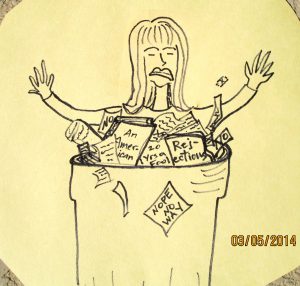
One bright morning, sometime after my collection of rej slips topped 2000, I opened the manuscript drawer and started shoveling. All those pulped trees and heartfelt phrases that no one cared about (except me, who didn’t seem to count) weighed like an albatross around my neck. A ton of stuff that didn’t deserve to see the light of day went straight to recycling.
But as I wheeled the last bits—the best of my rejected work—down to the curb, a fresh thought dawned in my sorrowful brain.
Why not publish some of it myself?
Please bear in mind: self-publishing is not what I had ever wanted. Well, okay, here’s a true confession: for one minute, almost 20 years earlier, I did want to self-publish a book. My fervent desire to NEVER do so again is a direct result of that ill-fated experiment. I have spent nearly every day of the subsequent decades yearning for the other kind of publication: the knight-in-shining-armor kind, where my work, on its own stellar merits, attracts a caring agent who finds an intelligent editor at a major publishing house just dying to produce my work and promote it to all the world, which of course comes flocking to buy and read!
Oh, God—Farrar, Strauss & Giroux! Yes, yes—W. W. Norton! Don’t stop—Knopf, Penguin, Random House! Such was my fantasy life, year after year after year. (Dare I imply that these Great Houses f*ck their writers? Do writers delude themselves into believing traditional publishers offer the best arrangement since wine started coming in bottles?)
In short, after all that unrequited lust, you can imagine how hard it was to accept the new idea dawning upon me. I resisted furiously, drummed up excuses why self-publishing was wrong for me—even if other writers were embracing the process left and right. For example—
I hate e-books.
I don’t speak mobi and don’t intend to learn.
Arcane formatting makes me break out in a rash.
Don’t trust the term “creative team.” Don’t work well with others after years in that lonely garret.
Can’t find a competent copyeditor, proofreader, designer, illustrator, or other members of that team I don’t trust.
Can’t tell a shyster from a legit author’s services company.
POD what?
And on and on.
But more compelling than any excuses, all the while I wallowed in my stalling tactics, the characters in my latest novel kept speaking in my ears. Their babble of voices told me, “You owe it to us to try! We want out to see the sunlight! You know people will love us if they only get the chance. We don’t care if it’s not Knopf—just publish us. We’ll do the rest.”
What could I possibly say to that?
Tell me what you think: Does corporate publishing make off with too much of the pie while writers starve in their garrets? Is it fair for the house to take the major cut even on low-overhead e-books? Please feel free to comment on these and related matters.

 You mean they didn’t fly off the shelves, after all?
 The woman’s name is Jane Click. She had never composed music before, but the words and rhythms of my poem had inspired her to try a new path. Eager simply to capture the melodies born in her mind, she promised not to seek profits, or to share them with the poet (me!) should any proceeds unexpectedly result.