Listen to a reading of “Relic of a Bygone Day”
Let me read to you!
Here’s my voice recording of “Relic of a Bygone Day,” an essay in my collection To Boldly Go: Essays for the Turning Years.

Here’s my voice recording of “Relic of a Bygone Day,” an essay in my collection To Boldly Go: Essays for the Turning Years.
 How did an old-school scribbler—a garret-sitting recluse and hater of newfangled technology—make the leap to electronic publishing, social networking, and that bête-noire of all things authentic, self-promotion?
The leap is not complete. Right now, I’m skidding between safe harbors, grappling my way up the slopes of a “vertical learning curve.” Whether I manage to touch down lightly in the high-tech literary world remains to be seen. You’re invited to watch the virtual Reality Show of my struggle, right here on the Blog at the website I never thought would bear my name!
What forces a formalist poet and literary novelist like yours truly to attempt such a jump in the first place? Short version: I found myself at a crossroads where I had to make a drastic change. I needed to take my artistic future in my own hands, or else do something destructive—reject my identity as a writer: erase files, burn journals, rent out my office to a deserving graduate student.
As writers (or artists of any stripe) our own psychology is no doubt our greatest asset. It can also become a terrific stumbling block. Before I began inching forward with self-publishing plans, I had hit an all-time low. I fell into a depression and suffered from agoraphobia, refusing to leave the house for days on end.
One of my favorite cartoonists, Peter Vey (www.pcvey.com), brilliantly captures aspects of those feelings in an item I ran across in The Funny Times (www.funnytimes.com)—
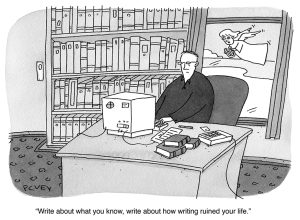
Writing can be a lonely business. For almost two wasted years, I DID feel that writing had ruined my life: While others engaged with the world, teaching children to read, growing food, or building cars, I sat in my garret pondering a fuzzy navel. I had dedicated my “talents”—paltry as they seemed—to a cruel muse who offered fewer satisfactions with each passing year. Self-expression was my be all and end all, but if no one beyond the self takes the slightest interest, what’s the point in expressing anything?
What do you think: Is writing an isolating occupation, or does the exercise of imagination let you connect with all humanity? Are artists more prone to depression than people in other walks of life? Please feel free to comment on other relevant matters, as well.
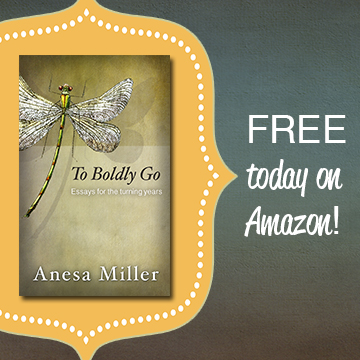

Here’s a free book promotion just in time for all of you that got a new Kindle or iPad for Christmas! Today and tomorrow, you can download my collection of essays To Boldy Go for free on Amazon.
“These are provocative and eloquent essays, fierce meditations on our human capacities and frailties, the nature of memory, acts of forgiveness. Anesa Miller summons our better angels and makes firm reckonings with the devil, casting it away. A stunning collection.”
– Tiffany Midge author of The Woman Who Married a Bear
“The world is blessed to have creative souls who write out of a need to make sense of what we experience when senseless things happen. Anesa is one of those people. …These essays reflect the healing of a fine poetic mind. They explore the inner life of an exceptional artist, intertwined with the history of our times, the lives of her family and friends, some of whom brought her joy, some misery. …Her moving thoughts come as a revelation…”
– From the Foreword by Jaak Panksepp
here is my recording of “Now I Lay You Down to Sleep,” an essay from my collection To Boldly Go.
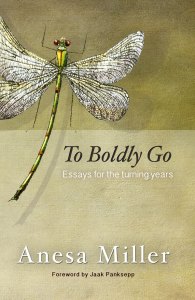
Essays for the Turning Years
BUY NOW ON AMAZONA summer of lush flowers and perfect weather. Girls dancing on a moonlit field. A cold house overgrown with abandoned gardens. These images come together in Anesa Miller’s To Boldly Go, which explores the “turning years” of our new century from both a personal and a universal perspective. The author reveals the intimate pains of anger and loss at the death of her estranged father, but looks beyond emotional damages toward the wider horizon of environmental issues, runaway technology, and the implications of 9/11. This journey toward healing and hope traverses the landscape of memory with an eye for a better future.
“These are provocative and eloquent essays, fierce meditations on our human capacities and frailties, the nature of memory, acts of forgiveness. Anesa Miller summons our better angels and makes firm reckonings with the devil, casting it away. A stunning collection.”
– Tiffany Midge author of The Woman Who Married a Bear (Salt Publishing) and Outlaws, Renegades and Saints; Diary of a Mixed-up Halfbreed (Greenfield Review Press)
“The world is blessed to have creative souls who write out of a need to make sense of what we experience when senseless things happen. Anesa is one of those people. …These essays reflect the healing of a fine poetic mind. They explore the inner life of an exceptional artist, intertwined with the history of our times, the lives of her family and friends, some of whom brought her joy, some misery. …Her moving thoughts come as a revelation…”
– From the Foreword by Jaak Panksepp author of The Archeology of Mind: Neuroevolutionary Origins of Human Emotions (W. W. Norton & Company)
eBook available for purchase now. Print available December 2013.