The LA Progressive says that, “Brad Parker is an award winning artist, songwriter, producer and musician. He has recorded, toured and produced hits in North America, Europe and Asia. Parker owns Indie label Riozen records and is a co-founder of ‘www.muzlink.com’.” His work has been recorded by Cher, Richard Page, Edgar Winter, Karla Bonoff, and many other well-known artists. In addition, Brad is a serious and dedicated poet, which began as a journey he describes for us here—
What is it about poetry that attracts us so? And when it is wedded to music, why does it take us so far into places we can never go but experience as if we have? My life in poetry has never brought me any answers, only these questions and more. Today, the question asked most often is, “How can I or anyone make a living writing poetry?” Well, that depends on the definition of, “making a living.”
At the age of eight I had begun my journey into the practice of music.
Then, I began writing poetry quite by accident when I was ten or eleven years old. It came about so suddenly, so effortlessly, that I cannot remember the first days very clearly. There I was, writing poetry without restriction, rules or knowledge of the art, let alone the craft. It swept me away. Over time, music and poetry cross-pollinated in my subconscious and emerged as songs. At the time, it had no purpose other than just creating. Maybe you started out that way too?
Many years later, I was writing and producing songs with M. Nasir, a Singaporean-Malaysian poet, singer-songwriter, composer, producer, actor and film director, in Kuala Lumpur, Malaysia. Every night after work, we fell into discussions about the origin of the arts. Not only where we started, but where it all started. Nasir is a Sufi, a mystic and a joker. Our discussions centered on the first drawing, the first poem, the first song, the first instrument and the first dance. We challenged ourselves to determine the circumstances that created the primal arts and the ancient artists. It was our conclusion that among them all, poetry was the first and the most radical.
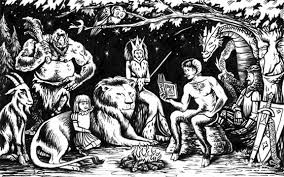
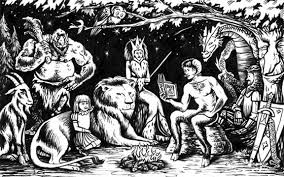
We imagined the several tribes of humans spread across the globe huddled around their campfires late at night. There, in somber tones and joyous rapture, the elders let their breath carry the first sounds, the birth of communication. It would not have been long before the sounds told the stories of existence, organized as poems, so that each generation could memorize them and pass them along. Any variation in pitch became singing, the first deliberate music. Eventually, instruments were devised and added to accompany the poetry that had become stories that had become songs. Then dance was added to bring the world of the epic poems to life and imbue them with enchantment and hurl them into the mystic. Finally, they were immortalized in drawings on cave walls…and on we went, careening down the corridors of time with only poems left to tell the tale of our brief, tragic and absurdly comic existence.
It is amusing and perhaps even informative to ponder the actual events that sparked poetry into reality. And though no one will ever know the true time and place for the birth of poetry and the arts, just the mere discussion calls forth the power from within that animates them all. And among all of the arts, poetry remains the most elusive, the most indecipherable. So, given its magical nature, its ephemeral existence, how then does anyone make a living writing poetry, especially in the global disruption of commerce and communications know as the Internet or Information Age?
It was quite possible to make a meager living as a poet throughout the ages if you could find a patron to support your work. More often, a patron was not available and poetry was composed as a passion, a compulsion that the poet was driven to pursue. Writing down your poetry for the sole purpose of creating it had to suffice. Every culture in every era has had its poets. Few of them made any kind of a living from the art itself. This struggle to survive by art alone was the truth of nearly all of the arts save for the decorative or architectural arts. And yet, it kept coming out of non-being into being.
Eventually, manuscripts recorded the epic poems, which had been handed down in the aural tradition, and troubadours traveled the countryside performing like the lyric poets of old in the courts of royalty and the marketplaces of the common folk. Actors performed the classic and contemporary dramas and comedies, which were the other repository of the poet’s inspirations. Poetry was most often heard and not read until the invention of movable type. Printed books, available to anyone who could read and purchased from the writer changed the circumstances of poets for a brief historical moment.
No sooner had poets and writers of prose been rewarded with a means of “making a living” from their art, than the publishers and printers took over the new lucrative business of literature. This tradition of organized theft or business management, masquerading as patronage, survives to this day. But no matter ~ Artists must create by any means necessary. This brings us to our current dilemma, our struggle to survive by writing poetry, or maybe, while writing poetry.
Like its related arts, prose and music, film and video, storytelling in every form has taken a beating in the Internet Era. It seems as though we poets and our fellow artists have been devalued, but that is an illusion. The arts have been stripped of their relative value, commoditized and tossed on the pile of digital information, to be consumed by the masses, profiting only the owners of the transmission systems, the Internet Service Providers or website owners. Profits on the works of artists of every type are soaring. Funds are just not going to the artists. Can we turn that around?
First, we must educate ourselves on the economics of the current era, the Internet. Yes, we must come out of our creative caves and take a look around. Many of us, like myself, will continue to write, to create, and find other ways to get by. But what if we could organize ourselves and align with other creators, collaborate on a solution to regain the fruits of our labors, cut out the middlemen? I believe that not only can it be done but that it will be done.
Here is an excerpt from an essay I wrote on a solution to part of that puzzle:
“…Amid the wonders of the Information Age that gave birth to the Internet and the World Wide Web is the vexing and unfinished business of, who owns the content, who pays for the content and all of the other issues surrounding modern copyright law and digital content distribution. The complexities of digital information and distribution systems have obfuscated a simple solution: the Blanket License Agreement…
Apple’s success can be greatly attributed to Steve Job’s foresight that all of the software and electronic systems and connections that comprise our new digital world can only be accessed by “hardware.” An Internet Service Provider connects every piece of hardware to the Internet. They are the new broadcasters, the new medium comprised of all of the old media. You can access them over phone lines, cable lines, Wi-Fi or by satellite. In every case someone pays the ISPs for that connection. Either the consumer pays directly or a business establishment pays or a municipality, etc. Most of the time those rates are quite high. That is where the profit is and that is where the New Blanket Licensing Agreements need to be applied…(just like radio royalties).”
I have just released a new book of poetry, “One Hundred Days Of Poetry.” It is selling, albeit in nominal amounts. Nonetheless, more music albums will accompany it and books from this creator as long as I can find a way to pay the bills. Writing and composing are a constant in my life, a north star. I hope they are in yours as well.
As M. Nasir and I considered many years ago, we are a crazy lot, artists, poets, and creators. Why we do what we do is a mystery. How we will make a living in the digital era is almost as great a mystery. Never mind ~ let it go and let it roll.
Here’s to the life of a poet and the continuing search for beauty and truth! May it beguile, disturb and comfort you all your days.
This is what Anesa says about her own work: “Two motives drive my writing: self-expression and communication. I find the need for self-expression strongest when negative emotions overwhelm the mind, as in a state of grief. But the person who speaks, or who writes, can use language to reassert selfhood by expressing the inner pain. And since language is a shared medium, the possibility of connecting with others is inherent in most forms of verbal expression. Understanding, concern, and sharing the burden are only words away. I tried to convey those truths in this poem.”
In the past few years, Anesa Miller has had to work through plenty of the “negative emotions” of which she speaks. She’s written a novel called Our Orbit, and has been struggling to break into the literary fiction genre, an uncommonly tough nut to crack. It’s been made even tougher by the simple albeit infuriating fact that no publisher will even look at her book. Why? Well, it hasn’t been for lack of trying. I first connected with Anesa on Twitter @anesam98, and I was honored when she agreed to talk to me about her experiences.
As summer prepares its steamy descent on the northern hemisphere, I find I owe my friends an update. You may have noticed that publication of my novel, Our Orbit, which I was drumrolling back in February, has been delayed by several months.
First, there were setbacks with the cover art. Plan A called for a commissioned painting to show a scene from early in the story where the foster family watches a meteor shower on a summer night. That proved harder to arrange than I had imagined. It takes a lot of detail to explain the ambiance of a scene—more detail than even appears in the novel itself!
I soon resorted to Plan B, which called for a simple backdrop of vintage calico with text in hand-lettered calligraphy. But there are a lot of options in fabric, and calligraphers must be recruited and schooled in the assignment. (Or not, as it turned out.) So Plan B also took more time than I’d budgeted.
Eventually, the cover got sorted out. I’m very happy with it.
Next came the editing issues. Our Orbit contains a good deal of dialect, namely, Appalachian English, also known as hill-country twang. The first editor I consulted found this troubling. True, words like ain’t and oncet may be considered incorrect, but try telling that to my characters! Concerned that new errors had entered my manuscript in the process of cleaning up the grammar, I turned to a second editor—this time, one with experience in the region where my story takes place.
Those complications set the schedule back a few more weeks.
But finally, my text was edited and proofed. The book was fully designed from cover to margins to page numbers. Everything looked terrific! Then, on the eve of clicking “Publish” at CreateSpace, I phoned my publishing consultant: a knowledgeable freelancer who advised me on my previous book. I wanted to make sure she’d be ready to assist again this time.
Alas—! Urgent family matters were calling her away from the office for the next three weeks.
What shall I do?
A more confident person than myself would no doubt shrug and go it alone. I tend to be nervous, however. A wee bit hyper-emotional. As I recalled a number of last-minute glitches in the formatting of my earlier book, I saw a nightmare waiting to happen. What if KDP didn’t like my conversion, and I had nowhere to turn for help? I decided I’d rather tolerate one last delay and wait till my consultant was back on the job to help me publish and promote Our Orbit.
That’s when she dropped a bomb on my comfort zone.
“If you’re going to wait a few weeks, anyway,” my consultant said, “you might as well use the time to apply to literary agents. Your type of book still tends to do better with a traditional publisher, rather than as a DIY.”
?!?!
This flipped me around 180 degrees. I had done the agent-search before. I devoted months to that time-consuming process with each of the three novels I’ve written. My first novel was too experimental—the main characters were inanimate objects. Agents nibbled, but none bit. My second, based on the Kosovo conflict, was too tragic. Only the likes of Andre Dubus III (House of Sand and Fog) or Hubert Selby Jr. (Requiem for a Dream) are permitted to pen such things in our “happy” postmodern era.
By the time I finished my third novel, I had learned many lessons: nothing too outlandish or heart-wrenching! So Our Orbit should have been just right. Sadly, even after several complete revisions, my text was too long. I spent a full year querying agents, and most seemed to agree. It was too long by a substantial, and oddly specific, amount: 35K words.
Most of these agents were passing judgment without requesting a sample. Not even a 5-pager to check on my style! Eventually, I figured out the unstated backstory: my novel was not too long for potential readers, at least some of whom pride themselves on soldiering through War and Peace or Memories of Things Past. No, it was only too long for standard publishers’ formulae for marketing a novel by an unproven author. They prefer no more than 90K for a debut.
More of a novella.
I could list examples of longer books by unknown people, such as the wildly popular The Story of Edgar Sawtelle by David Wroblewski. (Also, coincidentally, an acceptable tragedy!) The system seemed rigged against me, but how could I appeal for an exception to the formulae, if no agent would take me on?
I think you get the idea that the suggestion of going back to the drawing board to query agents all over again was not what I wanted to hear. In fact, the prospect of never appealing to agents again had become the most delightful aspect of self-publishing! So it was a testament of respect for my consultant when, after a few days of peeving and moping, I bit down on my knucklebone and sent out a group of query letters to literary agents.
Other than my pride, I figured, it couldn’t really hurt.
Because, regardless of their kindly protests to the contrary, I find myself forced to take agents’ rejections very personally on behalf of my book. They say things like, “Your writing is lovely”—but, obviously, not lovely enough. “Your characters are intriguing,” but what difference does that make if readers don’t meet them? “Your story deserves to be told,” so why won’t anyone help me get it out there?
Fellow writers, have you heard all this before? How do you manage not to take it personally? And how do you keep from feeling that your cherished book just isn’t worth reading, after all?
The upshot is that Our Orbit will be delayed in going to press by another few weeks, minimum, while those rejections roll in. The hard part? Turning back to this drawing board has sapped my enthusiasm for self-publishing. I will no doubt wind up launching Our Orbit on my own, in the end, but where will I get the energy to promote it, now that I’ve admitted to myself I would really rather have a traditional publisher and an agent to help me along?
Like the rest of us mere mortals, I’m waiting to see what the future may bring…
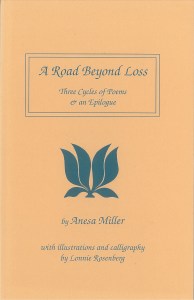
Almost 20 years have passed since I self-published my book of poetry, A Road Beyond Loss, and 24 years since the death of Tiina Panksepp, the lovely young woman in whose memory I wrote many of the poems. My life has certainly changed over that time. I married Tiina’s father and have done my best to give him emotional support while also grappling with the losses in my own life.
Writing has always been central to that process.
Today a new era prevails. For one thing, fewer garages are cluttered with self-published books since the advent of online marketing and electronic distribution. Such innovations have leveled the playing field, at least somewhat, for the average non-famous author. But “The Net,” as we called it, existed back in the 1990s, as well. I surfed it via a program known as Netscape. (Remember the icon of a large N riding something like a tidal wave?)
And how does one sell stuff on The Net? I’ve often been advised to start with a target audience. So in 1995, using a pre-Googlian search engine, I discovered some half-dozen “chat rooms” for grieving families.
One of the largest of these was GriefLog.* The name sounds almost shocking to me now—like off-key gallows humor—but the site represented a serious attempt for bereaved parents and others to find support by sharing with those who could best understand their pain.
I viewed GriefLog on the 10 x 8″ screen of my Macintosh Color Classic desktop, but the color capacity was superfluous here—like on many user-driven sites at that time, posts appeared as white letters on an even gray background. There were no graphics. No visuals. No diverse fonts. Threads were tricky to disentangle. But a desire to share my poems drove me to try.
A list of rules for GriefLog stated that no commercial activity was permitted on the chat board. I found this reasonable: no one in the midst of sorrow wants to be pestered by salesmen. But then, what exactly was I doing there? I thought of my husband: Every day I tried to help him live with grief: I listened, read him humorous stories, sang, chatted, walked by the river, gave of my time (not to mention cooking and cleaning). This seemed important because my husband wasn’t one to visit chat rooms or join support groups. How could I translate the positive energy I gave him to strangers at GriefLog?
Of course, I wanted to offer my poetry, but it had to be done in a non-commercial way.
I engaged in discussions and mentioned in passing that I had a book available upon request. To anyone who showed interest, I sent off a free copy with the hope (and gentle suggestion) that they urge friends and family to purchase additional copies. My hope was that this approach might gain its own momentum over time through spontaneous recommendations.
One man who’d recently lost his teenage son gave me some very touching feedback. He said he kept my book on his bedside table and read a poem every night. When he finished the book, he started over and, in the process of re-reading, chose a few favorites. These he revisited, over again, always one each night. Months later, he was still reading and still kept the book by his bedside.
There came a day when this man left me a message on the chat board, saying that I should visit some particular group or thread where he believed the folks were interested in my book. But how to find these people? I was still confused about the organization of threads. It’s not as if you could send out a tweet or direct message. You just had to wait for them to turn up at the chat room.
I nosed around the site as best I could but never found the allegedly interested folks. It looked as though this type of “marketing” would yield precious few results.
In fact, I didn’t sell a single book on GriefLog. To keep perspective, I remind myself that many poets, including those more talented than I am, don’t sell lots of books, either. Grief, after all, is a topic people naturally tend to avoid.
But—! Thanks to the wonders of PayPal technology, I am now able to offer my books here, at this website. If desired, I’m happy to sign the title page and provide a dedication (“For Sam on this special day…”) at no cost. I’m also making available Jane Click’s lovely CD with my poems set to music, and a score of the songs arranged for two voices, piano, and flute!
With thanks for all recent messages of encouragement, I’d like to share a poem that was set to music by my dear friend Jane Click. Here is text, as well as audio, for “The Ladder of Words.” It addresses the writing process and the role that process can play in healing.
Looking back, my book of grief poems, A Road Beyond Loss, was an effort to capture the two essential motives that drive my writing overall: self-expression and communication. Maybe that sounds abstract or simplistic, but it makes sense to me. My need for self-expression is strongest when negative emotions overwhelm the mind. In a state of grief, those feelings can become so strong they threaten one’s identity, the foundation of mental health.
But the mind that speaks, or writes, can use language to reassert selfhood by expressing the inner pain. Language is a shared cultural medium, so the possibility of connecting with others is basic to most forms of verbal expression. Connection is only words away. I tried to convey those truths in this poem.
For a recent update, visit “New Cover for OUR ORBIT” with information on a forthcoming novel, Best Regional Fiction
“The Ladder of Words” music by Jane Click, poem by Anesa Miller; performed by Clyde Kunz (vocal) and Jane Click (piano).
The Ladder of Words
When the world came down upon me,
and the sky closed like a door,
sounds filled my ears from far away.
I lay down on the floor.
And no one near could find me,
and nothing near was mine.
I sank into the floorboards
from the voices soft and kind.
It seemed like days, eternity,
that I could not be reached,
from sight and sound withdrawn
like a whale beached out of water
and thrashing like a fish.
Until one thought got through to me,
one image filled my mind:
a pencil and a paper, lying
close to hand, nearby.
Somehow I took them up and traced
one word and then the next,
until they linked together
in a chain that first perplexed
the darkness in my eyes—
Then, rowing on my paper barque,
I soon was far away
and saw the water trail I’d left
rise up into a chain
—a ladder reaching high above
to light and sound and friends.
And that’s how I climbed out
of the grief that has no end.
This poem is in memory of Tiina Shilts-Panksepp who almost became my step-daughter. Many thanks to Jaak Panksepp for giving me the chance to self-publish my poetry collection, A Road Beyond Loss. Special thanks also to Jane Click who heard such beautiful music.
~ ~ ~ ~
Thank you so much for visiting my blog today! Please browse the website and let me know if you like what you see, or if you have suggestions. You can reach me by leaving a comment in the box below or by clicking the Contact link at upper right (or just click here). Consider subscribing to my blog or newsletter. And stop by again soon!

 Many years later, I was writing and producing songs with M. Nasir, a Singaporean-Malaysian poet, singer-songwriter, composer, producer, actor and film director, in Kuala Lumpur, Malaysia. Every night after work, we fell into discussions about the origin of the arts. Not only where we started, but where it all started. Nasir is a Sufi, a mystic and a joker. Our discussions centered on the first drawing, the first poem, the first song, the first instrument and the first dance. We challenged ourselves to determine the circumstances that created the primal arts and the ancient artists. It was our conclusion that among them all, poetry was the first and the most radical.
 As M. Nasir and I considered many years ago, we are a crazy lot, artists, poets, and creators. Why we do what we do is a mystery. How we will make a living in the digital era is almost as great a mystery. Never mind ~ let it go and let it roll.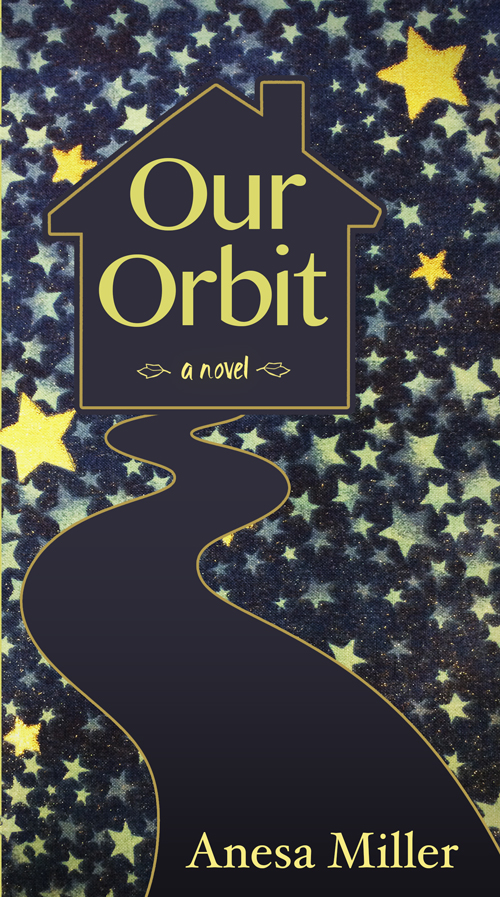
 I soon resorted to Plan B, which called for a simple backdrop of vintage calico with text in hand-lettered calligraphy. But there are a lot of options in fabric, and calligraphers must be recruited and schooled in the assignment. (Or not, as it turned out.) So Plan B also took more time than I’d budgeted.




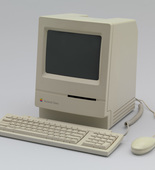 I viewed GriefLog on the 10 x 8″ screen of my Macintosh Color Classic desktop, but the color capacity was superfluous here—like on many user-driven sites at that time, posts appeared as white letters on an even gray background. There were no graphics. No visuals. No diverse fonts. Threads were tricky to disentangle. But a desire to share my poems drove me to try.