by anesamiller_wuhi6k | Oct 10, 2024 | Blog

By the Numbers: The New York Times Best Books Ratings
We’ve nearly reached the quarter mark of the Twenty-first Century, so it must be time to emphasize the horse-race aspects of contemporary literature. This appears to be the premise at The New York Times Book Review, which has released three lists in recent months acclaiming “The Best Books of the Century.” In April, The Times published an extensive compendium of over 3200 fiction, poetry, and non-fiction titles chosen from books reviewed by their staff over the past 20 years.[i] In July, the competition underwent further winnowing with “The 100 Best Books of the 21st Century,” a numerically ranked inventory compiled by a voting electorate of just over five hundred “literary luminaries.”[ii]
Just days later, the Times offered yet another list, titled “Readers Pick Their 100 Best Books of the 21st Century.” Reportedly, “we knew we’d hear from readers who were incensed or gutted or driven wild by grief. How could So-and-So’s book not make the cut?”[iii] (I note in passing that considerable overlap exists among the three compendia.)
A semblance of democratic principles is comforting, so we might consider that the process is trending in a positive direction with participation by the general public. For my purposes, however, I chose to examine a segment of the largest and most top-down of the lists. I isolated the fictional works of the past ten years from April’s multi-thousand item inventory. My plan: to interrogate the selections in hopes of revealing unstated assumptions. Any comment on any book appearing in The New York Times joins an extensive discourse of aesthetic and sociological pronouncements that deserve exploration.
In the interests of full disclosure, as a novelist who cherishes no hope of ever seeing my work referenced in our national “newspaper of record,” I confess to holding a somewhat jaundiced view of what the underlying criteria might be. After all, the once well-known author Mary Hunter Austin critiqued what she saw in 1920 as “the centralization of publishing trades in and around Manhattan.” Geography appeared to reduce American literature to whatever “a small New York group thinks ought to be written and thought.”[iv] Scholars such as Jon Lauck and others have extensively confirmed that little has changed in the more than one hundred years since.[v] Indeed, consolidation and profit motives in publishing have only increased in recent decades, while small presses and self-publishers struggle to bring attention to books that “major” outlets happily ignore.[vi]
My primary aim in examining the past ten years of outstanding fiction was to analyze settings to reveal quantifiable trends. Setting does not receive a great deal of focus in criticism. Indeed, I was struck by the frequency with which location went entirely unmentioned in The Times’ reviews of their favorite books.
I cannot guarantee that all aspects of my methodology are entirely scientific. I identified 437 books by 380 authors; this excludes volumes of poetry and some short story collections (both grouped by the Times under the rubric “fiction”). This was due to the difficulty of characterizing a setting in these writings. Of the 422 novels, many feature multiple settings. To address this dilemma, I chose an “all of the above” approach, identifying 566 settings, which I divided into eleven geographical regions.
Readers may be horrified to learn that I did not, in fact, read every page of every book in the data set. (In my defense, I suspect that not all members of the NYT staff read every book, either.) To ascertain where the most salient events of a plot take place, I relied on reviews, fly leaves, Amazon and Goodreads synopses, skimming, and posting questions online. For the most part, I did not include settings that I found confined to summarized backstory. I did attempt to distinguish and account for those where dramatized scenes occurred with character interactions. I hope readers will concede that varying degrees of subjectivity in literary decisions are unavoidable.
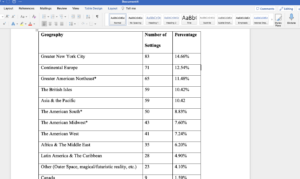
The frequency by which my eleven geographical regions occur as settings in the “best” fiction of the century is summarized below.

Screen Shot at PM
Figures are derived from “The Book Review’s Best Books since 2000,” published in The New York Times on April 29, 2024. Details of methodology and other aspects of this study are available by inquiry via the contact form below.
Items marked by asterisk on the chart above:
The Greater American Northeast*—Combines New England, Pennsylvania, and the Mid-Atlantic seaboard. I have included the metro regions of Washington CD and Baltimore in this grouping. Apologies to readers who deem these essentially southern cities.
The American South*—Includes Texas and Oklahoma with apologies to those who consider these states part of The West.
The American Midwest*—My decision to consider multiple settings within works resulted in several novels showing a Midwestern component solely by virtue of including limited episodes in Chicago. It may be worth interrogating the special role of this metropolis in regional and national discourse as a literary setting.
Some elements of these numbers are embarrassingly obvious, but I will point out that only one of the eleven regions represents a single metropolitan area: The Greater New York City area. The remaining ten regions include multiple states, provinces, or nations. As such, more fiction takes place in this limited urban setting than in several larger regions combined. Note that all other parts of the Empire State—Syracuse, Buffalo, the Southern Tier and so on—are placed in the The Greater American Northeast grouping. If we combine these two into an overall American Northeast region, it becomes still more dominant with roughly 26% of all settings.
It seems fair to say that the New York Times deems literature depicting their home locale to be “the best” in all of world literature. In this regard, it’s worth observing that The Times clearly means to present not merely American but international fiction. My findings indicate that settings in other countries constitute 46% of the total, which may reflect intentional decisions. I also calculated that titles in translation make up 12.35% of the 437 books in my data set. As a former literary translator (Russian to English), I applaud efforts to bring work from abroad to the attention of American readers. However, when we assess the imbalances of The Times’ preferences, one might conclude that a disclaimer would be in order: “Best Books of the Century For Those Who Prefer Eastern Cities and Enjoy Reading About Foreign Lands.”
In conclusion, I suggest a few avenues for further inquiry along the lines of the present study. Earlier in the twenty-year retrospective, an extreme imbalance in authors’ genders was painfully obvious; this began to approach 50/50 by the mid-2010s; one might elucidate the process whereby editorial evolution led to an egalitarian approach. More recently, non-binary writers have made an appearance. The delineation of genres has also changed over the years, which may reflect a degree of acceptance beyond the traditional high-brow novel. One can only hope that openness to the rest of our country may one day join the diversities celebrated by the New York Times. And it could be enlightening to generate an explicit—though, likely, very short—list of the publishing houses whose books are most approved.
The author invites those seeking further information on this study to reach out via the contact form:
[contact-form][contact-field label=”Name” type=”name” required=”true” /][contact-field label=”Email” type=”email” required=”true” /][contact-field label=”Website” type=”url” /][contact-field label=”Message” type=”textarea” /][/contact-form]
Notes
[i] The New York Times Books Staff. “The Book Review’s Best Books since 2000.” The New York Times, April 29, 2024. https://www.nytimes.com/interactive/2024/books/top-books-list.html?. Accessed on August 8, 2024.
[ii] The New York Times Books Staff. “The 100 Best Books of the 21st Century.” The New York Times, July 8, 2024. https://www.nytimes.com/interactive/2024/books/best-books-21st-century.html?. Accessed on August 8, 2024.
[iii] The New York Times Books Staff. “Readers Pick Their 100 Best Books of the 21st Century.” The New York Times, July 18, 2024. https://www.nytimes.com/interactive/2024/books/reader-best-books-21st-century.html. Accessed on August 8, 2024.
[iv] Quoted in Lauck, Jon K., p. 105. From warm center to ragged edge: The erosion of Midwestern literary and historical regionalism, 1920-1965. Iowa City: University of Iowa Press, 2017.
[v] Lauck, Jon K., p. 105. From warm center to ragged edge: The erosion of Midwestern literary and historical regionalism, 1920-1965. Iowa City: University of Iowa Press, 2017.
[vi] Fister, Tonya. “What Does the Consolidation of the ‘Big Five’ Book Publishers Mean?” Ask.com, August 16, 2022. https://www.ask.com/culture/consolidation-of-big-five-book-publishers-explainer. Accessed August 8, 2024.

by anesamiller_wuhi6k | Nov 8, 2019 | Blog

Classic “weird sisters” stir the pot of deplorable ingredients…
Last night, in my hourly check of national news for late-breaking tidbits on the impeachment, I made a disconcerting discovery: Attorney General William Barr’s inquiry into the origins of the 2016 Russia investigation has now been expanded into a criminal probe. This move gives prosecutors the power to subpoena witnesses and documents, issue search warrants, impanel a grand jury, and—potentially—issue indictments.
OMG, I’m thinking, will this be the ultimate distraction from blockbuster impeachment testimony? Will Mr. Barr conclusively besmirch his once not-so-awful reputation by charging someone with treason, as his boss claims many enemies richly deserve?
Never mind that the Department of Justice’s own Inspector General has already conducted an internal review of these matters, including FBI actions that have long been a point of rage-tweeting by our emotionally-unregulated POTUS. Never mind that the US Attorney from Connecticut, whom Barr tasked with the more far-reaching probe, found himself confronting a fool’s errand (by most accounts), thinly disguised as “Gotcha” law enforcement.
Mind the part that could lead to federal charges as political payback. Who are the likely targets? James Comey? John Brennan? Barack Obama (Remember, he ordered those wiretaps)?
I have many thoughts on this (and the New York Times has more details than I’ll explore here). But if you’re so inclined, indulge me in a small digression.
Because, all too often in the dark of night, I find myself beset by fears that I might face indictment someday my own self…
In my dreams of a future time, I picture a beloved child who has narrowly escaped the impending morass of corruption and social chaos that assails us in these times. This clear-eyed young person calls me to account, saying something on the lines of —
“Back in 2016, when our slice of the world—which in retrospect appears so innocent and whole—teetered on the brink of 11/9, what were you doing, Grandma? How did you help to preserve our sacred democracy?”
I can only hope that children of the future will possess such a concept as the incomparable value of government of, by, and for the people, however they may yearn for more perfect forms and expression. That very concept seems profoundly endangered today. Amid the belittlement and brownshirt tactics emanating from the halls of state since that fateful election, the idealism required to uphold civic norms is undercut on a daily basis—all but reduced to a quaint relic of bygone eras.
How do I answer the unflinching child of my dreams? Sadly, in 2016 I didn’t knock doors, make phone calls, or even write letters to editors of small-town papers across Ohio—actions I proudly performed during the three previous national elections. I do have an excuse for that lapse. Not one I’d expect to exonerate me in the eyes of that someday-grandchild, but something of an apology to trot out for those of my own generation, who may be more forgiving:
In the autumn of 2016, my partner of 26 years was grappling with the final illness that would take his life just five months after diagnosis. He had beaten two cancers in the past, but this one proved to be a more virulent beast. I couldn’t find it in me to reach out to strangers with an upbeat political message, urging one and all to vote down the demagogue. Instead, it seemed essential to, somehow, combine my political activism with the escapist, numbing activity my mind so desperately craved.
Naturally, I turned to Twitter.
I embraced the causes of several obscure state-level candidates, joined up to boost their followings, RT’d their positive appeals, as well as tweeting national news stories that rang like bellwethers of dire days ahead: The buffoon (who surely never could win the Presidency, could he?) was charged with defrauding gullible students of his get-rich-like-me “university.” Professionals of many stripes warned of the effects his degraded rhetoric would have on foreign relations, domestic extremists, and young minds. I believed I was doing my small bit to spread the word and inform American voters who were certainly intelligent enough to reject that sorry excuse for a candidate.
Checking out the trending hashtags of those times, I soon became aware of a virtual realm commonly dubbed “the fever swamp.” This was not the swamp our Republican nominee claimed he would drain. Far from it. Here was a realm where lies were deliberately churned into full-blown delusion by shadowy operatives of unbridled cynicism devoted to entrapping the gullible, the unstable, the traumatized — loosely moored human beings who might otherwise muster sufficient will to vote in their own best interest.
The trolls under those bridges were poised to drag down any vulnerable citizen showing an inclination to support the first female candidate of a major political party for President. They dug many pits for this purpose, deployed heavy weights of doubt, despair, and aspersion: effective obstacles to paralyze the infant hopes of first-time or sporadic voters, as well as those already defined as marginal, who might be prone to peeling off.
The best known of these pits was #Pizzagate.
When I first encountered this comical-seeming hashtag, I failed to realize that rational argument and even citations to Snopes’ online anti-rumor mill would prove incapable of denting troll armor. Thankfully, the Pizzagate narrative would be critically wounded by reality, when an irate believer showed up at the offending pie-shop IRL, his trusty AR-15 rifle at the ready. He fired three rounds into a wall and door in his determination to drive out the insidious pedophiles supposedly taking refuge behind cans of tomato sauce and jars of olives. The resulting barrage of real news explaining the absurdity of tales about Hillary Clinton and other Democrats running a child-sex operation out of the basement of this small business managed AT LAST to tamp down fevers in that dank cranny of the swamp.
Sadly, it happened a few weeks after the 2016 election.
But earlier that fall, on Twitter, I felt like a warrior for truth in spite of my obvious inability to save people from rampant false beliefs. I searched the hashtags for plaintive tweets from obvious humans among the dubious avatars of busty blond women, alleged veterans of special ops forces, and young dudes resembling Peter Fonda’s Easy Rider persona.
(Oh, and let me not forget the tweeters with faces of young black men whose contempt for Hillary and all Democrats — Da worse mo’fuckin’ racists on the planet! — knew no bounds but somehow conveyed a telling pose that drove me to ask on one occasion, “Be honest, @BaltHomeboy. Is that your picture? Are you truly not a white guy behind a black guy’s photo?” Cool to the core, he assured me he was “black as the night sky.” But within a matter of hours, his picture, tweets, name, and account had all vanished, as if into a black hole in that same sky.)
So I would seek out the humans among these trolls, the ones tweeting questions like, “Are well-vetted politicians really heading up trafficking rings in pizza shops?” I visited their profiles. Many were older people living in small towns with pictures of grandkids, pets, and cakes in their home feed. Lonely people, inclined toward Republicanism, but hesitant to believe the worst about their fellow Americans.
In case you imagine there’s no worse conspiracy theory than #Pizzagate, I must regretfully disabuse you. The one that became my Twitter obsession, against which I railed in long threads chock-a-block with fact and appeals to better angels was a narrative known as #SpiritCooking.
I will spare you the gorier details.
Suffice it to say that the heyday of #SpiritCooking coincided with poor John Podesta’s “time in the barrel,” as announced by that IRL troll Roger Stone. These were the delirious days after the WikiLeaks dump targeting Hillary’s campaign chairman. In a nutshell: A personal message from Podesta’s brother turned up in the hacked emails, asking about dinner plans. Like the tempest of a deranged sorcerer’s apprentice, trolls spun this less-than-nothingburger into the most lurid, libelous narrative of sex abuse, Satanism, cannibalism, and human sacrifice you can possibly imagine.
(But please don’t.)
They fanned inconsequential remarks into an urban legend that eventually featured Hillary (of course)—although she’s never mentioned in the actual emails, she’s now leading a coven under the cover of respectability shot through with such cracks as her gleeful participation in Bill’s countless forcible rapes and Epstein-fueled exploits. She frequented Fantasy Island, she drank deep of the brew concocted of blood and breast milk, feasted her eyes (if not worse) on huddled masses of kidnapped children and random body parts.
Because what else could possibly sate her depraved and limitless lust for power?
I remember one of the elderly women I discovered floundering under photoshopped “proof” on the #SpiritCooking hashtag. She had a normal human picture, a Midwestern profile, and several touching tweets in support of Jeb Bush. She asked, askance, “Did this stuff really happen? Where did it happen?”
I instantly sent her a personal tweet: “It is fake, @BuddysNana! #SpiritCooking is invented top to bottom!” I sent links to fact-based articles tracing the origin of the legend to performance art and neo-paganism. We exchanged a couple of tweets. I was peeling her back to reality. Then the trolls descended en force—it was like they watched my every move. They flooded the feed, blotting me out with “photos” of shrieking Hillaries, robed Satanic priestesses, missing and exploited children.
One proclaimed that I, too, “looked like a pedo.”
That’s when I understood there was something bigger behind all this than a few kooks with time on their hands, something broader than a social platform and better funded than a 400-pounder in his (or her) grandmother’s basement. This was an operation with resources and research behind it, with people putting in even more hours than the likes of me could spare to my mind-numbing addiction.
There were already hints coming out that Russia was behind many of the trolls and outlandish theories, the attacks on vulnerable American psyches. Sex abuse to entice and fascinate. Trampled taboos to repel, yet strangely attract. Fear and horror to transfix and immobilize. Money and control because that’s all that matters, right?
But Americans can take pages from the Autocrat Playbook, too, can’t we?
I felt a fresh chill, reading about AG Bill Barr traveling the world in search of support for multiply-debunked theories about Joe Biden, the DNC “server” magically spirited away to some babushka’s stove in Ukraine, and the mysterious Professor Mifsud believed by all American intelligence sources to be a Russian agent, yet named by Sean Hannity as a Democrat plant. With even greater resources at his disposal than a St. Petersburg troll farm, Mr. Barr is sure to find “evidence” if he looks long and hard enough. Some functionary somewhere will oblige. A few straws-to-grasp can always be scrounged from the dirt.
When truth itself is on the defensive, decades of life in the public eye cannot convince troubled minds that you don’t shapeshift into a giant carnivorous lizard the minute we let down our guard from pure exhaustion. Save the children, LOCK THEM UP, try them later!
Is this the world we’re leaving to future generations? Ideals of democracy on the back foot, our great American republic imperiled by nostalgia for the security of a strongman-style government?
Perhaps I’m an alarmist, and AG Barr won’t indict anyone in the Obama administration for “spying” on the Trump campaign. Or perhaps he will indict, but remnants of the Republican Old Guard will remember what outrage is for and repudiate the move resoundingly.
Perhaps a wonderful future awaits us, free of fake news, a future where citizens negotiate consensual reality in tones of mutual respect. Where children aren’t fetishized as objects of abuse and defilement. Where hope and idealism flourish. It appears bright and probable in my imagination, but I know it remains elusive unless we rededicate ourselves to Truth, and work our hearts out to boot pathological liars from office.
by anesamiller_wuhi6k | Nov 16, 2015 | Blog, Writing & Publishing
Many thanks to friend and fellow writer Ellen Harger for including my thoughts on book clubs at her lovely blog! The following post was first published there on July 27 of this year. Here, I’ll suggest some answers to the perennial question, “What makes a great read?” I’m always looking for a book that people will love to discuss as a group.
I’ve attended book clubs in Washington state, Ohio, Idaho, and elsewhere. For the most part, it’s been a wonderful experience with dedicated people discussing contemporary literature. When a group sacrifices their usual weeknight duties to gather and share ideas, I always like to see socializing kept to its own timeframe (before or after discussion). And it’s great when everyone makes an effort to stay on-topic! ;-D
Looking back on the best club meetings I’ve attended, I notice two factors, either of which makes for lively conversation:
- Controversy! It’s no surprise that people get passionate about sharing their opinions. In the book-club context, controversy tends to come in two varieties: social or personal. By social, I mean related to societal issues, and by personal, I mean our interpretations of a book’s characters and events. More on these below.
- Subject matter that enjoys a buzz around the time your club meets. This is hard to plan for, but buzz certainly inspires active discussion. What’s less obvious is that older books, including classics, may work as well as new releases, by serendipity.
- When these two factors coincide, as they did in the first example below, you’re in for an especially dynamic evening!
Book-clubbers tend to take considerable interest in current events and issues. That’s often why they join the group. And books can provide a unique avenue for engaging with controversial subjects. Hopefully, a degree of detachment—since we’re talking literature rather than politics or religion—will allow for airing all sides in a receptive atmosphere.
Sometimes it’s helpful to remind people of that!
My group in Moscow, Idaho, scheduled a meeting on Meg Wolitzer’s novel, The Interestings (2013). It’s a popular book about a group of high school friends that remain close into middle age and pass many milestones together. Who knew this would become an excellent vehicle for discussing the American health care system?
In The Interestings, the main character’s husband suffers from treatment-resistant depression. His illness periodically becomes severe, requiring hospitalization. Although medical insurance is not a key topic of the book, it had recently been all over the news with portions of the Affordable Care Act being hotly debated. At the time the novel takes place, major depression was a pre-existing medical condition that could lead to skyrocketing insurance costs or even denial of coverage.
While the fictional couple deals with this problem over the years, they struggle to maintain a middle-class lifestyle. The cost of living in the New York metropolitan area becomes prohibitive. Their friendship with other characters from younger days turns awkward as the latter attain astronomical financial success.
One reader in our group shared a strong opinion: “How could the poor guy not get depressed when that other couple flaunts their wealth? Vacation homes, trips, servants – and he’s supposed to grin and bear it on 65K per year.”
Others raised the issue of lost productivity due to illness. Some focused on the privileges of inherited wealth. Still others saw a tendency for the rich characters to exploit the struggling couple’s loyalty. With the novel’s many relationships as touchstone, we managed to talk about “Obamacare” without straying too far from our book.
And without losing any friends in the process!
Another terrific discussion took flight around a more personal controversy: members’ interpretations of a key character in Anita Shreve’s The Weight of Water (1997). This is a historical fiction/mystery novel that’s tough to summarize without spoilers. Suffice it to say that I’m a big fan of the book and found myself drawn into the plight of a Norwegian immigrant’s bleak existence. Shreve’s interweaving of this tale from the 1870s with a modern woman’s discovery of a wrongly punished crime is nothing short of masterful.
Some of our club members found Maren, the Norwegian heroine, believable and highly sympathetic. By contrast, an equal number felt that she was the worst kind of sociopath: always seeking pity for herself while dismissing the humanity of others. A few took the position that Shreve’s portrayal of Maren was flat and implausible: a mere pawn of the plot who inspired little confidence and less compassion.
But even those who disliked Maren and her role in the story enjoyed this gripping book and our intense discussion!
As mentioned above, The Interestings was a lucky case of controversy and topical subject matter dovetailing in a contemporary book. Another excellent discussion that played off news reports sprang up when we read a book published nearly 90 years earlier: Virginia Woolf’s Mrs. Dalloway (1925).
Mrs. Dalloway enjoyed a rediscovery at the turn of this century thanks to Michael Cunningham’s acclaimed novel, The Hours (1998) and the Oscar-winning film based upon it (2002). My club happened to schedule Woolf’s modernist classic in 2012. Our discussion was memorable, although not one of our happiest.
The meeting was held several weeks after the New York Times ran an article revealing that deaths from suicide among soldiers returning from Iraq and Afghanistan had surpassed those dying in battle. Two of our members had read the article and wound up taking the discussion in that direction. They emphasized that Woolf’s fiction hinges on the death of a WWI veteran suffering from what was then termed “battle fatigue.”
See the NYT report here.
It was a challenging but enlightening discussion that touched on current events as well as history. We all felt that we learned from each other’s views. One friend was even inspired to share her feelings about the suicide of a family member several years before. This proved cathartic for her and deeply moving for the rest of our group.
These memorable evenings go to show the power of literature to shine a light on matters that deserve thought and attention. Conversation plays an essential role in building our understanding of events and people – even those we thought we already knew.
by anesamiller_wuhi6k | Oct 1, 2015 | Blog
Seven Days, Seven Blogs, Seven Chapters
Day Four, Chapter Four
The Distant Sound of Violence by Jason Greensides
Relaunch Blog Tour

To celebrate the relaunch and Kindle $0.99 / £0.99 promotion of Jason Greensides’s acclaimed literary coming-of-age debut, The Distant Sound of Violence, you can read the first seven chapters on seven different blogs over seven days. I’m proud to host Jason for day four of the tour, featuring chapter four.
Author: Jason Greensides
Title: The Distant Sound of Violence
Genre: Literary/Contemporary/Coming-of-age/mystery
Book Content Rating: Adult, based on language, violence, and sexual content
Synopsis: Do we ever escape the decisions we make when we’re fifteen?
Nathan Dawes, the loser from school, an outsider, street philosopher and member of The Grove Runners gang, needs Ryan’s help to get Stephanie to fall for him. When Ryan’s lawnmower is stolen, Nathan sees this as his chance to enlist Ryan in his plan.
Although Ryan knows becoming friends with Nathan could lead to trouble, he reluctantly agrees to help.
Stephanie wants nothing to do with either of them. Besides, she’s more interested in the one guy in the world she really shouldn’t be.
As Nathan continues his pursuit of Stephanie, and Ryan gets mixed up with The Grove Runners, soon events overtake them all, haunting their lives for years to come.
This intelligent and compelling debut is a heart-breaking tale of bad decisions and love gone wrong. It’s about choices that lead to violence, loss and tragedy.
Excerpt
Chapter Four
That evening as I was delivering the bad news to Nathan about my chat with Stephanie, Stephanie herself, still dressed in her school uniform, was sat on her bedroom windowsill. Taylor was sat on the floor, her legs stretched out in front her, her feet encased in yellow and black striped socks.
‘You’re not considering it, are you?’ Taylor said, her glossy mouth hanging open moronically.
‘Considering what?’
‘Don’t give me that, you’ve had a face like a used sanitary towel all afternoon. Dawes, of course.’
‘Ugh, no.’ She was in fact conflicted. Not about Nathan Dawes – that would never happen – but about the thought of someone fancying her. She was more mystified, like hearing about some quirky rite from a distant culture, how anyone could fancy her, with her crappy clothes, squinty eyes, and worst of all, her funny front teeth, angled inwards, as if she’d worn braces two years longer than she should have. No, something must be wrong with that Nathan guy.
‘Are you sure?’ Taylor went on. ‘I don’t need to tell you what a loser he is. If you need a boyfriend – and I think you should consider it, it would lighten you up a bit – come clubbing with me. I meet hot guys all the time.’
The only thing worse than getting a boyfriend, Stephanie reflected, was going to some sleazy club she was too young to get into with Taylor, who would leave her standing alone while she got off with every boy in sight. ‘I don’t think so,’ Stephanie said. ‘Maybe after exams…’
Taylor regarded her questioningly, almost sneeringly, apparently not used to anyone saying they could wait until after exams to get a boyfriend.
Then Taylor’s eyes began twinkling in mischief, her tongue plunging into the side of her too-wet mouth. Evidently Taylor was undergoing the ravages of a new thought. She leaned forward to get Stephanie’s full attention and said, ‘Can I ask you a personal question?’
Stephanie groaned through gritted teeth. ‘If you must.’
Taylor framed her question slowly, tentatively, as if she knew it might hurt her friend, yet compelled to ask it nonetheless. ‘What’s your magic number?’
Stephanie laughed, thankful the question wasn’t embarrassing at all. Out of all the numbers that had meant something to her over the years, she settled on her old house number. ‘Forty-seven.’
Taylor exploded into laughter. ‘Forty-seven?’ she screamed. ‘Forty-seven?’ She turned purple as she tried to control herself.
‘Yes,’ Stephanie said, attempting a smile to show she was willing to join in with the joke, ‘what’s so funny about that?’
‘You’ve snogged forty-seven boys, you little slut!’
Stephanie cringed, her smile faltering. ‘Oh, that’s what magic number means.’
When Taylor had gained control of herself and her face had returned to its normal off-white, she said, ‘God, Stephanie, forty-seven; and here I was thinking how frigid you looked.’
Stephanie snapped. ‘Oh, for God’s sake, Taylor, I haven’t kissed any boys, not even one. My magic number is zero.’
Taylor cleared her throat. ‘Oh, I’m sorry. You mean to tell me you’ve never kissed a boy, like, ever? That’s er…’
‘Sad? Pathetic?’
‘No,’ Taylor replied, trying to find the correct word, ‘it’s…tragic.’ And without further ado, Taylor tucked her legs beneath her bum and jumped up. She strolled over to the Fantasia calendar pinned to the far wall. ‘What the hell is this?’
Because Taylor’s back was to her, Stephanie rolled her eyes as far back as they would go and said in a bored tone, ‘It’s a calendar.’
‘Well, duh. But what are all these R’s?’
That day in her first week of term, Stephanie had been restless. She’d taken down the calendar and written a capital R in every blank square, right up until the last day of exams on 22 June 1992. ‘It stands for revision,’ she said.
Taylor shook her head, her blond spikes gleaming. ‘What kind of freak writes in R for every single day of the year, including Christmas and New Year? Who even wants to do that much revision?’
‘Me, I guess.’ Was her so-called friendship with Taylor even worth it? She was just one rung lower on the ladder of annoyingness than her mum. Taylor, however, was the only friend Stephanie had made at school, and she wanted to hold onto her.
But why did she have to make her feel so bad about everything? And now what was she doing?
Taylor ripped off the pen from the top of the pinboard. ‘Right…’ she was muttering, wriggling the pen as she surveyed the calendar, ‘we’re gonna sort this.’ Her chubby finger ran along the dates up until the last day of exams. She scribbled out the final R, and in the square next to it, with an arrow pointing left, wrote FK.
Stephanie jumped up in horror, bolted over to the calendar and tried to snatch back the pen. Taylor dodged away and kept the pen behind her back.
‘I’m just trying to help you,’ Taylor insisted.
‘What, by scribbling filth on my calendar? If my mum sees that…’ She could see it now: her mum walking into her room to see that her daughter planned to F**K on the last day of term. She made another frantic grab for the pen, but Taylor held her at bay.
‘What filth? What are you on about?’
‘You know exactly what I mean. FK? Fuck? You expect me to have sex on some prearranged date like some common slag.’
‘Oh, no,’ Taylor giggled, relaxing and offering her the pen back, a look of pity upon her squished face. ‘That’s not what it means. It means first kiss, babe. FK: first kiss? And it doesn’t mean you have to do it on June twenty-second either, just sometime before.’
Stephanie squeezed her eyes closed and wished a plane on its way to Heathrow would crash into the house, killing them both. How uncool could she possibly look? It was bad enough getting the whole FK thing wrong, but the way she’d freaked out about the thought of having sex was shameful.
Without taking the pen, Stephanie slumped back on the bed, unable to look Taylor in the eye. She was dimly aware of Taylor re-capping the pen and placing it back on the pinboard. Stephanie plucked up the nearest textbook and peered inside.
It was silent for some time as Stephanie pretended to read the textbook and Taylor examined the posters on the wall. The shouting kids, the screech and lurch of buses and other traffic, filtered through the open window.
Eventually Taylor, in a softer tone than before, broke the deadlock. ‘Isn’t there anyone at school you want to kiss?’
‘No. They’re all gross.’
‘We’ve got just about every race on the planet in our school, and there’s not even one person you’d consider?’
Should she say Nathan Dawes – not because she wanted to kiss him (which of course she didn’t) – but just to annoy Taylor? Oh, what’s the point? ‘No, no one,’ she said.
Taylor, however, had already moved on. ‘Oohh…’ she groaned, ‘what about him?’ She was still in the area of the pinboard, but Stephanie couldn’t tell whether she was referring to one of the posters by it or one of the photos on it. ‘He is so gorgeous,’ Taylor moaned. ‘No, it’s more than that. He’s…beautiful.’
Her interest awakened at what had got her friend into such an excited state, Stephanie closed the textbook and joined Taylor.
When Stephanie saw the photo Taylor was salivating over, her skin prickled, and her heart raced into oblivion.
‘Well, what do you reckon? Why don’t you kiss him?’ Taylor tore her gaze from the photo and, looking askance at Stephanie, said, ‘Oh my God. What is wrong with you? You’ve turned white. No, that’s not right – you’re grey.’
The back of Stephanie’s mouth seemed to shrivel and the room began to spin. She sat on the bed and held her head.
‘Jesus,’ Taylor joked, sitting beside her, her stupid black and yellow socks making Stephanie’s stomach fizz, ‘I know he’s hot, but this is crazy.’
What had come over her? She’d been feeling weird all afternoon. Maybe she was coming on.
‘I’m OK,’ Stephanie said once the room had stopped spinning.
But wasn’t there a part of her that wanted to kiss the man in the photo? Who wouldn’t want those dark brown, forlorn eyes staring into theirs, or to run their fingers over that light, heroic stubble and wide-set jaw. Who wouldn’t want those juicy lips pressed against theirs?
Yes, he was worth swooning over.
Taylor was right. Her brother was beautiful.
————————————————————————–

The Distant Sound of Violence is on sale $0.99 / £0.99 Kindle countdown deal from Tuesday 29th September to Sunday 4th October!
Jason Greensides has a degree in Video Production and Film Studies and has made several short films, two of which have been broadcast on television – but writing fiction is his real passion.
He’s interested in ‘outsider’ types, people operating on the edge of society. This inspired him to write his first novel, The Distant Sound of Violence. It’s about a group of kids, one in particular, Nathan Dawes, whose philosophical obsessions and criminal connections have made him an outcast at school.
Jason is now working on his second novel, another coming-of-age mystery, but on coffee breaks he blogs and tweets about writing, and throws in the occasional book review.
Connect with Jason —
Website: jasongreensides.com
Facebook: facebook.com/jasongreensidesauthor
Twitter: twitter.com/jasongreensides
Google Plus: plus.google.com/+JasonGreensides
Pinterest: pinterest.com/jasongreensides
Goodreads: goodreads.com/Jason_greensides
Amazon page: amazon.co.uk/Jason-Greensides
by anesamiller_wuhi6k | Sep 21, 2015 | Blog
Social Media and WordPress Consultant Barb Drozdowich has taught in colleges, universities and in the banking industry. More recently, she brings her 15+ years of teaching experience and a deep love of books to help authors develop the social media platform needed to succeed in today’s fast evolving publishing world. She owns Bakerview Consulting and manages the popular blog, Sugarbeat’s Books, where she talks about Romance – mostly Regency.
She is the author of 6 books and over 20 YouTube videos all focused on helping authors and bloggers. Barb lives in the mountains of British Columbia with her family.
Creating buzz for your book and your career as an author just got easier.
‘The Author’s Platform’ will help you create, understand and use a powerful author platform to sell books!
Social Media and WordPress Consultant Barb Drozdowich will steer you through the technology behind book marketing without all the techno-speak. She has helped many authors just like you build an author platform that engages readers and builds sales.
This book will help you decode the mystery behind building a powerful author brand and navigating the social media platforms essential to publishing success
‘The Author’s Platform’ teaches you why you need the various facets of the author platform to build visibility. Barb uses a simple analogy, Operation Book, to help you understand the steps to successful book marketing in the media age. She covers:
• The Difference between a Website and a Blog
• The Important Items Your Blog Should Contain
• The Nine Essential Social Media Platforms
• Newsletters
• Amazon’s Author Central and many more
˃˃˃ With simple-to-follow steps, Barb will help you create, understand and use an Author Platform to support your career.
Grab a copy today!
Your can find and connect with Barb in many places —
Author Website: http://barbdrozdowich.com
Business Blog: http://bakerviewconsulting.com
Facebook Author Page: https://www.facebook.com/BarbDrozdowichAuthor
Twitter: http://twitter.com/sugarbeatbc
Google+: https://plus.google.com/110824499539694941768/posts
Pinterest: https://www.pinterest.com/sugarbeatsbooks/
Goodreads: https://www.goodreads.com/author/show/7234554.Barb_Drozdowich
YouTube Channel: https://www.youtube.com/channel/UCSgVt36XlVAHWj5dk