
A Guest Post by Brad Parker
The LA Progressive says that, “Brad Parker is an award winning artist, songwriter, producer and musician. He has recorded, toured and produced hits in North America, Europe and Asia. Parker owns Indie label Riozen records and is a co-founder of ‘www.muzlink.com’.” His work has been recorded by Cher, Richard Page, Edgar Winter, Karla Bonoff, and many other well-known artists. In addition, Brad is a serious and dedicated poet, which began as a journey he describes for us here—
What is it about poetry that attracts us so? And when it is wedded to music, why does it take us so far into places we can never go but experience as if we have? My life in poetry has never brought me any answers, only these questions and more. Today, the question asked most often is, “How can I or anyone make a living writing poetry?” Well, that depends on the definition of, “making a living.”
At the age of eight I had begun my journey into the practice of music.
Then, I began writing poetry quite by accident when I was ten or eleven years old. It came about so suddenly, so effortlessly, that I cannot remember the first days very clearly. There I was, writing poetry without restriction, rules or knowledge of the art, let alone the craft. It swept me away. Over time, music and poetry cross-pollinated in my subconscious and emerged as songs. At the time, it had no purpose other than just creating. Maybe you started out that way too?
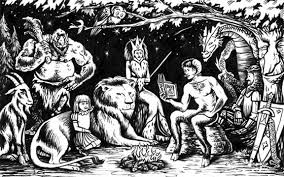 Many years later, I was writing and producing songs with M. Nasir, a Singaporean-Malaysian poet, singer-songwriter, composer, producer, actor and film director, in Kuala Lumpur, Malaysia. Every night after work, we fell into discussions about the origin of the arts. Not only where we started, but where it all started. Nasir is a Sufi, a mystic and a joker. Our discussions centered on the first drawing, the first poem, the first song, the first instrument and the first dance. We challenged ourselves to determine the circumstances that created the primal arts and the ancient artists. It was our conclusion that among them all, poetry was the first and the most radical.
We imagined the several tribes of humans spread across the globe huddled around their campfires late at night. There, in somber tones and joyous rapture, the elders let their breath carry the first sounds, the birth of communication. It would not have been long before the sounds told the stories of existence, organized as poems, so that each generation could memorize them and pass them along. Any variation in pitch became singing, the first deliberate music. Eventually, instruments were devised and added to accompany the poetry that had become stories that had become songs. Then dance was added to bring the world of the epic poems to life and imbue them with enchantment and hurl them into the mystic. Finally, they were immortalized in drawings on cave walls…and on we went, careening down the corridors of time with only poems left to tell the tale of our brief, tragic and absurdly comic existence.
It is amusing and perhaps even informative to ponder the actual events that sparked poetry into reality. And though no one will ever know the true time and place for the birth of poetry and the arts, just the mere discussion calls forth the power from within that animates them all. And among all of the arts, poetry remains the most elusive, the most indecipherable. So, given its magical nature, its ephemeral existence, how then does anyone make a living writing poetry, especially in the global disruption of commerce and communications know as the Internet or Information Age?
It was quite possible to make a meager living as a poet throughout the ages if you could find a patron to support your work. More often, a patron was not available and poetry was composed as a passion, a compulsion that the poet was driven to pursue. Writing down your poetry for the sole purpose of creating it had to suffice. Every culture in every era has had its poets. Few of them made any kind of a living from the art itself. This struggle to survive by art alone was the truth of nearly all of the arts save for the decorative or architectural arts. And yet, it kept coming out of non-being into being.
Eventually, manuscripts recorded the epic poems, which had been handed down in the aural tradition, and troubadours traveled the countryside performing like the lyric poets of old in the courts of royalty and the marketplaces of the common folk. Actors performed the classic and contemporary dramas and comedies, which were the other repository of the poet’s inspirations. Poetry was most often heard and not read until the invention of movable type. Printed books, available to anyone who could read and purchased from the writer changed the circumstances of poets for a brief historical moment.
No sooner had poets and writers of prose been rewarded with a means of “making a living” from their art, than the publishers and printers took over the new lucrative business of literature. This tradition of organized theft or business management, masquerading as patronage, survives to this day. But no matter ~ Artists must create by any means necessary. This brings us to our current dilemma, our struggle to survive by writing poetry, or maybe, while writing poetry.
Like its related arts, prose and music, film and video, storytelling in every form has taken a beating in the Internet Era. It seems as though we poets and our fellow artists have been devalued, but that is an illusion. The arts have been stripped of their relative value, commoditized and tossed on the pile of digital information, to be consumed by the masses, profiting only the owners of the transmission systems, the Internet Service Providers or website owners. Profits on the works of artists of every type are soaring. Funds are just not going to the artists. Can we turn that around?
First, we must educate ourselves on the economics of the current era, the Internet. Yes, we must come out of our creative caves and take a look around. Many of us, like myself, will continue to write, to create, and find other ways to get by. But what if we could organize ourselves and align with other creators, collaborate on a solution to regain the fruits of our labors, cut out the middlemen? I believe that not only can it be done but that it will be done.
Here is an excerpt from an essay I wrote on a solution to part of that puzzle:
“…Amid the wonders of the Information Age that gave birth to the Internet and the World Wide Web is the vexing and unfinished business of, who owns the content, who pays for the content and all of the other issues surrounding modern copyright law and digital content distribution. The complexities of digital information and distribution systems have obfuscated a simple solution: the Blanket License Agreement…
Apple’s success can be greatly attributed to Steve Job’s foresight that all of the software and electronic systems and connections that comprise our new digital world can only be accessed by “hardware.” An Internet Service Provider connects every piece of hardware to the Internet. They are the new broadcasters, the new medium comprised of all of the old media. You can access them over phone lines, cable lines, Wi-Fi or by satellite. In every case someone pays the ISPs for that connection. Either the consumer pays directly or a business establishment pays or a municipality, etc. Most of the time those rates are quite high. That is where the profit is and that is where the New Blanket Licensing Agreements need to be applied…(just like radio royalties).”
(From, A Digital Content Solution: Crafting a Win-Win for Creators and Consumers Online)
I have just released a new book of poetry, “One Hundred Days Of Poetry.” It is selling, albeit in nominal amounts. Nonetheless, more music albums will accompany it and books from this creator as long as I can find a way to pay the bills. Writing and composing are a constant in my life, a north star. I hope they are in yours as well.
 As M. Nasir and I considered many years ago, we are a crazy lot, artists, poets, and creators. Why we do what we do is a mystery. How we will make a living in the digital era is almost as great a mystery. Never mind ~ let it go and let it roll.
Here’s to the life of a poet and the continuing search for beauty and truth! May it beguile, disturb and comfort you all your days.
further…
Brad Parker
2014