
Do You #LitFic? Does Anyone, Anymore?
As you would expect, I believe literary fiction is still vibrant and important because those are the books I like to read. Still less surprising in light of my convictions: it’s the type of book I do my best to write. My new novel, Our Orbit, may not be philosophical, contains no elaborate symbols, and little poetic language. Nonetheless, it aspires to such literary values as psychological depth and social relevance. Popularly termed “lit fic,” this category is tricky to pin down with a definition. With your indulgence, I’ll share some preliminary thoughts.
I like to imagine literary fiction as a coquettish college-aged human (of any gender you like) attending a costume party dressed as Mark Twain. S/he twirls one end of an old-fashioned string tie, and eyes twinkle under that mop-like wig. A lilting voice reminds us that, “Reports of my death are an exaggeration.”
 It’s good to keep in mind that literary fiction is a sweet young thing. Its detractors often point out that, “Shakespeare [or Tolstoy or other greats of the past] never wrote #litfic! He just wrote what he wanted!” Leaving aside the fact that Shakespeare wrote drama and poetry, this claim makes no point at all. The concept of “literariness” is one we grapple with in relation to contemporary fiction. It is always a fresh quality for its own time. Anything else, however highbrow and elaborate, would be formulaic.
Moreover, anything of Shakespeare’s era or Tolstoy’s, which is still being read today, should be called a “classic,” or “canonical work,” rather than literary fiction. Confusing these categories lands us in hot water. The most well-written, intellectual novels of today, whether they climb a best-seller list or not, may be forgotten ten or twenty years from now. Once forgotten—regardless of how literary these books were once considered—they will never become classics for future generations (barring the increasingly unlikely event of a new vogue or rediscovery).

Instant classic, or crackpot?
Virginia Woolf by Roger Fry
Allow me to evade the issue of a cut-off date. Even so, “literary,” in the sense I mean here, is an adjective properly applied to fiction of one’s own time. Books earlier than—say, arbitrarily—the cultural shift of the 1960s, came to the publishing market contending with such a different set of tastes and expectations that we can no longer perceive them on their original terms. We cannot read them with the same mentality that prevailed when they were created (although I’m sure this varies for individual readers).
What this implies is that we may find older works interesting for reasons other than those that draw us to contemporary literary fiction. Indeed, our reasons may have nothing to do with literary quality: historical interest, curiosity about an author’s life or death, the comforts of a bygone world, etc. Whether these older books were deemed literary when published or not, they may yet become classics or enter a canon of some sort, if their appeal persists over time.
I find this distinction important because resentment among writers of different genres is running especially high these days. True, such feelings tend to be perennial but are especially unfortunate at a time when all writers are lucky if the public chooses any book over Facebook. But, I understand how authors of popular genres (the name Jennifer Weiner springs to mind) may well resent those who embrace the term “literary” IF we claim it means our work is closer to the classics that millions have loved for years or centuries. There is no necessary connection.
Let me emphasize the obvious: Contemporary literary novels ≠ classic works of literature!
Of course, resentment rarely seeks a rational cause. AND there is a pregnant similarity between the words “literary” and “Literature.” But attempting to change established terminology in any field is a bigger task than I can advocate in good conscience.
I can feel this topic expanding even as I struggle to address it! So in short (if not too late for that): I believe literary fiction is a meaningful category, one that has existed for some decades, and is likely to remain viable in the future. As a purveyor of #litfic myself, I plan to revisit many of these questions.
~ ~ ~ ~
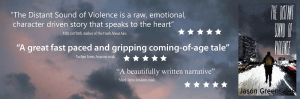 Many thanks to Jason Greensides for hosting this original post on his blog on 6/29/15. Jason is the author of the acclaimed novel The Distant Sound of Violence. Visit Jason today!
Connect with Jason on Facebook.
Follow Jason on Twitter.
On Goodreads.
And on Pinterest.
~ ~ ~ ~